The St Petersburg Legal Forum as an ideology factory
· Denis Salnikov
In June 2026 the West was watching the St Petersburg Economic Forum, with its signals about investment, sanctions and the war. An event no less important for forecasting was taking place in the same city almost unnoticed: the XIV St Petersburg International Legal Forum. Despite a comparable scale — more than five thousand participants from over eighty countries, a hundred and twenty sessions — it stayed outside the field of vision of Western media. And it is that forum, not the economic one, that is the place where the Russian apparatus encodes its direction for the years ahead.
The thesis of this text is simple: at the St Petersburg legal forum, law was everything except a system of norms. Three independent accounts confirm it. The investigative, exiled newsroom of Novaya Gazeta described the forum as "two alternative series" — in some halls young corporate lawyers discussed crypto-assets, arbitration and AI, in the halls next door professors of law and men of the security apparatus debated good, evil and sovereign historical truth. Meduza reported on the digital sessions and the new draft AI law. Vedomosti — on the plenary. From the three accounts one picture emerges: a forum at which law itself was discussed least.
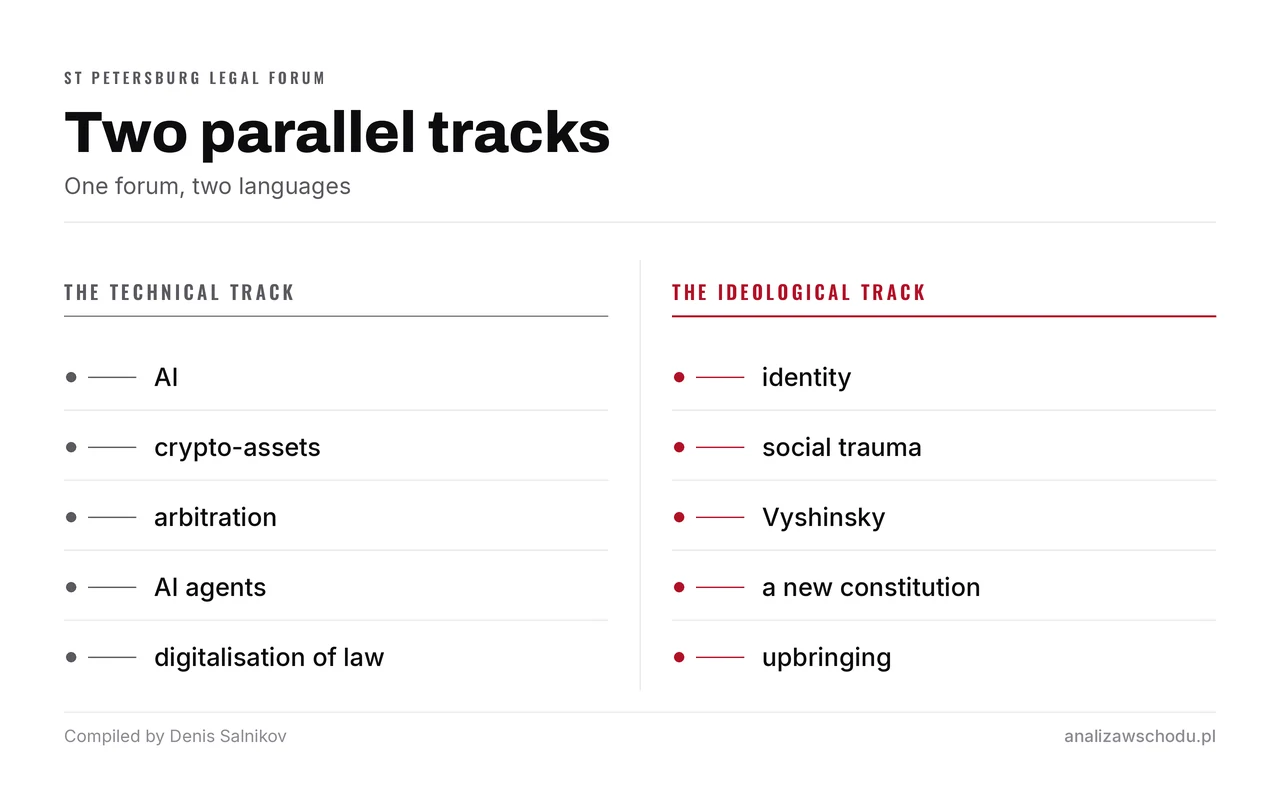
SPBILF is organised by the Ministry of Justice and the Roscongress foundation. This year's slogan was "A time to be in the law". The setting completed the message. The guest country was Vietnam, and among the accompanying exhibitions were two significant ones: "200 years of the Decembrist uprising: lessons of the past" and "The sovereign code", devoted to the history of Western interference in Russia's affairs. The entry price rose by 60,000 roubles year on year, to 350,000 for a three-day package. Such a frame serves a state telling itself who it is more than a profession looking for legal knowledge. The question the forum actually posed is a different one: what the word "law" means in Russia in 2026.
Law that orients itself by rhetoric
The forum's most important session concerned neither arbitration nor AI. It was titled "Law as a factor in securing Russian national-cultural identity, the protection of sovereignty and historical truth". It was moderated by Aleksandr Savenkov, director of the Institute of State and Law of the Russian Academy of Sciences — an institution that in both the Soviet and post-Soviet hierarchy counts as the highest academic oracle in matters of legal theory. Savenkov formulated the session's leitmotif in a single sentence: human rights against the state "are not primary". With approval, as he noted — "as a scholar" — he invoked Andrey Vyshinsky, the Soviet prosecutor general of the Great Terror, who rejected the presumption of innocence.
Invoking Vyshinsky at a legal forum is not one speaker's gaffe but a signal of which theory of law the Russian legal elite today considers speakable aloud. Vyshinsky built a doctrine in which law is an instrument of the state rather than a limit on its power, and procedure yields to political expediency. The return of that doctrine to the academic salon — in the mode of praise, not warning — describes a shift invisible in the text of the codes but visible in who can be quoted without consequences.
The mechanism linking these declarations to practice is precise, and Novaya Gazeta names it outright. When legislation is deliberately blurred and repressive provisions deliberately left undefined — "discrediting the army", "activity of an undesirable organisation", "propaganda of extremism" — law enforcement and the courts have no hard norm to refer to. So they orient themselves by what they hear from the rostrum. Official rhetoric becomes a real source of law, and the legal forum becomes the place where that rhetoric is updated and calibrated. A judge in a provincial court will not read the transcript of Savenkov's session, but will catch its resonance: that this winter it is safer to rule for the state than for the individual.
The subjects absent from a forum devoted to law-making, despite being obvious to the profession, say as much as the subjects present. There was no discussion of the arbitrariness of law enforcement, of the erosion of the bar's role, or of the political repression of recent years. Silence at those points marks the boundary: there law as a profession ends and law as loyalty begins.
Zorkin: law as katechon, the force that holds back the end
The forum's most serious intellectual voice sounded different from the rest. The chairman of the Constitutional Court, Valery Zorkin, delivered a lecture titled "The thorny road to a civilisation of law", in which he introduced the notion of "sociotrauma": a historical event so severe that it marks a nation's legal consciousness for generations. Among Russia's sociotraumas he listed the Mongol yoke, the oprichnina — Ivan the Terrible's terror — serfdom, the revolution of 1917, collectivisation, the Great Terror and the collapse of the USSR. By these traumas he explained the weakness of the Russian legal tradition, its paternalism and its distrust of parliamentarism.

In Zorkin's own understanding this is a defence of law, not an undermining of it. What he named as the clot holding back chaos was law, not authoritarianism, and a civilisation of law he called the goal. In a constitutional reading the same lecture does work opposite to its declared intention. If all the pathologies of Russian legal consciousness are the inheritance of traumas centuries old, then nobody living bears responsibility for them, and the present order appears not as a choice but as the tail end of a long course of therapy. The diagnosis sounds like criticism. It works as an alibi. A hundred years ago Jan Kucharzewski described the same continuity of the Russian police state — from the white tsardom to the red — as an indictment, as proof of the durability of a certain model of power; Zorkin takes the same continuity and turns it into a mitigating circumstance. Separating what Zorkin says from what his speech legitimises is here the whole difference between a naive reading and an analytical one.
The constitution as an open project
The second signal concerns the foundation. At the same session on identity, Konstantin Malofeyev — founder of the Orthodox-monarchist Tsargrad and author of the scenarios for Russia's future presented a few weeks earlier at the economic forum, in which the "good" variant assumes a nuclear strike — proposed convening a Constitutional Assembly to rewrite the basic articles of the Russian constitution. His main target is article two, on human rights and freedoms as the highest value. In Malofeyev's view it is "too liberal" and should be strengthened with duties towards the state and traditional values.
The demand did not stay in the hands of an eccentric oligarch. A convergent thesis was stated by the minister of justice, Konstantin Chuychenko, who spoke of a "Western trace" in the very idea of limiting power and repeated last year's appeal to "revise the constitutional balance between human rights and the strengthening of the state". When the same idea is formulated by the creator of Tsargrad at an expert session and by a sitting minister from a ministerial rostrum, it stops being a private opinion. It becomes a position that has moved from the margin onto the ministry's official agenda.
Here a discipline applies that is easy to avoid in a narrative of an inevitable turn. The capacity to rewrite the constitution is not the same as doing it. On the side of probability stand the precedent of the 2020 amendments, which already broke the taboo on the inviolability of the basic law, and the fact that the demand is now voiced by a minister, not a columnist. On the side of the brake stands the fact that the Constitutional Assembly mechanism still has no implementing statute, and that convening it would open a risk the apparatus avoids in stable conditions. The trajectory leads towards revision but does not settle it. If by the end of 2027 no law on the Constitutional Assembly appears and no concrete draft amendment to article two, then reading the forum as a stage of implementation rather than merely a sounding of the mood will lose its force.
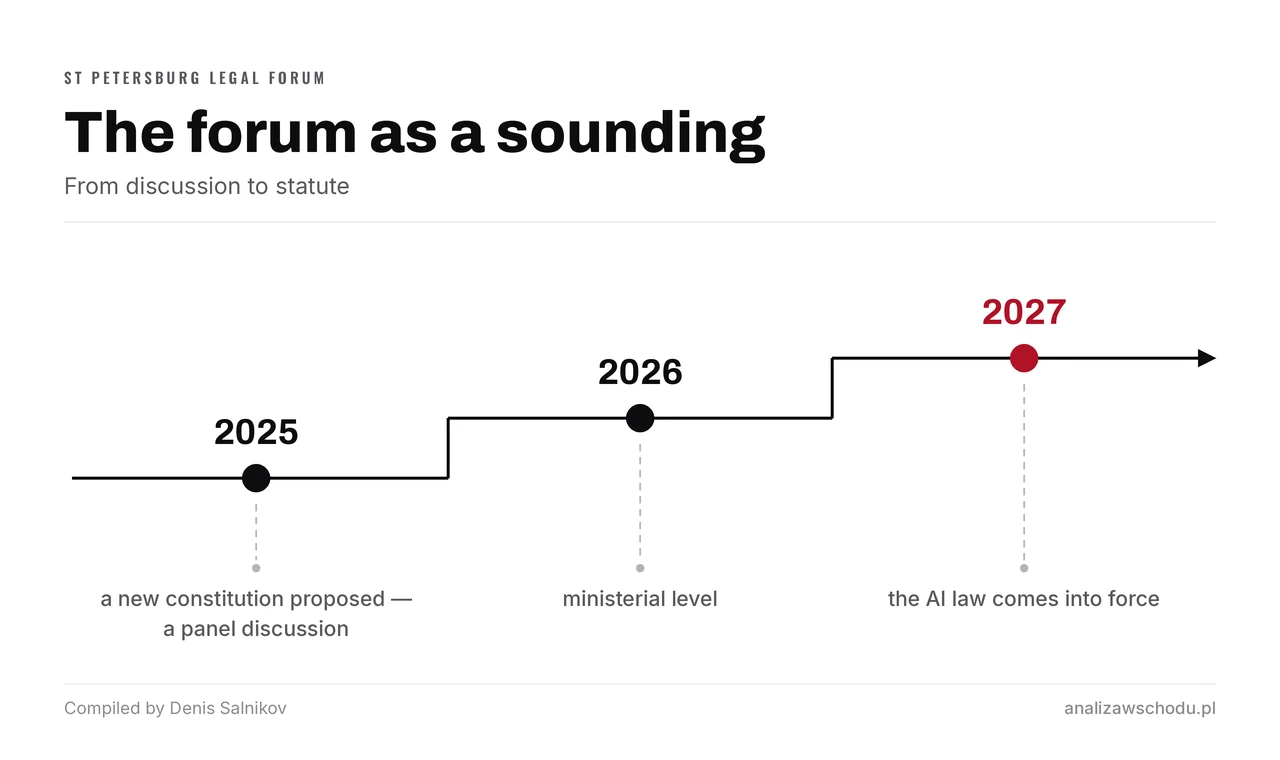
And here lies the key to understanding what SPBILF is. The ideas that appear there — a new constitution, criminal responsibility from the age of twelve, a code of values written into the law on artificial intelligence — do not come into force the next day. They are being tested. The profession's reaction is measured, the boundary of what can be said aloud without cost is checked. 2025 brought the demand for a new constitution at the level of a panel discussion. 2026 brought it to ministerial level. The forum is a sounding in which the apparatus examines its own room for manoeuvre before deciding how much of it to occupy.
The revision of the foundation also has a retrospective dimension, directed at history. At the session "1905: revolution and reforms" Malofeyev praised the Black Hundredist Union of the Russian People and argued that the reforms of 1907 and the creation of the State Duma were a mistake, because the parliamentary rostrum "was used by demagogues criticising tsarist power". The negation of parliamentarism as a historical error was uttered within the walls of a forum devoted to law-making, and it was not isolated: it closed a thread that Zorkin propped up with the theory of sociotrauma and Savenkov with praise of Vyshinsky.
The same project has an educational dimension. The session on national legal traditions was opened by the presidential aide Vladimir Medinsky and the education minister Sergey Kravtsov, presenting a new school civics textbook. The deputy Irina Yarovaya enumerated from the rostrum the traditional Russian values — self-sacrificing labour, mercy, family and faith in God — citing no research whatsoever. The constitution, the textbook and the language model are three carriers of one catalogue of values, introduced in parallel into the basic law, into the school and into the machine.
The sovereign code: technology as ideology

The most interesting thing about the forum's architecture is that the "digital" track — sessions on AI, crypto-assets, the data market — was strictly technical in character and at first glance stood in opposition to the ideological sessions. That contrast is apparent only, and the point at which the two tracks converge is the draft law "on supporting the development of AI technologies", approved shortly before the forum.
The document, cut from twenty-one articles to thirteen, introduces two categories of model. A "sovereign" LLM is to be created entirely by a Russian entity, to process queries and store data on Russian territory and — and this is the key fragment — to comply with Russian legislation and with "spiritual and moral values". A "national" LLM is subject to looser requirements as to the origin of its components. Spiritual and moral values are not a rhetorical figure in this draft. The catalogue accompanying the law enumerates them concretely: patriotism, civic spirit, service to the Fatherland, a strong family, creative labour, historical memory and the primacy of the spiritual over the material. The language model destined for Russian schools, offices and courts is to comply with that catalogue.
At this point the technical and the ontological sessions turn out to be one project. What the security apparatus formulates as ideology at the session on identity, the lawyers encode as a compliance requirement at the session on AI. Russia's technological sovereignty is in the first instance a sovereignty of narrative: what is at stake is not only where the servers stand but whose values the model reproduces in its answers. The drafters understand "sovereignty" as protection against external interference; in a constitutional reading the same provision becomes a distribution channel for an ideology approved from above. It is worth seeing the operation, not only its effect — because the difference between the two is the difference between data security and control over what the machine "thinks". The Estonian think tank ICDS, working from a Baltic security perspective, described the Russian project of sovereign AI as a double-edged construction: isolation and enforced narrative consistency. That is independent confirmation that what is at stake here is narrative, not infrastructure.
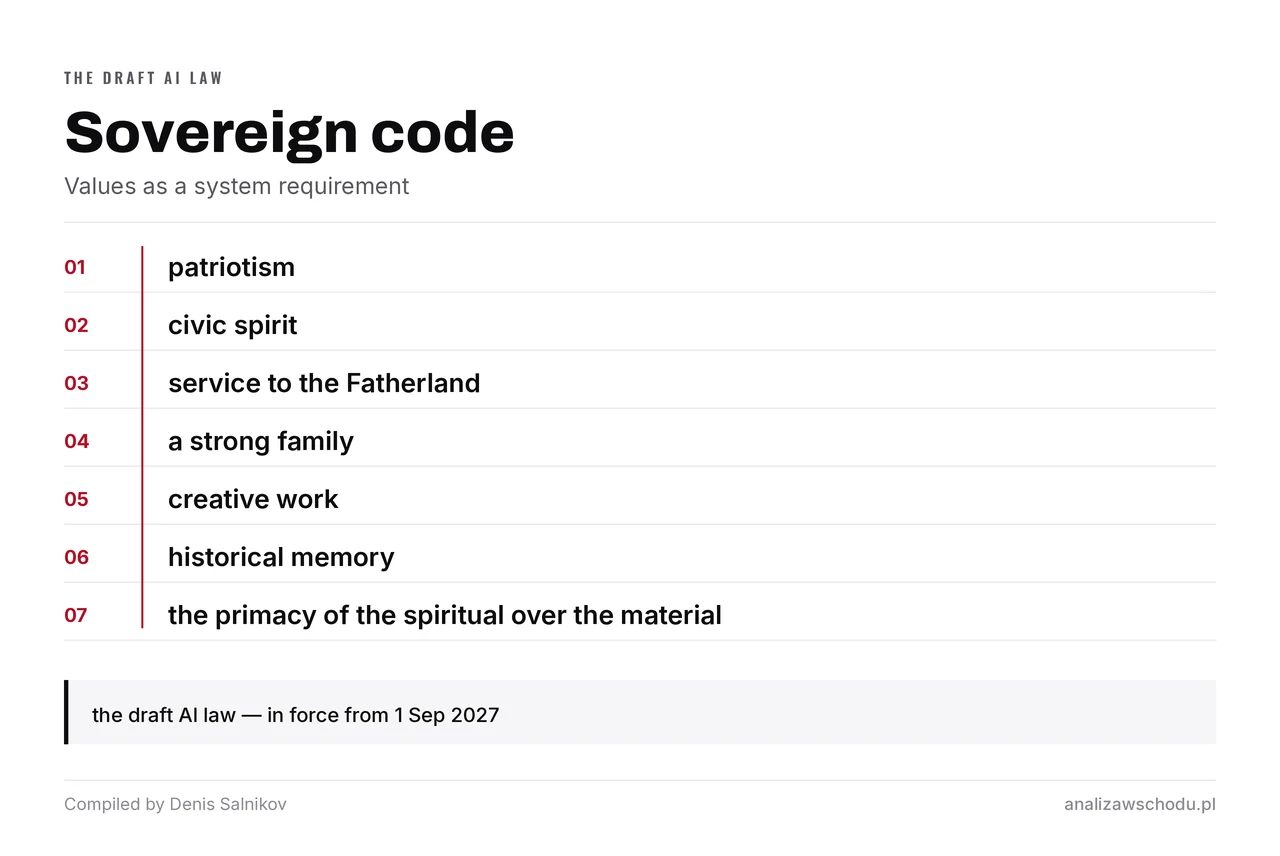
The draft has a second layer too, less visible. It legalises text-and-data mining solely for the purpose of training sovereign and national models, with no opt-out mechanism for rights holders. The Russian technical portal Habr described this as a fundamental difference from the European AI Act: there the object of regulation is human rights, here it is the state's technological sovereignty. The law is scheduled to take effect in September 2027.
The background to this project reaches deeper than the forum itself. Putin had signalled the drive for sovereign AI as early as November 2025 and January 2026, but it took sharp form on 10 April, when at a Kremlin meeting he ordered the urgent creation of a sovereign foundational LLM "for the security and defence" of the state. Both Vedomosti and the Kremlin's own service report it, so the directive itself is a well-documented fact. A few hours before the meeting, Trump had posted about Palantir's Maven system, which in the first day of the campaign against Iran helped American forces strike more than a thousand targets. The coincidence in timing cannot be proved as a cause, but on an already existing trajectory an accelerant is visible. What happened next is telling too: Rosneft publicly stated that creating a fully sovereign model on Putin's terms is technically unfeasible. Russian models are, moreover, many times more expensive than foreign APIs, because they require their own processors, their own data centres, their own research teams. The gap between ambition and capability is covered by policy: restricting access to cheaper systems from outside and mandating the use of "sovereign" solutions. Ideology moves in where engineering cannot keep up.
Bastrykin and the restoration wing
If the AI law shows how modernisation is harnessed to ideology, Aleksandr Bastrykin's lecture shows where that ideology is heading. The chairman of the Investigative Committee spoke at the youth forum, and his appearance became one of the most widely commented moments of the whole of SPBILF.
Bastrykin lamented that his long-standing proposal to lower the age of criminal responsibility for serious offences to twelve had still found no support. The Duma went only halfway: in November 2025 it lowered the threshold to fourteen, and only for sabotage. As a model he invoked England, where criminal responsibility begins at ten. He also called for punishing parents for "improper upbringing", criticised the school programme "Conversations about what matters" and the "Movement of the First" as insufficiently effective, proposed a return to youth organisations on the model of the Pioneers and the Komsomol, and the engagement of participants of the "special military operation" as deputy headteachers for upbringing in schools. He closed the speech with his own poem about longing for the Soviet Union: "I want to go back to the Union where I was born."

This contrast with the forum's official agenda is deliberate and is itself a signal. Bastrykin represents the segment of the apparatus for which the digitisation of law and the regulation of AI are instruments, not goals. The goal remains the reconstruction of the Soviet model of control over society — from the school to the court. The same forum at which lawyers design frameworks for AI agents hosts a general who publicly dreams of returning to the order that existed before 1991 and translates that dream into concrete legislative proposals. The two visions do not compete as much as it might seem. A sovereign language model fed on "spiritual and moral values" and a Pioneer's neckerchief in 2027 are two interfaces of the same idea: a state that brings up its citizens instead of guaranteeing anything to them.
A narrative for the Global South
So far the addressee has been internal — the elite encoding its own direction. The forum had an external addressee too, however, and that function was served by the plenary session, dominated by the deputy chairman of the Security Council, Dmitry Medvedev.
Medvedev proposed codifying colonialism as a separate crime against humanity — within the work of the preparatory committee for a UN convention — and declared Russia's readiness to support former colonies in pursuing reparations from Western metropoles. He stressed that "Russia had no colonies", which in his view makes its dialogue with the Global South easier. The crisis of international law he described as the result of attempts to turn it into "the privilege of the first". The rest of the speech broke that frame down into specifics: Ukraine as a "state deprived of sovereignty", Zelensky as a usurper without immunities, the announcement of a Russian suit at the UN court against the Baltic states in defence of the Russian-speaking population.
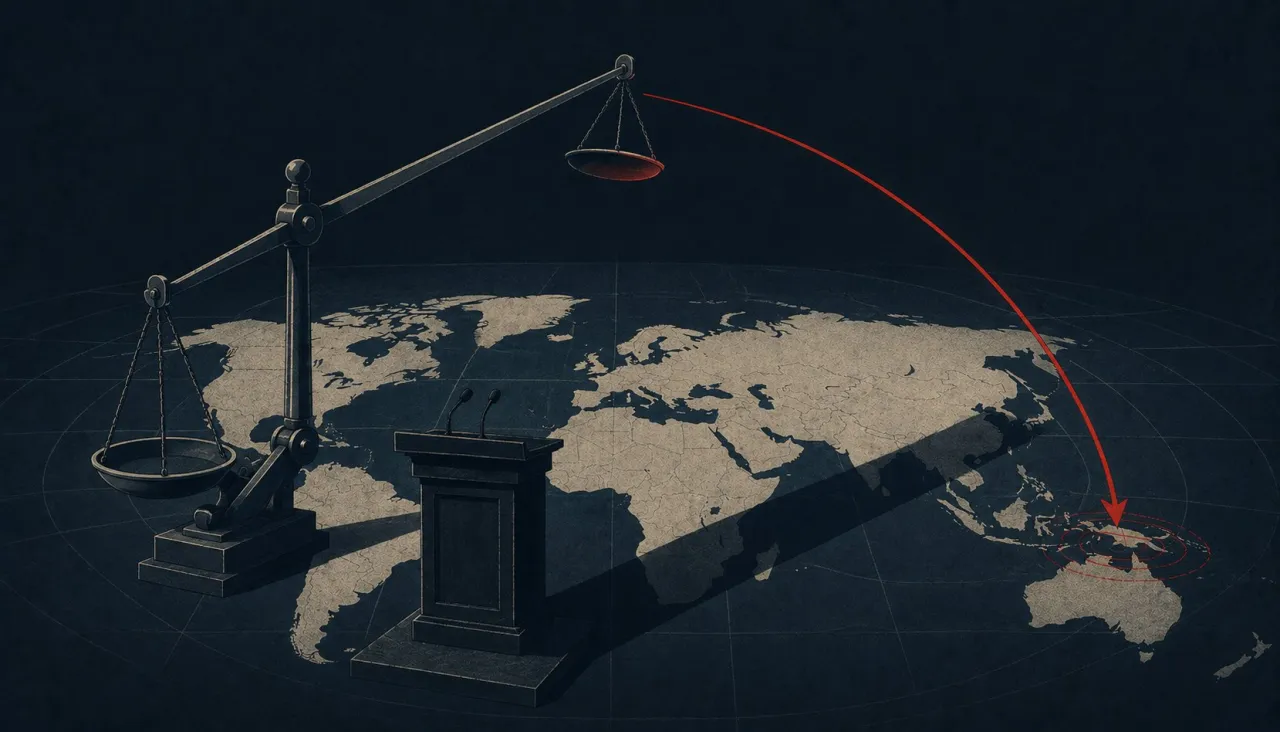
Within this coherent construction, Russia presents itself as the advocate of global equality against a racist, colonial West, and international law as an instrument of Western domination that must be reclaimed. The thesis that Russia had no colonies is historically dubious if one takes into account the empire's expansion into the Caucasus, Central Asia and Siberia, but its strength lies not in its truth but in its usefulness for an audience that associates colonialism exclusively with the maritime expansion of Western Europe. This is an export narrative, formulated in the language of law in order to gain the appearance of institutional legitimacy.
The same logic runs inwards. At the session on "the secrets of a foreign agent" spoke Andrey Lugovoy, a deputy accused in the United Kingdom of involvement in the killing of Alexander Litvinenko, lamenting that the authorities had noticed foreign influence "too late". The deputy justice minister Oleg Sviridenko reported that of the more than twelve hundred people on the foreign agents register, five hundred or more had fled abroad and were trying to circumvent the property restrictions through deeds of gift, and that the government would "shortly" close that gap. The agents register at home and the announcement of a suit in defence of Russian speakers abroad are two sides of one instrument: law as a device for classifying people as loyal or hostile, applied symmetrically inside and outside.
Legitimacy is also supplied by the presence of Western voices. Karin Kneissl, the former foreign minister of Austria and today head of the G.O.R.K.I. centre at St Petersburg University, moderated a session on "the use of law as a weapon" in Russian-Western relations. In her frame, Western justice is a politicised instrument of pressure and Russian law a shield of sovereignty. Kneissl herself presumably understands her role as that of an independent expert questioning Western hypocrisy; in the forum's economy she performs a different function — a Western face authenticating the Russian message for the legal centres of the South. How a speaker understands herself, and what work her presence performs, are two different things.
What the West did not see
Western media focused on the economic forum, because that is where the figures, the contracts and the investors' names appear. The legal forum supplies something harder to quantify but more important for forecasting: the matrix by which Russian elites understand their own state. One programme accommodated lectures on the regulation of crypto-assets and praise of Vyshinsky, a session on AI agents and a poem about longing for the USSR, a draft technology law and an appeal to rewrite the constitution. The apparent chaos arranges itself into a coherent picture of a system that treats modernisation as technique and ideology as the goal.
That coherence has to be qualified. "Ideology factory" is Novaya Gazeta's frame, which I adopt here, but the newsroom itself called the forum "muddy water", and part of that muddiness is real. More than one parallel session on arbitration or cryptocurrency is simply the work of corporate lawyers with no interest in ideology; not every speaker is executing a design. The coherence I reconstruct here is a reading of direction, not proof that the apparatus works to a single plan.
A register of scenes from the same programme completes the picture. Margarita Simonyan, head of the Russia Today media holding, chaired a session on "Europe's historical amnesia", at which a former deputy prosecutor general described the war with Ukraine as a "metaphysical struggle of light and darkness". Nikita Mikhalkov closed the forum with a session called "Besogon and Law 3.0", at which he did not talk about law at all but served the hall moonshine of his own brand to the cry of "To victory". A legal forum that ends with a toast from a propagandist film director declares its own genre: an ideological convention in the costume of a conference.
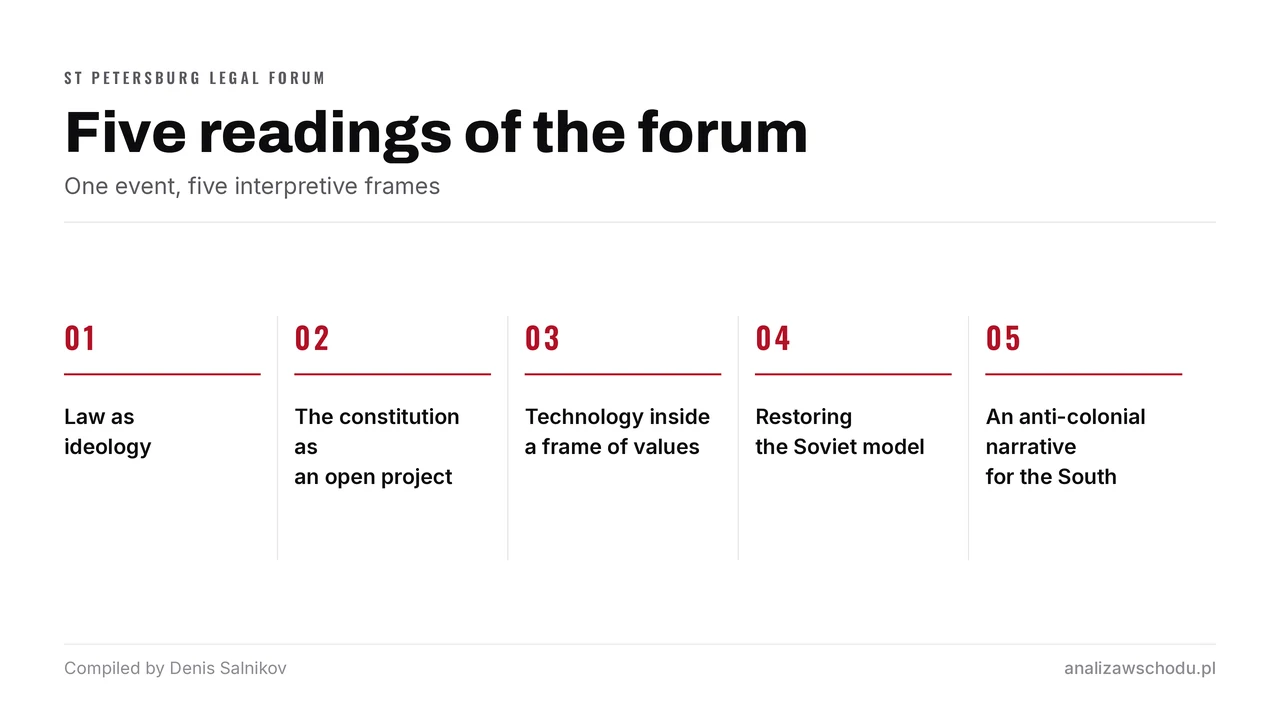
Five signals arrange themselves into one diagnosis. Law functions as ideology rather than as a set of norms, because with blurred legislation what counts is rhetoric, not the provision. The constitution is treated as an open project whose revision is tested in public. Technology is written into a frame of values and becomes a carrier of narrative. The security apparatus openly designs a return to the Soviet model of upbringing. And outwardly the whole order is sold as an anti-colonial alternative to the West. Each of these signals taken alone can be dismissed as the folklore of a single speaker. Together they describe a direction.
The St Petersburg Legal Forum is closer to an ideological congress than to a legal conference — and that is precisely why it says more about Russia's future than the forum the West watched instead. Law that ceases to bind the rulers does not disappear — it changes the addressee of its protection: no longer the citizen against the state, but the state against the citizen.
First published: X Article (in Polish), 29.06.2026
Cite as: Denis Salnikov, “The St Petersburg Legal Forum as an ideology factory”, Analiza Wschodu, 29.06.2026, https://analizawschodu.pl/en/articles/st-petersburg-legal-forum.html
Text © Denis Salnikov. Quotation with attribution and a link is welcome. To reprint a full text or reuse a chart, write to ds@analizawschodu.pl
* Graphics marked with an asterisk are mood images and may contain AI-generated elements. Charts, timelines and tables carry no asterisk — their figures come from the sources named beneath them.