Everywhere and nowhere: collective avoidance
· Denis Salnikov
Russian support for the war has a peculiar feature: it is surrounded by silence. The fourth year of the full-scale invasion has brought neither mass enthusiasm nor mass opposition — it has brought a third thing, far harder to name in one word: a condition in which the war is at once omnipresent and invisible, and most people have learned to live without looking directly at what is going on beside them.
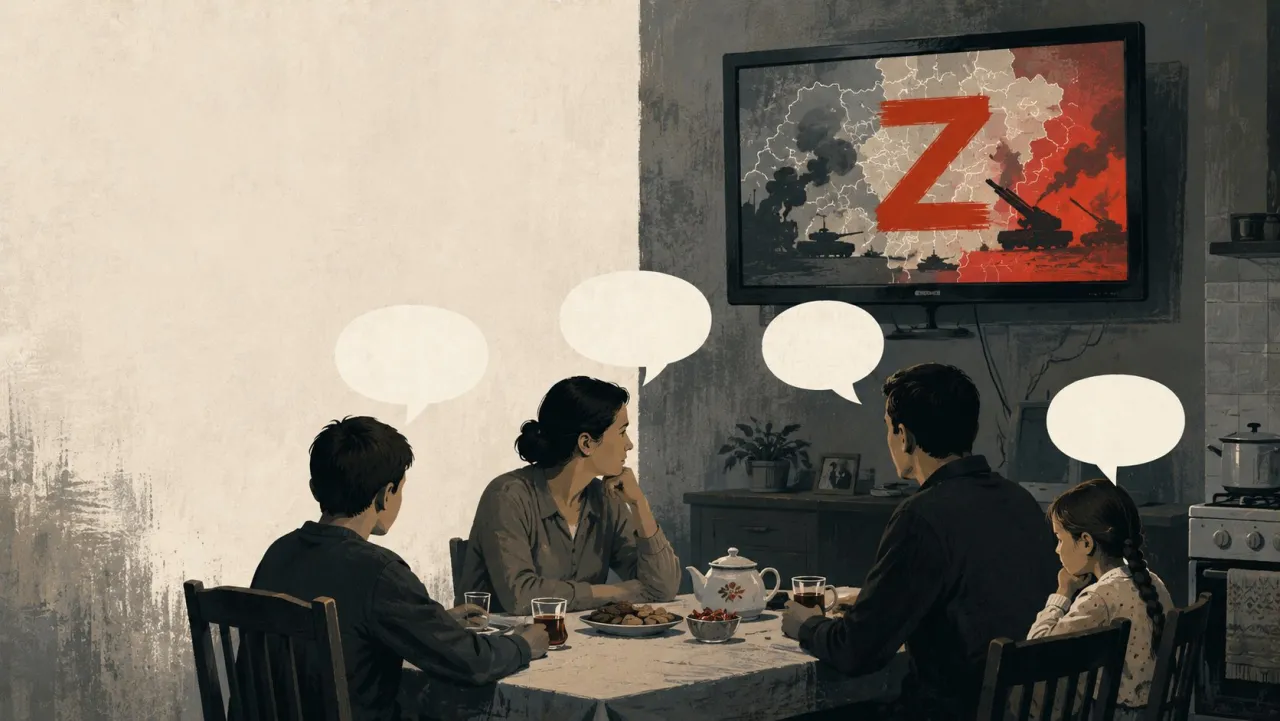
The most precise description of that condition came recently from Sam Greene and Graeme Robertson — the first at King's College London, the second at the University of North Carolina — in an analysis published by Re: Russia. Their diagnosis is cool and free of illusions: Russia today is a "collectively sustained equilibrium" in which citizens adapt to the war, distance themselves from its consequences and, most importantly, reproduce the conditions that let it continue. It is a managed condition: enthusiasm burned out long ago, opposition never gathered mass, and the system runs on what was left in the middle.
They look at the same phenomenon from two sides. Ekaterina Schulmann describes it from above, as an elite compact of "never again" and a policy Maria Lipman once called demobilisation and pacification rather than reconciliation. Danielle Lussier (PONARS Eurasia) shows it from below, in the form of institutions that turn a citizen's discontent into a private complaint before it can become politics. And Russian academia confirms the same thing from the data: loyalty grows where people feel they fit their surroundings.
The stake is simple and uncomfortable for both sides of the argument about Russia. This stability rests on practice — on a million small, everyday decisions not to ask, not to speak, not to put one's head above the parapet. The war is being waged by the hands of society itself. This article is an attempt to take that practice apart into the four mechanisms that hold it together.
From the "Crimea syndrome" to cool loyalty
Let us start with the contrast Russians themselves notice least willingly. The annexation of Crimea in 2014 produced a genuine surge. Putin's ratings jumped sharply, and their source — as the authors show in their earlier work (Affect and Autocracy) — was a social mechanism: rising attention to the news drove the intensity of conversations about it among people close to one another, and those conversations generated a wave of positive emotion. The territorial gain itself was only the spark. People felt love and gratitude towards Putin, and with them a sharp sense of pride and heightened optimism. Kirill Rogov called that condition "the Crimea syndrome".
The full-scale invasion of 2022 did not repeat it. There is no second "Crimea syndrome" — no comparable euphoria, no mass rallying round the flag. In place of an explosion of emotion there is a flat, learned assent. What matters is that the mechanism of emotional contagion, which in 2014 worked in the Kremlin's favour, today runs in reverse: since people avoid conversations about the war, there is nothing to spread. A wave needs a conductor. Silence is an insulator.
Support survived 2022. Its heat did not. In 2014 the emotion was contagious because people wanted to talk about it; pride fed on conversation and conversation fed pride. In 2022 the same circuit was cut at the source: the full-scale war is not discussed, so there is nothing to pass on. The Kremlin kept the support and lost its emotional drive. From the point of view of stability that is paradoxically convenient — an emotion that does not circulate cannot collapse abruptly either — but it also means there is no reservoir of enthusiasm underneath to reach for in a crisis.
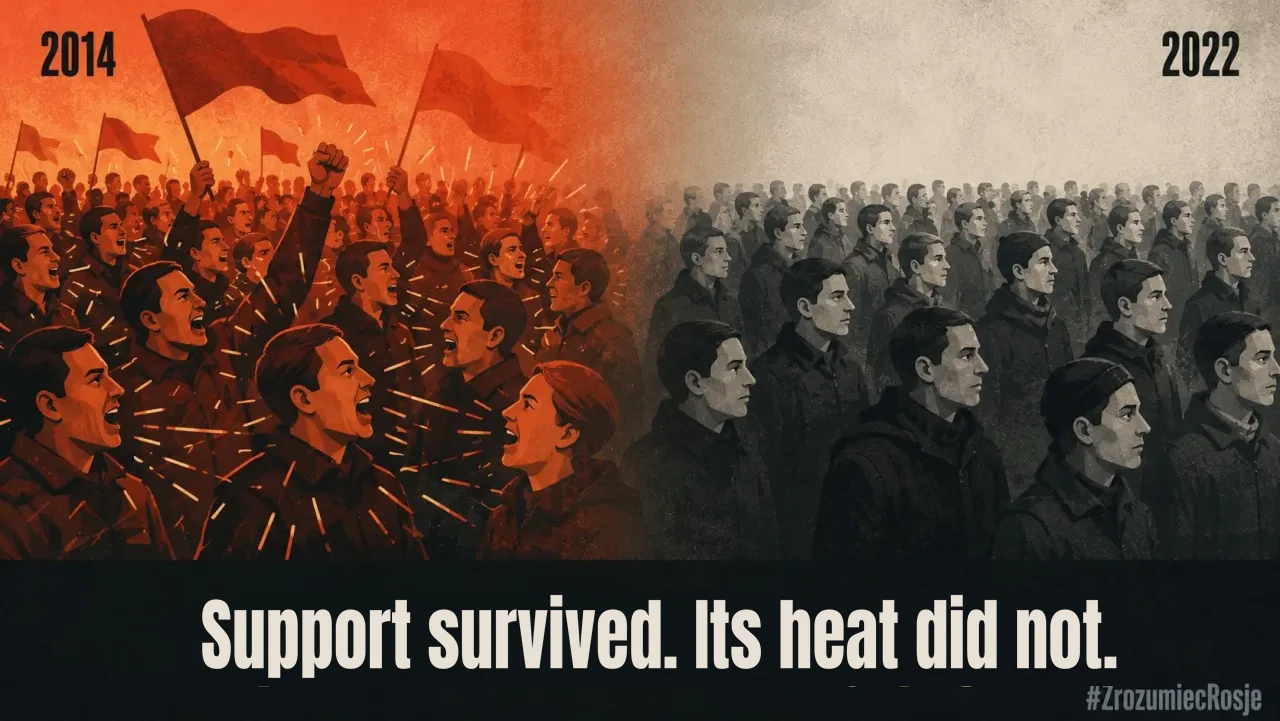
Even hard data on mood confirm it. Re: Russia itself notes that after Crimea and after 2022 alike the period of heightened loyalty lasted roughly four years — and is now entering its decline. The implication is uncomfortable for everyone: today's stability rests on habit, and no act of exposure topples a habit. A habit is harder to abolish than a belief — it needs no defending, only repeating.
The unemotional majority
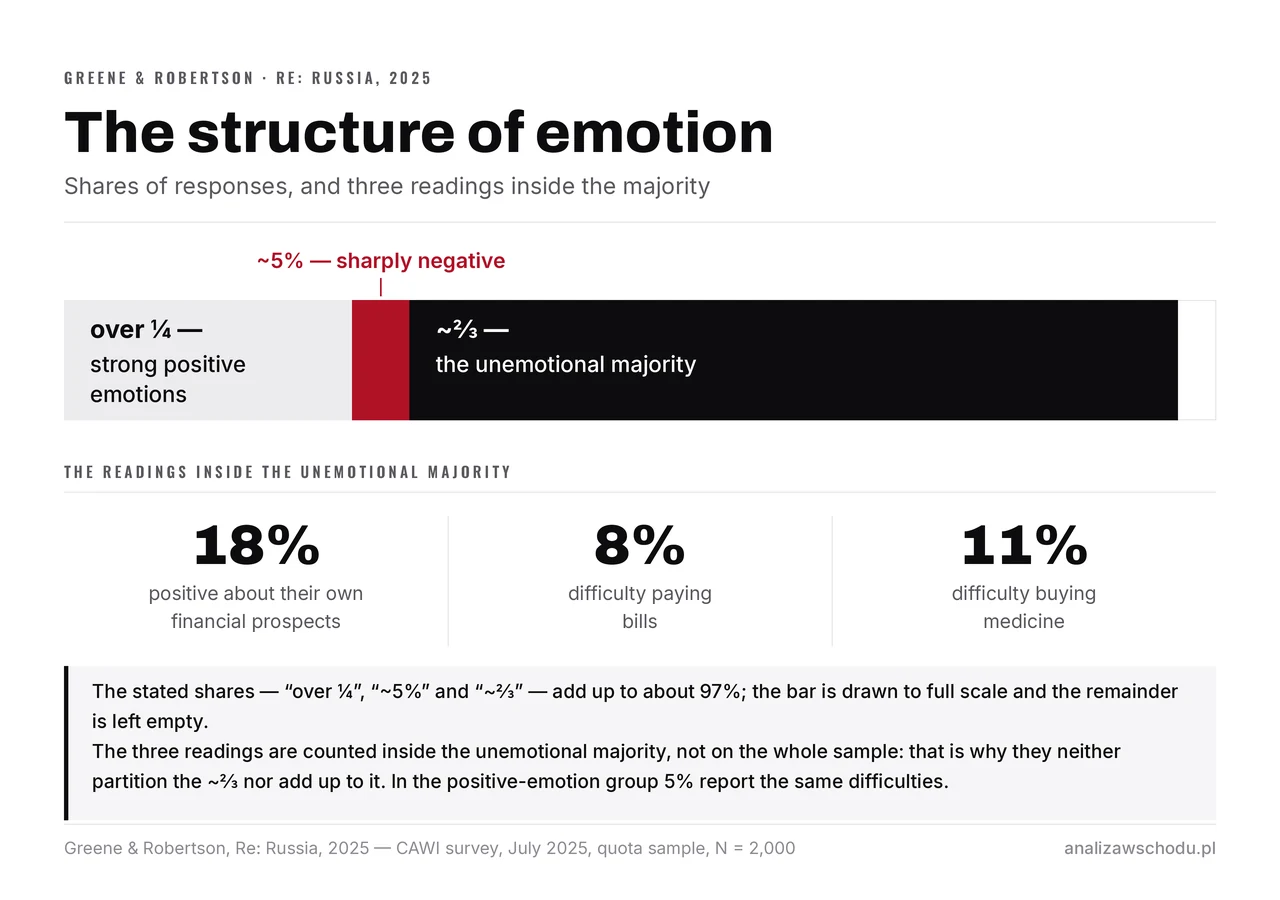
The core of this construction is the group Greene and Robertson call the unemotional majority. In July 2025 they ran an online survey on a quota sample of two thousand people. It broke Russian sentiment into three unequal parts. Slightly more than a quarter of respondents declare strong positive emotions about the political situation: pride, trust in the authorities, high support for Putin and a paternalistic attachment to the state as a provider of goods. A much smaller group, around five per cent, reacts sharply negatively, as far as anger and contempt. The remaining two thirds or so are the dominant cluster of people who support the system without any strong feeling at all.
It is that middle mass which is the key to the whole puzzle — and which sits worst with the picture of an "enthusiastic Putinist Russia". Because these people are not content. Fewer than a quarter of them are optimistic about the country's economic future, and only 18 per cent rate their own financial prospects positively. Barely more than half declare satisfaction with the state of democracy in Russia — against 77 per cent in the group with positive emotions — and fewer than half are satisfied with the way the Kremlin is conducting the war, against 71 per cent among the "enthusiasts".
What is more, this unemotional majority is on average worse off than the hard war electorate: eight per cent report difficulty paying their bills and eleven per cent difficulty buying medicine, against five per cent in the positive group. So we have people who are living harder, who do not believe in the economy and are not thrilled by the war — and who stay loyal nonetheless. "Why" is the right question to ask about contemporary Russia. The answer is "because it is safer that way".
System justification
The first mechanism holding that majority to the system is what social psychology calls system justification. It is a readiness to see the existing order as "acceptable enough" and "inevitable", even against one's own material interest. A person who struggles to pay the bills does not conclude from it that the system is failing — he concludes that this is how things are and that it is better to make peace with it, because every alternative looks worse and more uncertain.
That "worse alternative" has a specific date in Russia. The frame of reference for the generation now in its forties and fifties is the 1990s: the price shock, the 1998 default, the time when the state withdrew from everyday life. In that memory liberal reform became equivalent to destabilisation, and the "strong hand" to the end of chaos. This is the source of the most durable pattern in the Russian mentality — "order matters more than the uncertainty of freedom". System justification therefore does without a vision of a bright future; a worse past nobody wants to return to is enough for it. Order seems inevitable because the only remembered alternative to it is collapse.
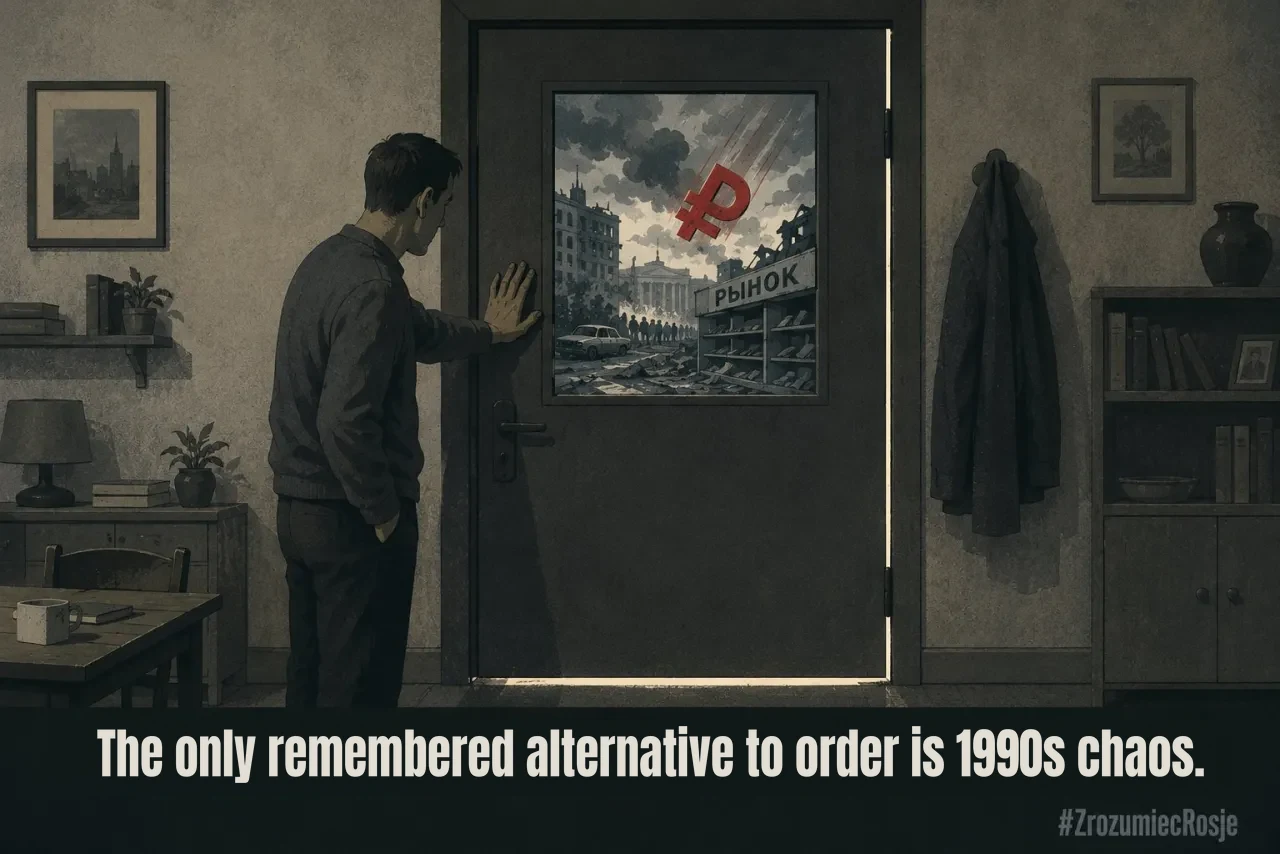
The proof lies precisely in that gap between circumstances and attitude. If loyalty were a function of prosperity, the unemotional majority — worse off, sceptical about the economy — ought to be a reservoir of discontent. It is not. One sentence holds it: "better not to touch it". The existing order becomes natural by the sheer fact of existing; it does not have to be good to seem unavoidable — what exists holds an advantage over imagination that the merely possible will never match.
Honesty requires admitting a hypothesis the émigré lens readily skips: part of that silent majority holds a quiet but real conviction about the system — it supports it sincerely, under no compulsion. Reducing a hundred million people to a mass of frightened conformists would be convenient and false at once. For the mechanism, though, it makes no difference. The authors themselves do not claim that nobody believes — they show that stability is satisfied by assent, even without belief. Sincere conviction and learned assent produce an identical effect at the level of the system: no action. Which is why the erosion of belief may change nothing until assent cracks.
The implication is fundamental for anyone counting on support eroding as conditions worsen. System justification severs the automatic link between poverty and revolt. Material deterioration does not by itself translate into political change as long as people treat the system as inevitable. Poverty becomes one more argument for keeping one's head down — not against it.
Synchronisation instead of fanaticism
Here comes Greene and Robertson's most important analytical move — shifting attention from the citizen–state axis to the citizen–surroundings axis. Loyalty to the regime is sustained not only by vertical mechanisms, that is propaganda and repression, but also by horizontal ones: the drive to synchronise with an imagined majority. A survey, the authors remind us, is like any social situation — a person does not so much reveal his emotions in it as decide how to display them so as not to complicate his life, cause discomfort or provoke conflict. He does the same at the table at work, at a family dinner, in conversation with a neighbour.
What stands behind that adjustment is the crucial part. The authors identify its source: concern to preserve order in one's own surroundings and to avoid rupture. A person keeps quiet so as not to break off relations with a brother, a boss, a friend; the state and its police are the background here. The strongest force is the image of the majority — what we believe others think, and the price of breaking out of that picture.
A study from Moscow's HSE confirms it paradoxically. Olga Gulevich and Daniil Chernov, analysing a sample of 16,656 Russians, show that a positive attitude to the system grows where people have a sense of influence and belonging — and in an authoritarian state the cheapest route to that sense is falling into line with what "everyone" supposedly thinks. The paper was written in a politically cautious, legitimising framing, but that is exactly what makes it strong: even Russian academia, describing it sympathetically, describes the same mechanism. Synchronisation is cheaper than fanaticism and far more durable, because it does without belief — a glance at the neighbour is enough.
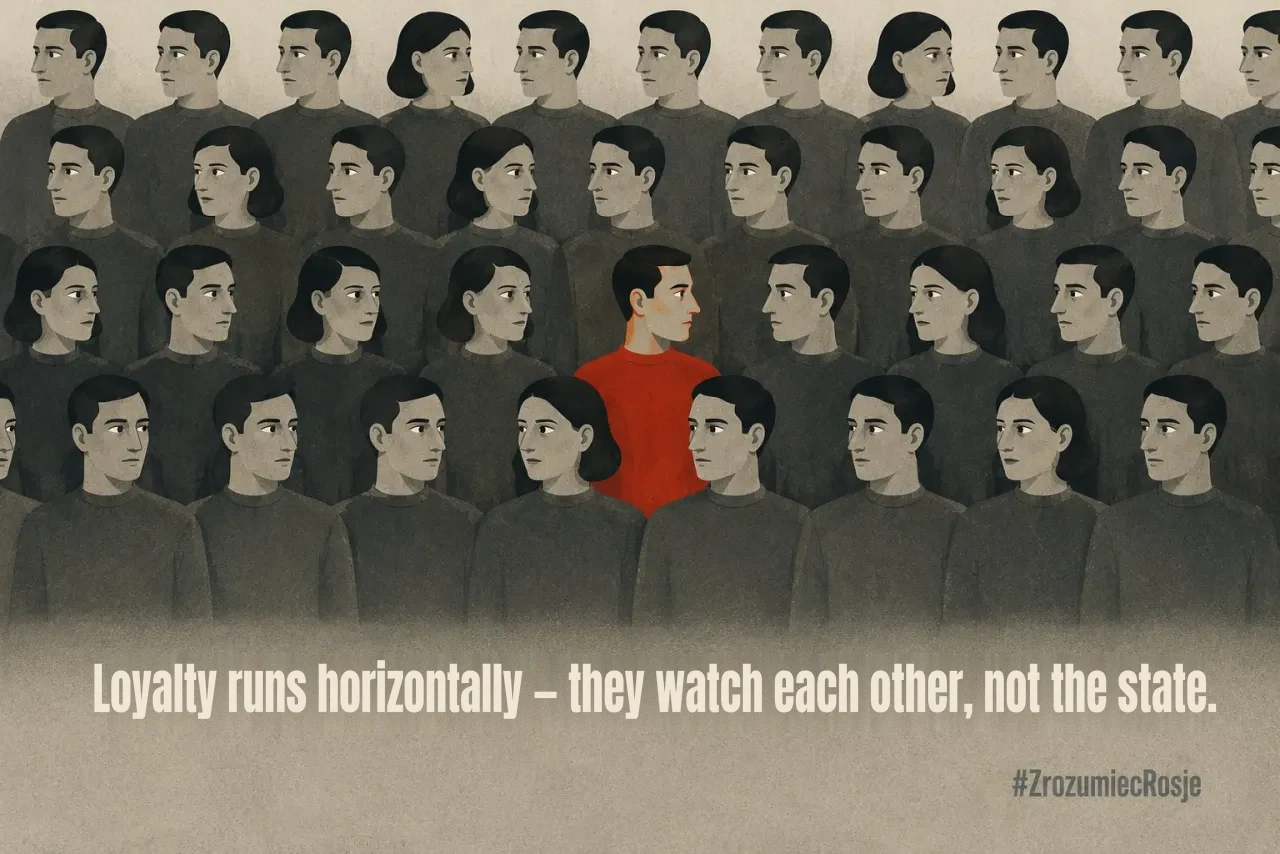
It is worth seeing how deeply this revalues the common picture of Russian support. The standard Western intuition assumes a vertical arrow: the state transmits, the citizen receives, propaganda formats minds. On that picture it would be enough to cut the cable and let real information in for support to collapse. What they show is harder: the strongest ligament runs horizontally, between the citizen and his immediate surroundings, and is largely immune to facts. You can convince a person that the war is going badly and the economy weakening, and still not move his behaviour — he is steered by the expected reaction of those around him, not by the state of affairs. Disinformation can be refuted with information. Synchronisation cannot.
The machine that listens
Social synchronisation has its institutional counterpart — and this is the strongest evidence that we are talking about a system rather than a mood. Lussier described it, in an analysis worth reading alongside Greene and Robertson. Lussier distinguishes two types of political participation: elite-constraining, which limits power (protest, an opposition campaign, building a party), and elite-enabling, which strengthens it (contacting officials, complaints, petitions). Russians consistently choose the second.
The numbers are unambiguous. According to a Levada Center survey from February 2019, 53 per cent of respondents were ready to sign a petition or an open letter and 49 per cent to approach the executive authorities — against a mere 22 per cent ready to go out to a street protest and 10 per cent ready to stand for office. In April 2020, 13 per cent said that over the previous year they had lodged a complaint or appeal with an office, and another 13 per cent had signed a collective appeal — against 3 per cent who had taken part in a protest. Outside elections this is the commonest form of political activity in Russia. Around a million such appeals reach the president himself every year (peak: 1.1 million in 2015).
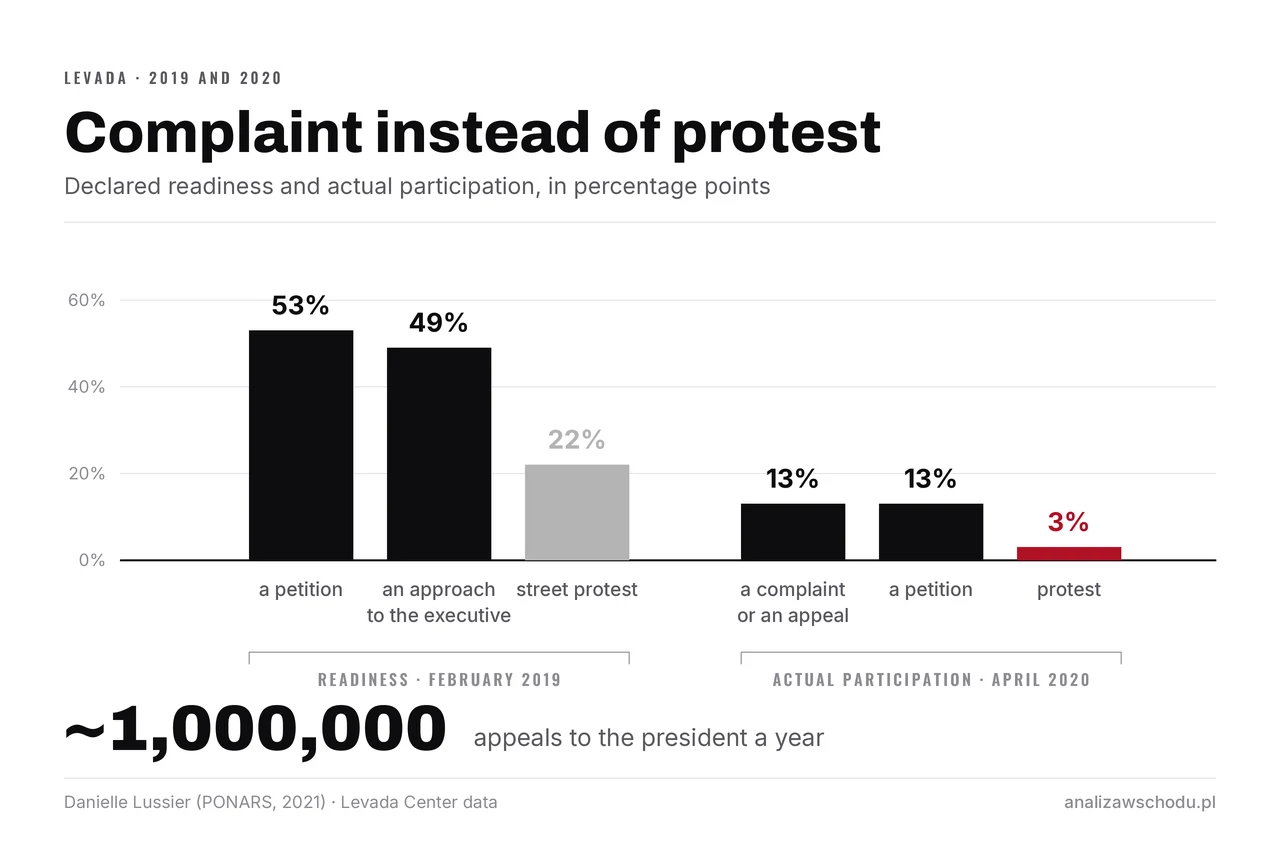
This is synchronisation built into law. The state does something cleverer with discontent than suppressing it: it channels it. A Russian with a problem writes a complaint to the president's reception office instead of going to a rally, because he considers it more effective and safer. And he does not treat it as politics at all; for him it is a private matter. The tradition reaches back to the petition to the good tsar in Muscovite times and to the Soviet paternalist welfare state. Lussier calls it voluntary compliance and shows that it is this, rather than violence alone, that stabilises the regime. A machine that lets you complain need not fear that anyone will take to the street.
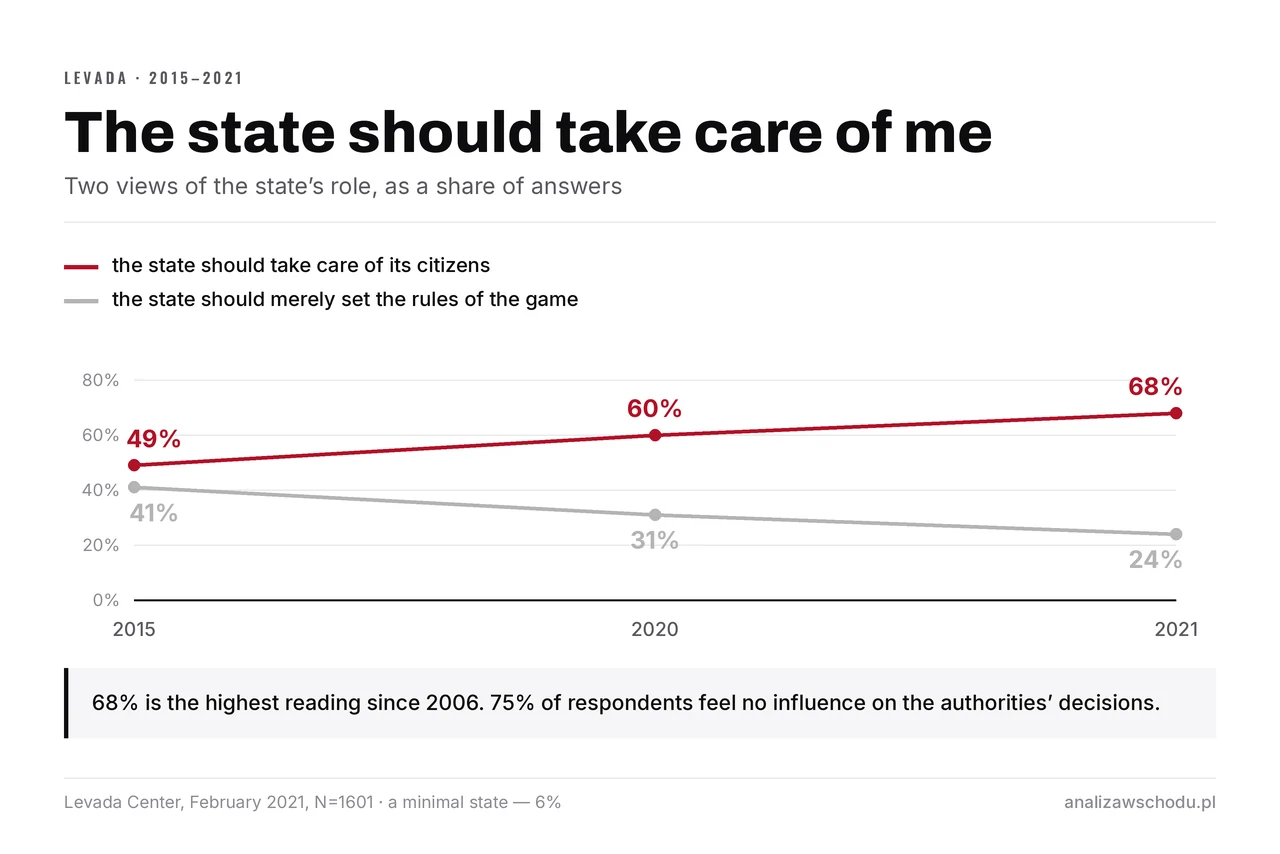
That inclination has deep ground in attitudes. Paternalism in Russia is growing steadily: according to the Levada Center, the share of citizens convinced that the state should take care of them and provide them with a decent standard of living rose from 49 per cent in 2015 to 60 in 2020 and 68 on the eve of the war in 2021 — the highest since 2006. Over the same period the view that the state should merely set the "rules of the game" shrank from 41 to 24 per cent, and supporters of a minimal state are a bare 6 per cent. On top of that comes a sense of powerlessness: three quarters of Russians believe they have no influence at all on the authorities' decisions. Those two attitudes together, high expectations of a guardian state and a conviction of one's own powerlessness, are perfect fuel for the complaints machine. A citizen who expects care from the state and does not feel himself a co-owner of it treats power as a patron to be asked for help. I flagged the same reflex in the previous article — about the Old Believers who came back from Brazil to the Russian Far East.
Collective avoidance as an everyday practice
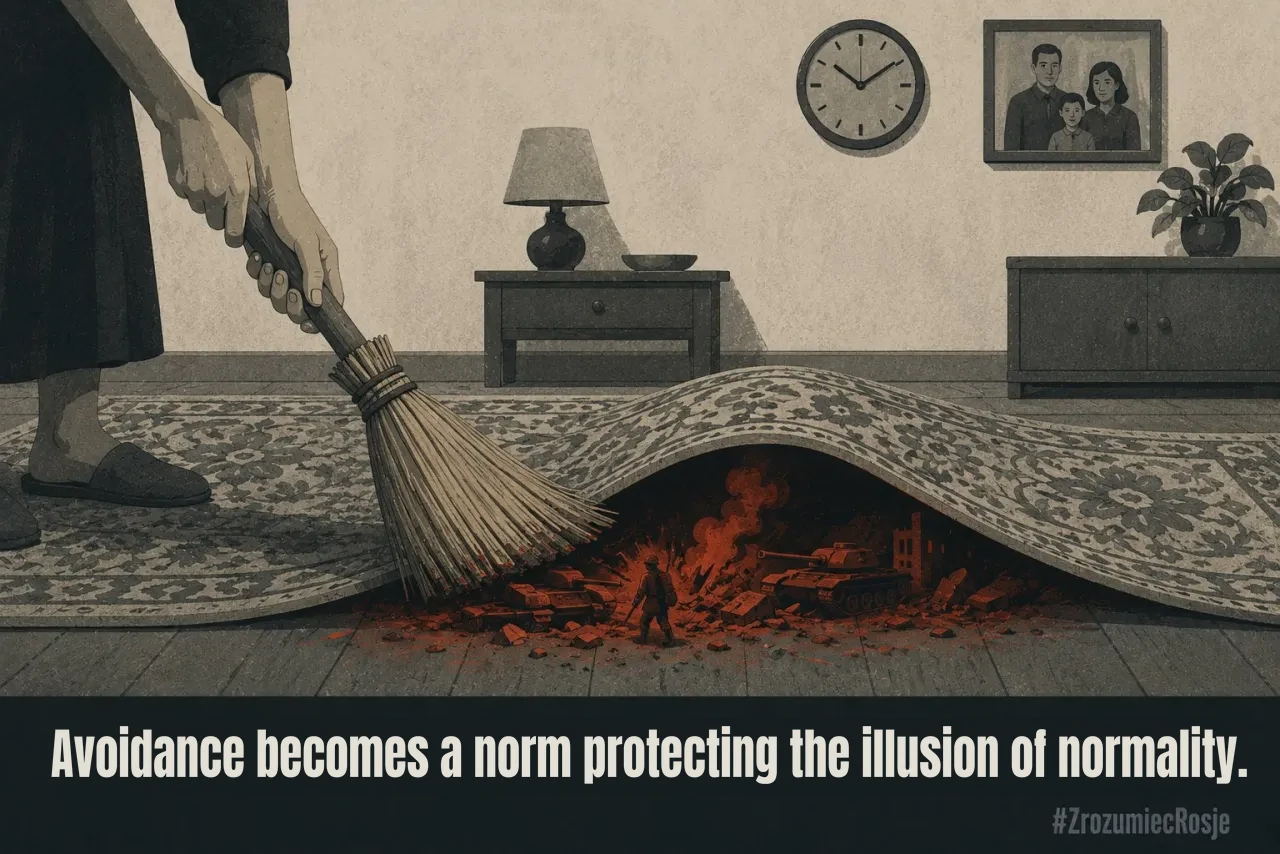
The everyday expression of this whole construction is collective avoidance — and this is the strongest image in the entire analysis. The war is everywhere and nowhere at once. Everywhere: in institutions, in rhetoric, in the letter "Z", in the school "conversations about what matters", in portraits of the fallen on classroom walls. Nowhere: consistently pushed out of private conversations, which stay shallow, ritual, confined to formulas of loyalty that commit to nothing. Symbolic omnipresence and real absence are not a contradiction — they are two sides of the same practice.
I have seen this mechanism at close range. At Forum Praktyk, the Warsaw Freedom Institute's practitioners' forum, I described the phases of psychological adaptation among friends who stayed in Russia. The commonest strategy turned out to be the silent change of subject: no declaration of agreement or dissent, simply "let's talk about something else". It is hard to call that cowardice. It is a technique for keeping a relationship, and one's own psyche, intact in a situation where a single careless sentence can break up a family or end a career.
The mechanics of that duality are precise. The symbolic omnipresence of the war works as a signal of loyalty — a billboard with the letter "Z", a minute's silence at school, the portrait of a "hero of the special military operation" in a display case — and precisely because it is a ritual, it demands no conviction. One can render unto ritual what is ritual's, then go back to talking about prices, the dacha and a television series as though the other thing had happened in a different country. Ritual and evasion are not opposites; they are the obverse and reverse of the same coin. The more symbolic presence on the outside, the less real conversation within — because one discharges the other. That is what keeps the illusion of normality standing: since everyone performs the same gestures, one can pretend nothing extraordinary is happening.
The technique has deep roots, reaching far beyond 2022. The Russian sociologist Maria Volkenstein recalled a moment, somewhere around 2006–2007, when people in focus groups "suddenly became afraid to speak", reflexively reaching for the old Soviet skills of hiding and dodging. Collective avoidance is therefore not an invention of the war. It is a cultural muscle the war merely reactivated. And that is exactly why it works so smoothly: nobody had to learn it afresh.
Atomisation against synchronisation
Here one has to face a competing explanation honestly, because it long dominated descriptions of Russia. In that older frame the key word is atomisation — a deliberate state policy which, as Yegor Zhukov said in his celebrated court speech, "dehumanises us in each other's eyes", breaks ties and suppresses common action, because it sees a threat in every collective effort. That description is true and important — it describes the vertical pressure from above which really does destroy the horizontal fabric of society.
But on its own it is not enough. If Russians were only atomised — single, distrustful, cut off from one another — there would be nothing to synchronise. The mechanism is subtler: the same horizontal ties atomisation was meant to destroy work as a mechanism of loyalty. People still look at one another — except that they look in order to adjust, not in order to organise. Atomisation and synchronisation do not exclude each other; they describe two different storeys of the same building. The state breaks the ties that could threaten the centre and leaves — or even strengthens — those that make the individual fall into line with an imagined majority.
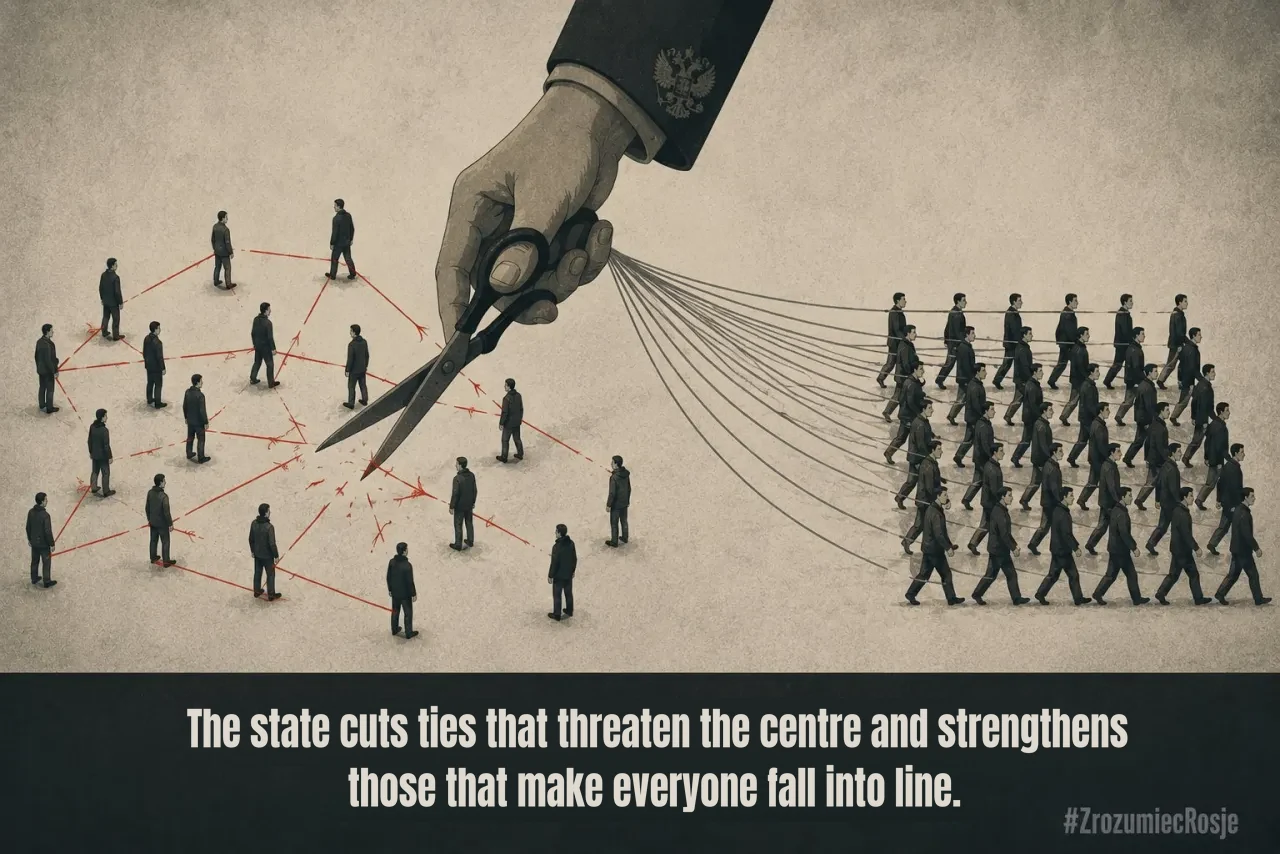
This is visible in policy directly. The law on "foreign agents" and the liquidation of independent organisations, from Memorial to local civic initiatives, cut away the horizontal fabric from which elite-constraining participation grows: protest, a party, a self-governing network. In their place the state installs collective forms it controls itself: the Immortal Regiment, the Movement of the First, work collectives, official parishes. There "being together" means "falling into line". It is no accident that it is easier in Russia today to walk in an organised procession on 9 May than to gather five people about one's own case. The same energy atomisation cuts off from politics, synchronisation redirects to where it reinforces the imagined majority. The state is satisfied with a society that holds together around the centre rather than against it.
Destabilisation deferred
From this follows the last and most important conclusion: deferred destabilisation. This whole equilibrium is durable and fragile at once, because it rests on a delicate, socially maintained balance of subjective assessments. Greene and Robertson signal that if assessments of the situation in the country keep worsening and the imagined consensus of the majority starts to waver, the system may enter a phase of rapid change — because synchronisation works both ways. The same mechanism that today holds people to the system ("everyone supports it, so I do too") may tomorrow push them away from it just as collectively ("since others already doubt, I can too"). The cascade of loyalty and the cascade of its collapse have the same logic.
Here, though, a discipline is needed that contemporary analysis of Russia often fails to keep. A capacity for a turning point does not settle its inevitability. Alexander Baunov, analysing the end of three European dictatorships — Franco's Spain, Salazar's Portugal, the Greek "black colonels" — reminds us that regimes are rarely brought down by the street alone. They become terminal only when the army stops shooting and the elite stops defending the centre. Prigozhin's mutiny in June 2023 was the closest such test — and it was survived and "managed" by fragmenting the security structures so that no officer corps could act as the Greek one did in 1974. Collective avoidance buys the regime exactly what it needs most: time in which nobody has to choose.
A simple counterfactual can be run here. If that same unemotional majority felt that its private doubts were already shared by those around it — that the "imagined majority" had tipped to the other side — no additional fact about the war or the economy would be needed for loyalty to start crumbling. The data would not change; their social interpretation would. Which is why the Moscow tabloid Moskovsky Komsomolets once summed it up more precisely than many a think tank: people give the authorities "quiet support — until they stop". Mark Galeotti added that even Russians are aware of the impermanence of power and are not prepared to indulge any leader indefinitely.
It is most accurate to see this loyalty as a social technology for managing fear. A Russian who avoids the subject of the war is protecting himself. The illusion of normality does two things at once: it shields the psyche of millions from the weight of complicity and at the same time keeps the war in motion, because a machine nobody questions aloud has no reason to stop. This connects to the earlier frames of this cycle — to "the Cult of Victory", a resource that ate itself, and to "the unfriendly state as an excuse": each time it is the same displacement of responsibility somewhere else, anywhere but onto oneself.
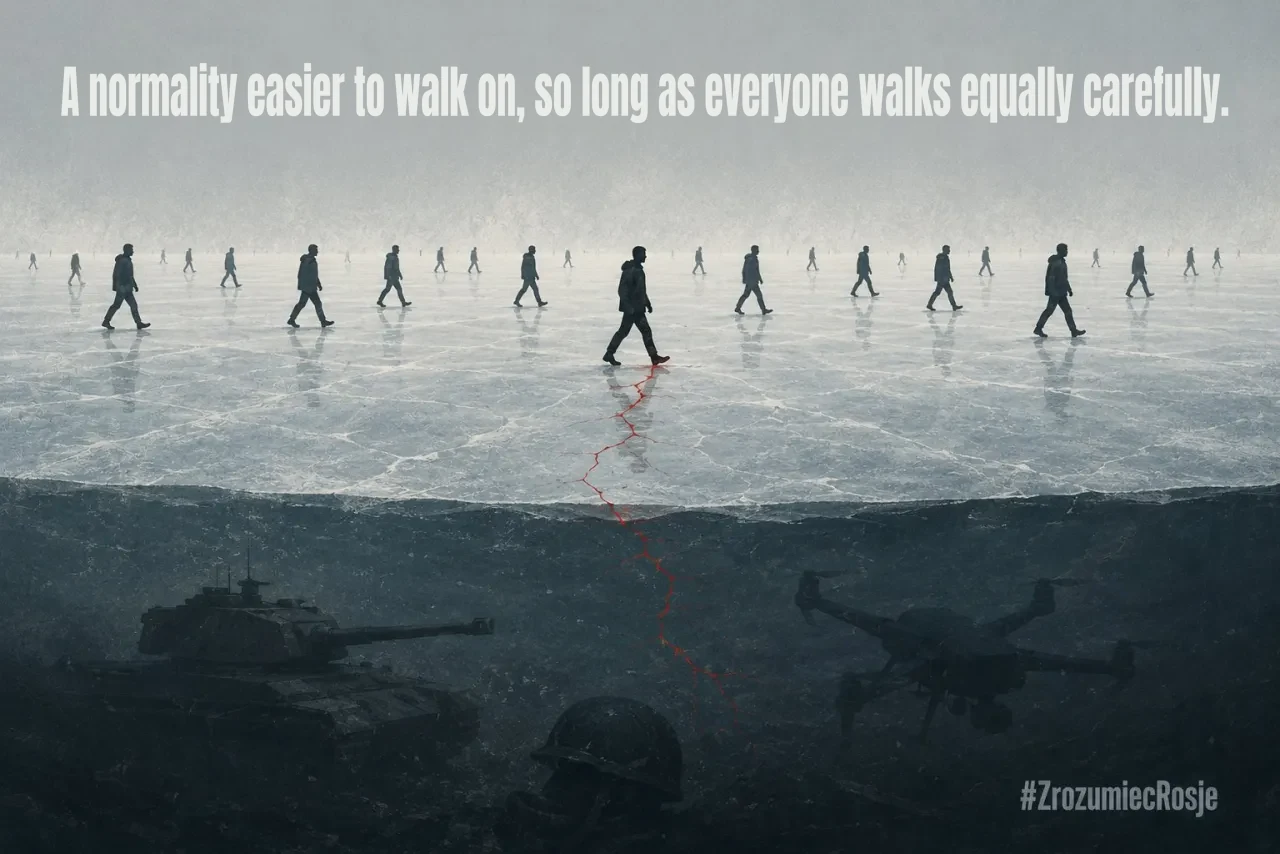
Russian normality is a thin sheet of ice, easier to walk on while everyone is walking equally carefully — and the war runs below, in dark water nobody wants to start looking at.
First published: X Article (in Polish), 16.06.2026
Cite as: Denis Salnikov, “Everywhere and nowhere: collective avoidance”, Analiza Wschodu, 16.06.2026, https://analizawschodu.pl/en/articles/collective-avoidance.html
Text © Denis Salnikov. Quotation with attribution and a link is welcome. To reprint a full text or reuse a chart, write to ds@analizawschodu.pl
* Graphics marked with an asterisk are mood images and may contain AI-generated elements. Charts, timelines and tables carry no asterisk — their figures come from the sources named beneath them.