A country as a substitute resort
· Denis Salnikov
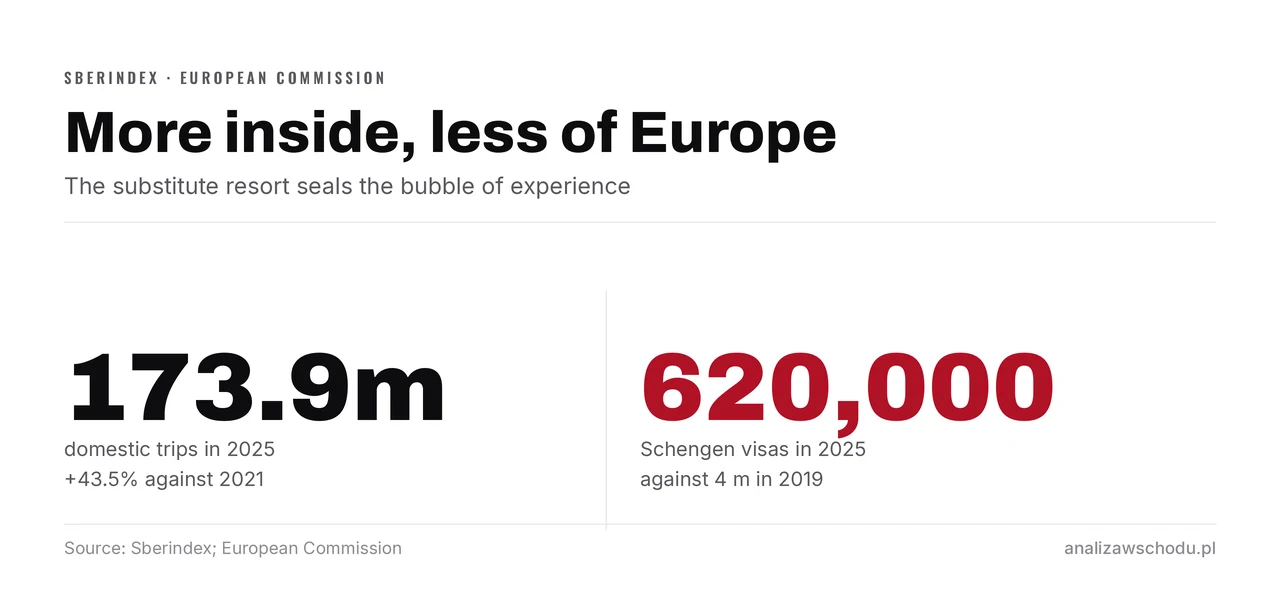
After 2022 Russia had to learn to take its holidays at home. Not out of curiosity. Out of necessity. Sanctions, the war, closed skies, harder access to Europe. In the statistics that compulsion turned into a boom: 173.9 million domestic trips in 2025, 7.4 per cent more than the year before and 43.5 per cent more than in 2021.
The state is now trying to turn that enforced concentration on its own territory into a political project — the "Tourism and Hospitality" programme, infrastructure subsidies, promotion of the "new" regions, the language of national self-discovery. This text is not an invitation to travel. It is an attempt to show how domestic tourism became one of the instruments for managing isolation.
A substitute resort
In official communiqués the boom is a success story. Russians travel more often, leave more money in the regions, "discover" places off the main circuit. From the point of view of the numbers the picture is partly true — 173.9 million trips is a historic result, and in the first nine months of 2023 alone there were about 115 million, 25 per cent more year on year.
The problem is where that growth came from. The strongest counter-argument runs like this: it is simply natural development — a country the size of a continent discovering its own regions, building hotels, maturing as a destination. That is partly true. But neither the scale nor the timing is accidental. The cutting-off came mostly from outside and against the Kremlin's wishes — it was sanctions, closed skies and harder visas that turned the traffic back inside the borders, not a decree from Moscow. The state's role is secondary, though not passive: it intercepts that compulsion and packages it as a choice — subsidies, "new" regions, the language of national self-discovery. The state did not design this cage — it is decorating the inside.
The map's two speeds
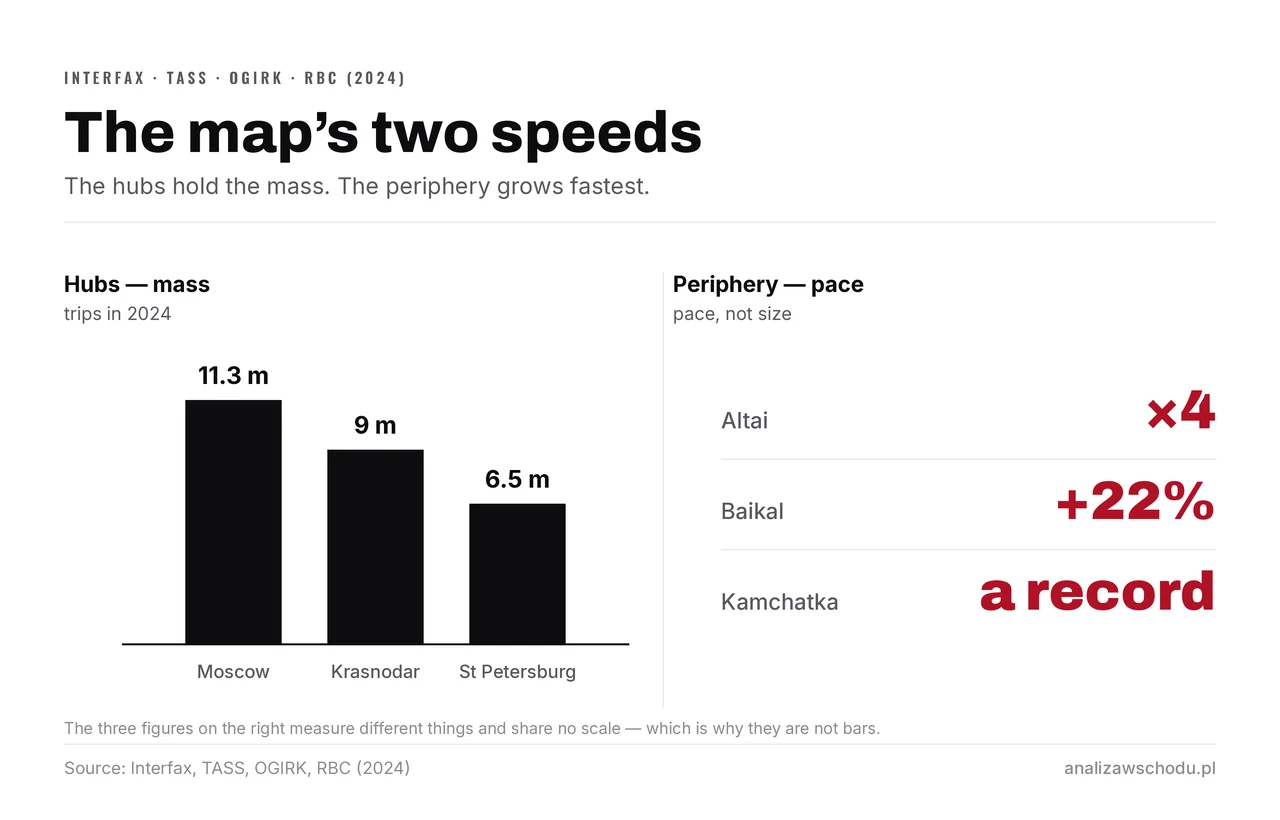
The country is not "opening up" to its citizens evenly. The traffic concentrates in a few hubs. In the first eleven months of 2025 Moscow took 11.3 million trips, Krasnodar Krai 9 million, St Petersburg 6.5 million. The rest of the federation remains in the role of satellite to the great centres and a handful of brand-name resorts. The map widens, but the centre stays the same — the capitals, the Black Sea, a few Caucasus republics, isolated regions sold as exotica to a middle class looking for new views inside the same state.
This is the crux. A country that for two decades accustomed its middle class to Antalya, Barcelona and Milan must now sell it Sochi, Dagestan and Kamchatka as an equivalent of the world. After 2022 Russia becomes a substitute resort for itself.
Concentration in the hubs is only half the picture, though. The other half is pace. Because what is growing fastest is not the capitals but the distant natural periphery — destinations that twenty years ago were an abstraction to the ordinary Russian.
The Altai Republic took about 2.7 million trips in 2024 — four times more than a decade earlier. Baikal: Irkutsk region took around 800,000 tourists in the summer of 2024, Buryatia passed 600,000 over the year (+22 per cent year on year), and the federal plan speaks of 5 million a year. Kamchatka — an expensive destination, hard to reach — grew from 280,000 trips in 2022 to 406,600 in 2024 and is aiming at a million by 2030. Karelia passed 1.5 million trips in 2024 and is still growing — by 40 per cent in 2025 — with 3 million announced for 2030. All of that is the trend up to 2025 — because in the 2026 season even that periphery hits a wall: queues of a dozen hours or more for fuel at Baikal and cancellations of the order of 20–45 per cent.
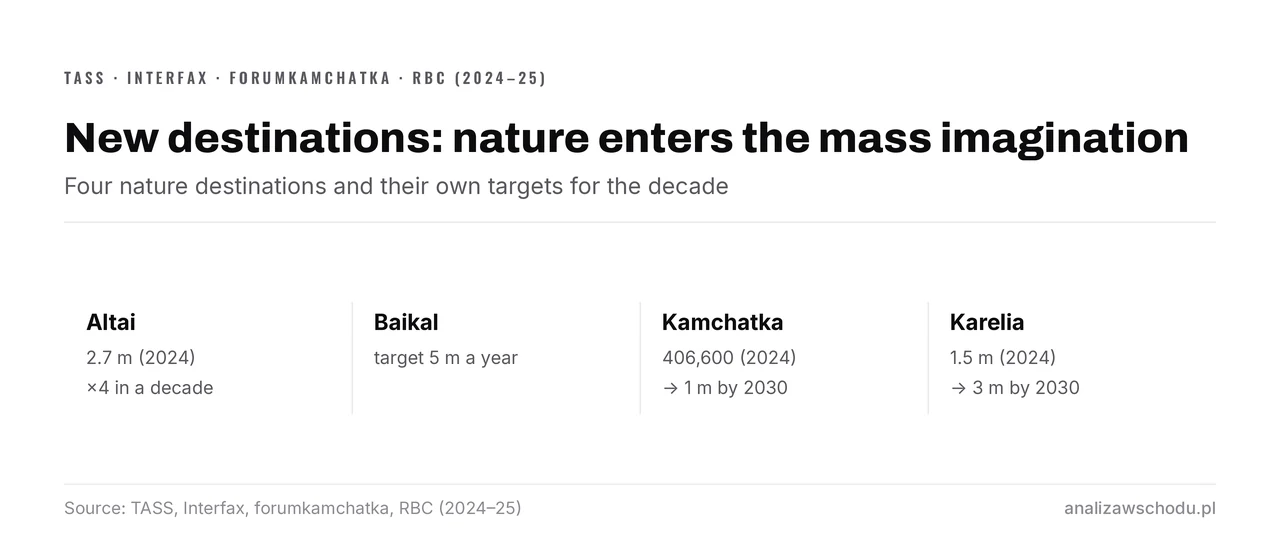
This is a real change, not statistical noise. Volcanoes, taiga, steppe and the deepest lake in the world are entering the mass imagination as a place for a holiday, not just a point on a school map. The state sees this and adds its own contribution — routes, subsidies, "new" regions in the brochure. The direction, though, stays the same as throughout this text: the energy once absorbed by abroad is redirected into the interior of the country. And the further from a hub, the harder a tourist is to count — and the easier to add to the tally.
Tourism as narrative
Russian tourism has long served an image function. After 2022 that function became political.
As the country disappears from the Western imagination as a normal space of contact, the state works all the harder to ensure that for its own citizens it remains "diverse", "hospitable" and "living normally". The tourist brochure and the political message begin to speak one language: everything works, the shops are full, the planes fly, the mountains stand, the Black Sea is waiting.
Some of the content aimed abroad does the same. An English-language vlog about "real life in Russia" does not have to say a single political sentence to become an instrument of narrative. A calm metro, a full restaurant, a shot from the beach or the bazaar is enough — and the viewer is given the suggestion that the war is far away and the sanctions ineffective. The problem is not that they show things that are untrue. It is that they show only those fragments of reality that are easy to turn into an argument against the very idea of isolation.
That is why writing about tourism requires care today. It is easy to reproduce the same images the state wants shown — beautiful mountains, full hotels, "discovering the regions" — and to lose the questions that matter most. Who pays for this boom. Who earns from it. Who is left with the waste, the overloaded infrastructure and the rising prices. A realistic picture of Russia does not deny the beauty of Dagestan or the potential of the Caucasus. It simply sees that a beautiful landscape can at the same time be an instrument of political closure.
Crimea: a record on paper
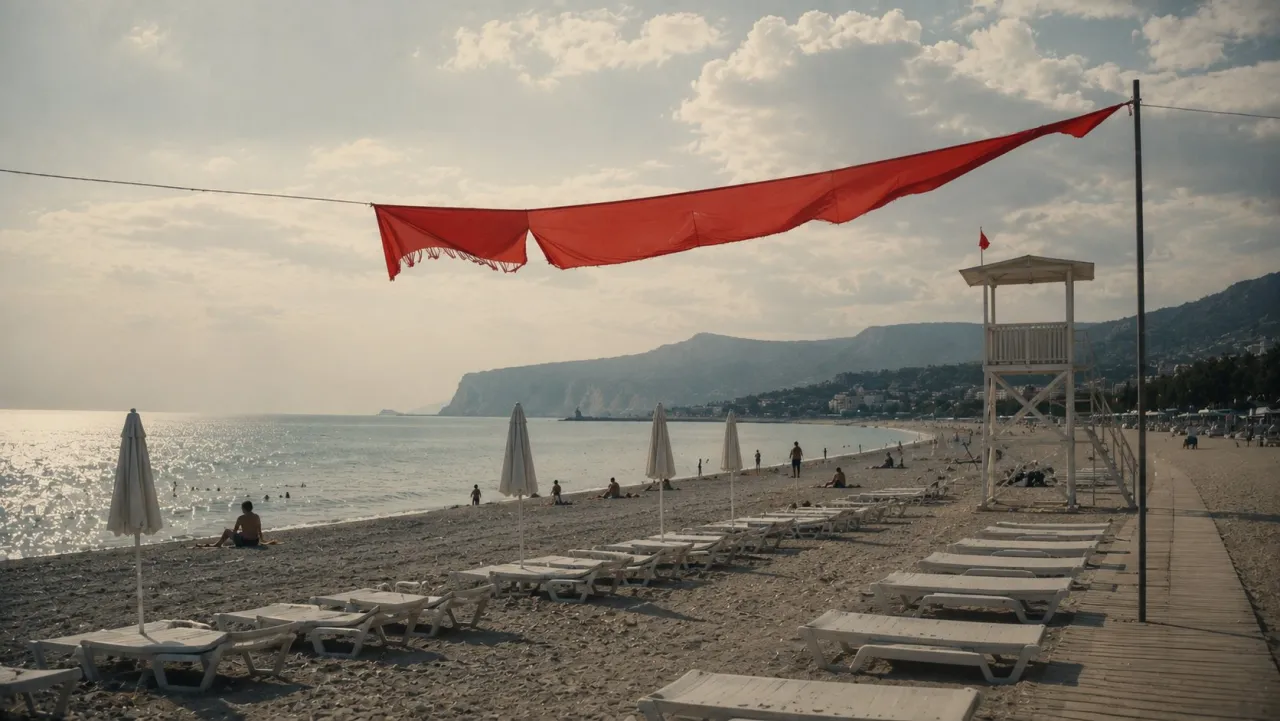
This is sharpest in Crimea. After 2014 the peninsula became the flagship substitute resort before the notion had even taken hold — a patriotic choice, "ours", reachable without a border. The starting point, though, was a trough: the last Ukrainian season was around 5.9 million tourists (2013), with the record of 6.1 million in 2012; after annexation the figure collapsed to barely 4 million. The official figures then rebuilt themselves year by year — 6.2 million in 2019, 6.9 million in 2025, announced as a "post-Soviet record". The thing is that this record only drew level with the Ukrainian figure after a decade — and that with a counting method easy to stretch. Meanwhile around 180 billion roubles were pumped into infrastructure.
And the record is largely painted on. Crimea's former tourism minister calculated that the accommodation base had shrunk by a fifth, and that with that number of beds 7.5 million tourists is a physical impossibility — "two Cypruses" at once. The tourist statistics take in day-trippers coming to shop, people visiting family, seasonal workers; some activists estimate as many as 2.5 million "dead souls" added to the season.
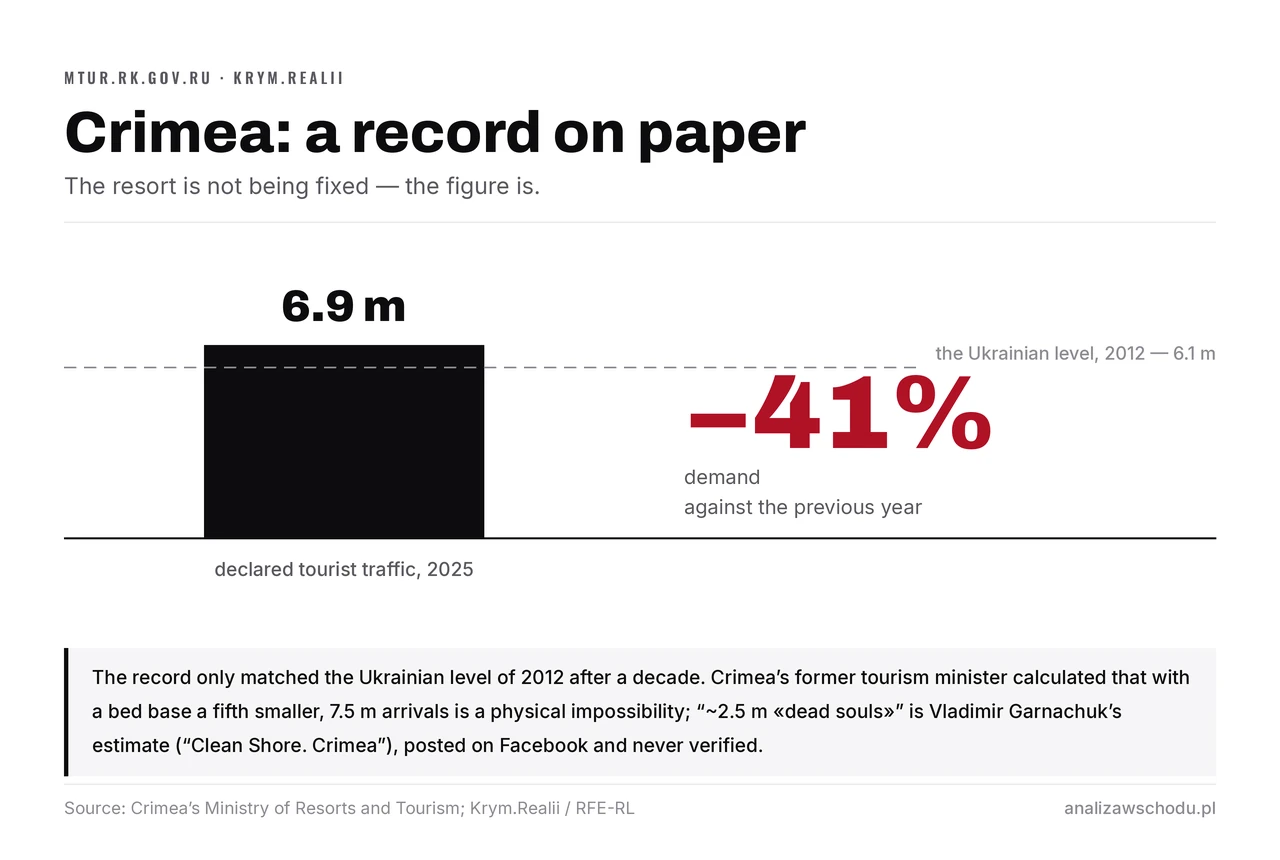
And since 2022 the war has been added to the paper record — and in the 2026 season the bill becomes visible. Bookings in Crimea fell by 41 per cent, and cancellations reached several tens of per cent; hotels were cutting prices by 40–50 per cent, the state reached for an emergency 3.7 billion roubles of support, and the resorts were tempting tourists with "free petrol" (10 litres for a longer stay) and a generator as an amenity. An official record and free petrol in the same season. Crimea is therefore a substitute resort in pure form: a record in the communiqué, a bailout in reality. It is the same logic as the replaced sand in Anapa — you do not repair the resort, you repair the number.
Kuban: a resort under pressure
Kuban has a special place in this story. This is where holiday normality was imagined for years. The Black Sea, guesthouses, sanatoria, Sochi as "our own riviera", Anapa as the mass version of a seaside break. Krasnodar Krai was to stand in for two worlds at once — the Soviet dream of a domestic holiday and the post-Soviet need to be "like abroad", only without a passport.
The model worked for a while. In the first eleven months of 2025 the region took around 9 million trips, second only to Moscow. But it is precisely here that one sees most sharply that a substitute resort is not a stable equivalent of the world. It is a construction dependent on the weather, the infrastructure, prices, the environment and the war — that is, on everything propaganda cannot ultimately control.
Krasnodar Krai is not a point on a map for me. When the war began I was living in Krasnodar and finishing the building of my own house near Sober-Bash, a flat-topped mountain in the interior of the region, away from the sea. A few minutes' drive separated that house from a vineyard, schools, shops and mountain trails.
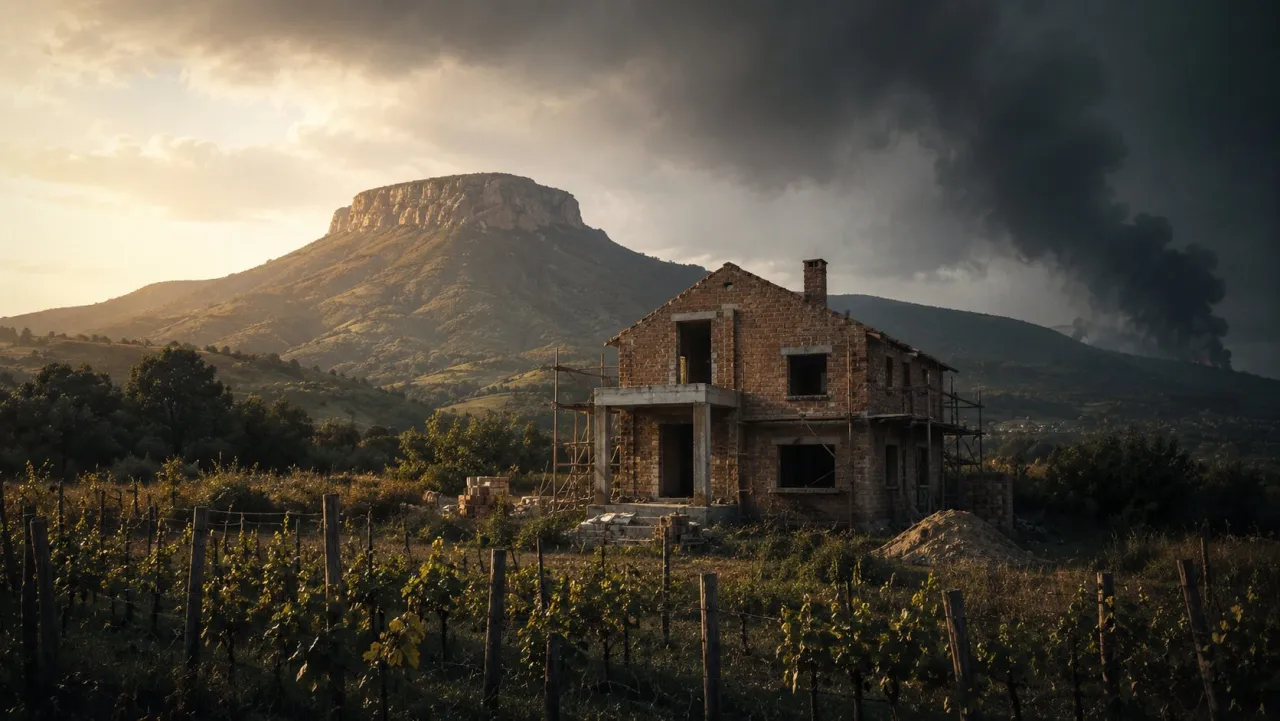
This is the less obvious Kuban: not the beach at Anapa and not the slopes at Krasnaya Polyana, but the foothills, the wine routes, a weekend at a vineyard instead of a weekend on an overloaded shore. The same goes for Taman. In my childhood the peninsula meant "wild" tourism — a tent on an empty beach, no infrastructure, the crossing to Crimea and not much else. Today it is sold with tastings, châteaux and a wine map. I know this destination from the inside — I was there before it grew to the scale the state now advertises.
I write about it precisely because it is attractive. The vineyards of Taman and the foothills of Sober-Bash really do have something to offer — and that is the most interesting moment at which to keep one's analytical sobriety. The same grassroots movement that builds houses and opens tasting rooms is being plugged by the state into its own project: subsidies, promotion of the "new" regions, the language of national self-discovery. The attractiveness of a place does not cancel the question of who steers its growth and to whom the value accrues.
Because success in this region has another side, about which the brochure says nothing: the bigger it gets, the closer to the state. In April 2024 a court transferred Kuban-Vino to the treasury — Russia's largest wine producer, 95.5 million bottles in 2023, with vineyards in Taman. Formally the matter was a criminal case against the owner. In practice the court itself acknowledged that these assets did not even originate in the privatisations of the 1990s — and they were taken anyway. Nor was this an isolated case: at the same time further Kuban agricultural companies were passing under state control. Deprivatisation stopped being an exception to the rule and became the rule itself.
That is the region's lesson in one sentence. You can build a vineyard, a brand, a small resort — as long as they stay small, you are part of "discovering the regions". Once they grow, you become a target. The substitute resort rewards growth. It does not guarantee ownership.
In the Russian imagination the south was to be a space of lightness. In residents' memory it tends rather to be a place of seasonal overload, chaotic building, overheated infrastructure and a life subordinated to the rhythm of a few months of income. That difference — between the brochure and everyday life — is the first thing to disappear when Krasnodar Krai becomes the backdrop to a postcard.
Anapa and Tuapse: the black coast
That difference was exposed most sharply by the series of crises that cut through the Black Sea coast within a little over a year.
First, in December 2024, the disaster in the area of the Kerch Strait. Two tankers sank and at least around 4,000 tonnes of fuel oil entered the sea. The beaches of Anapa and stretches of the nearby coast were contaminated. In the 2025 season this translated into a fall in demand for trips to Anapa of the order of 60–65 per cent year on year. The problem did not disappear with the first clean-up, because it struck at the very foundation of the product: the promise of a clean, safe beach.
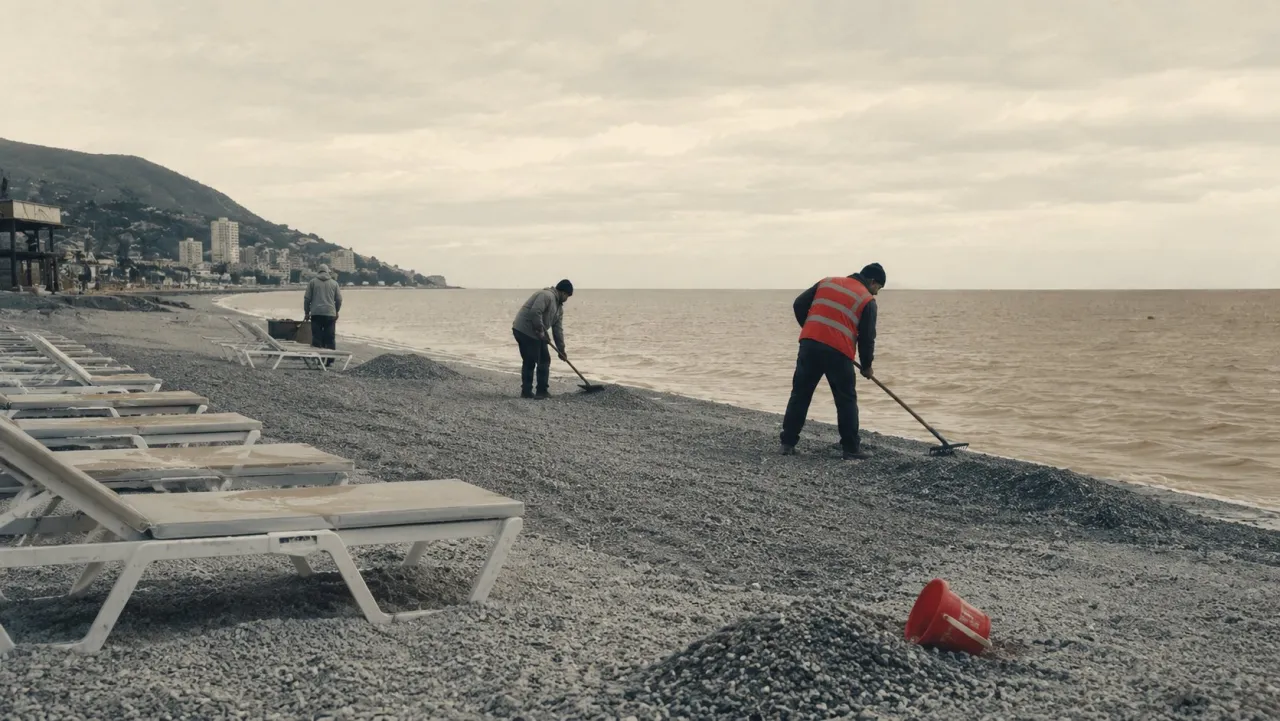
The authorities responded in a manner familiar from other Russian crises: not by cleaning but by managing the image. Bereg's report of 13 July 2026 shows what that looks like close up. In Anapa, Vityazevo and Bolshoi Utrish the contaminated quartz-and-shell sand was simply replaced with imported building material — a mix of clay and gravel — and the beaches were reopened. The sea still has a brown tint, dead dolphins coated in fuel oil wash up on the shore, and the river Anapka flows into it as a muddy brown stream. The resort was not cleaned. It was repainted.
You can force a region into silence, pump credit into a hotel, shift the advertising budget to the next town along, you can even replace the sand on a beach. Trust cannot be delivered by lorry. And tourism rests on trust more than on orders.
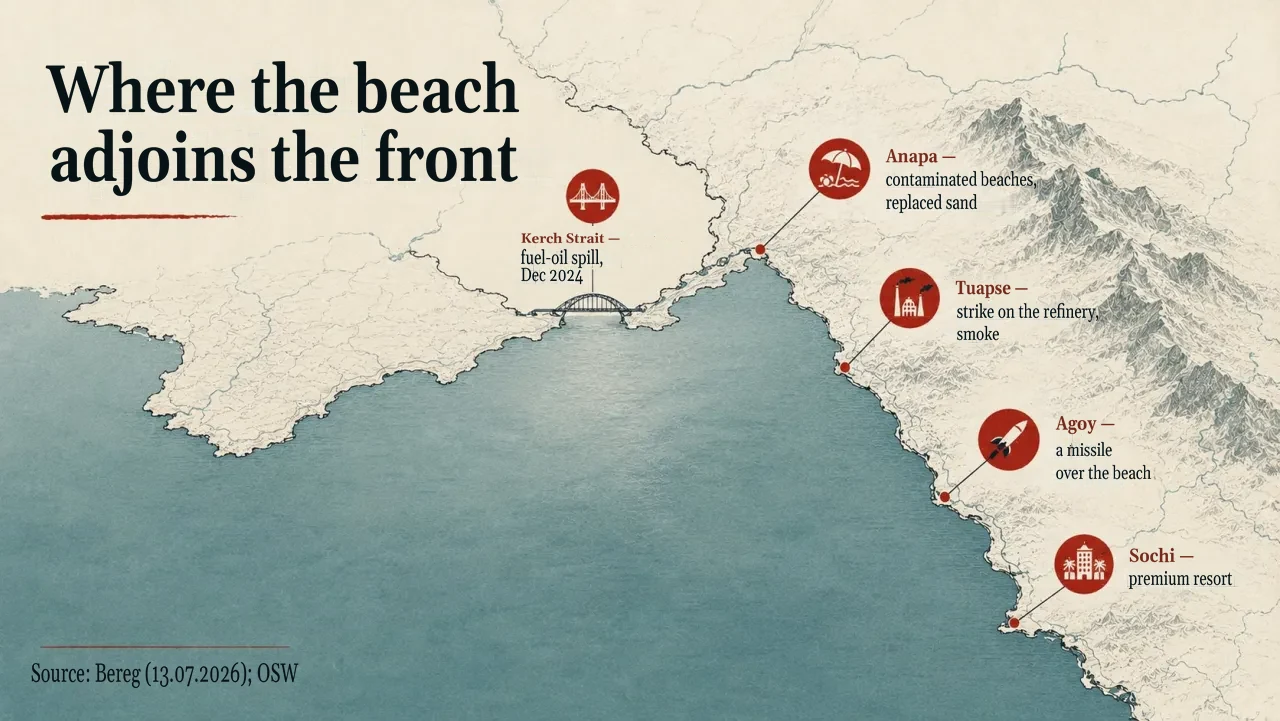
Tuapse adds a further layer: the war. Not in the form of a headline, but as physical contamination of the space people live in. The April and May strikes on the Rosneft refinery set tanks alight; a fine oil mist settles on pavements, railings and vegetation within a radius of a kilometre. In one of the strikes children were killed. The town entered the season with its central beach closed and with a question that Bereg quotes from a local woman: "Where are we supposed to hide? All the shelters are locked!"
The war has stopped being background here. In Agoy and near Vityazevo anti-aircraft missiles fly over the beach "at the height of a three-storey house". A tourist from Podolsk sums it up with the sentence that gave the whole report its title: "My whole life flashed before my eyes — I thought I would die of fright." A shop assistant, a military pensioner, reassures her without emotion: "Don't worry, for us this is almost an everyday thing." On top of that, queues for petrol at the height of the season — dozens of cars, with a limit of 20–30 litres a fill. Fear and anaesthesia on the same beach.
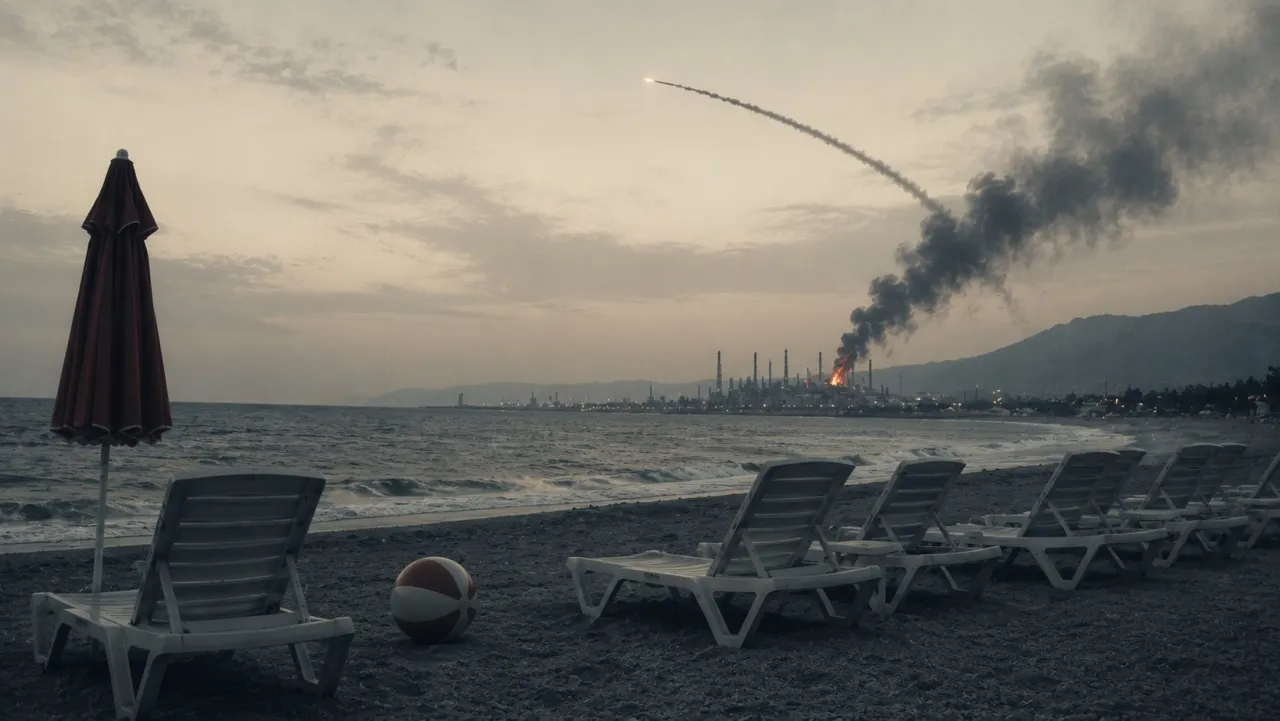
Without that layer it would be easy to describe Anapa as a one-off piece of bad luck — old infrastructure, neglect, an accident. Tuapse is a reminder that the Black Sea coast is today a space in which the economy of leisure meets the economy of war directly. The development of tourism in Kuban has stopped being a story about regional business. It has become a story about how the state maintains the appearance of normality on a coastline wired into the rear of the front.
The North Caucasus: from risk zone to product
If Kuban shows how easily a Russian resort breaks down, the North Caucasus shows the opposite movement. How a region treated for years as a risk zone gets repackaged as a fashionable domestic experience.
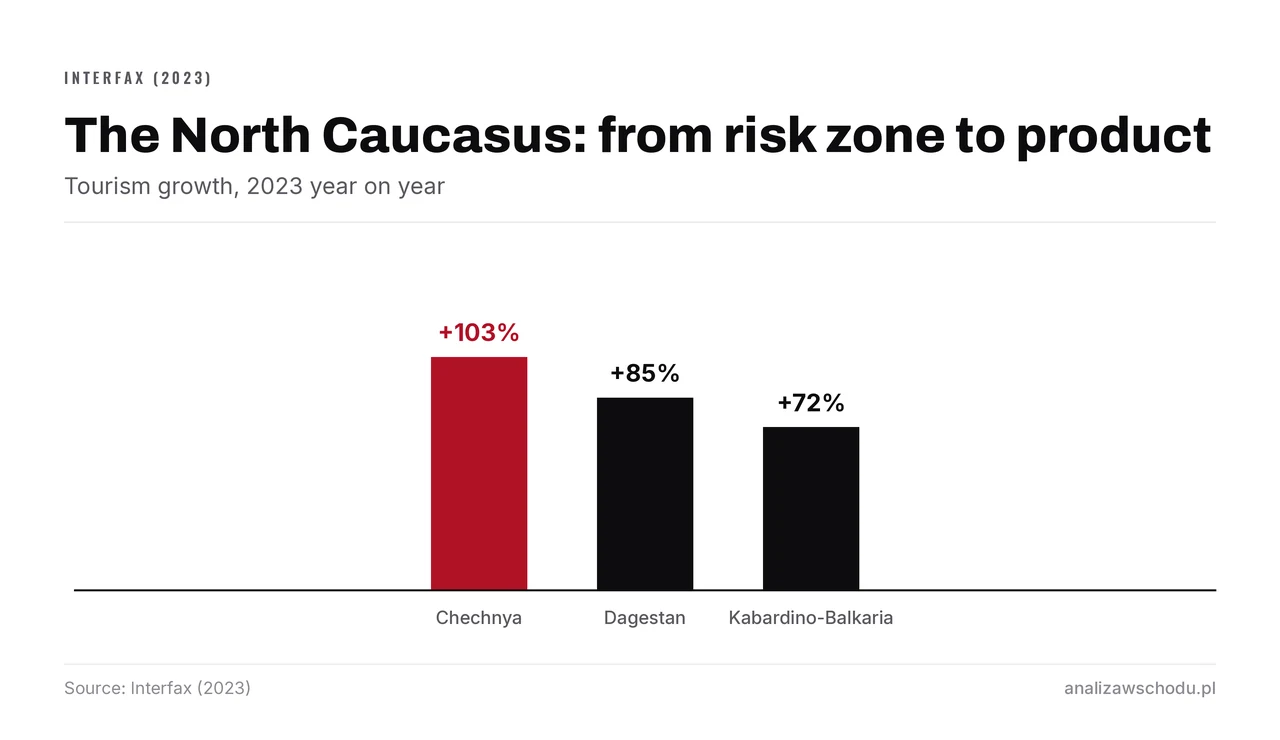
In 2023 some of the highest growth rates in the entire federation were recorded there. Interfax wrote of growth of 103 per cent in Chechnya, 85 per cent in Dagestan and 72 per cent in Kabardino-Balkaria year on year. Ten years ago such a picture would have been counter-intuitive for most Russians. The North Caucasus then meant the Chechen wars, bombings, checkpoints, the television language of "instability". The region functioned as a security problem, not as a holiday proposition.
I saw the transitional moment between one image and the other. I was in Ingushetia and North Ossetia with an organised group — briefly, as a tourist. That edge of the Caucasus I know from a visit, not from daily life; the western shore of the region, on the Kuban side, is a different matter, but into the mountains I went as a guest. The landscape was already ready to be admired — mountains to the point of excess. The security frame remained visible. Checkpoints. We were in a place at once beautiful and supervised, open and cautious — sold as an experience, but not yet domesticated by the mass imagination.
That tension is the measure of the change. Because part of that change is now fully mainstream. Dagestan has become one of the strongest brands in Russian domestic tourism, with close to 2 million visitors in 2025. A place the centre associated with violence, poverty and a "difficult region" is today sold as a space of waterfalls, mountain roads, local cuisine and authenticity. Exotica without a passport.
The old image has not disappeared. It has been covered with a new layer of consumption. A region that was previously the object of securitisation is today becoming merchandise in a tour catalogue. The centre no longer has only to control it — it can begin to consume it. That is an important change in the Moscow–periphery relationship. Not necessarily an emancipatory one for the periphery itself.
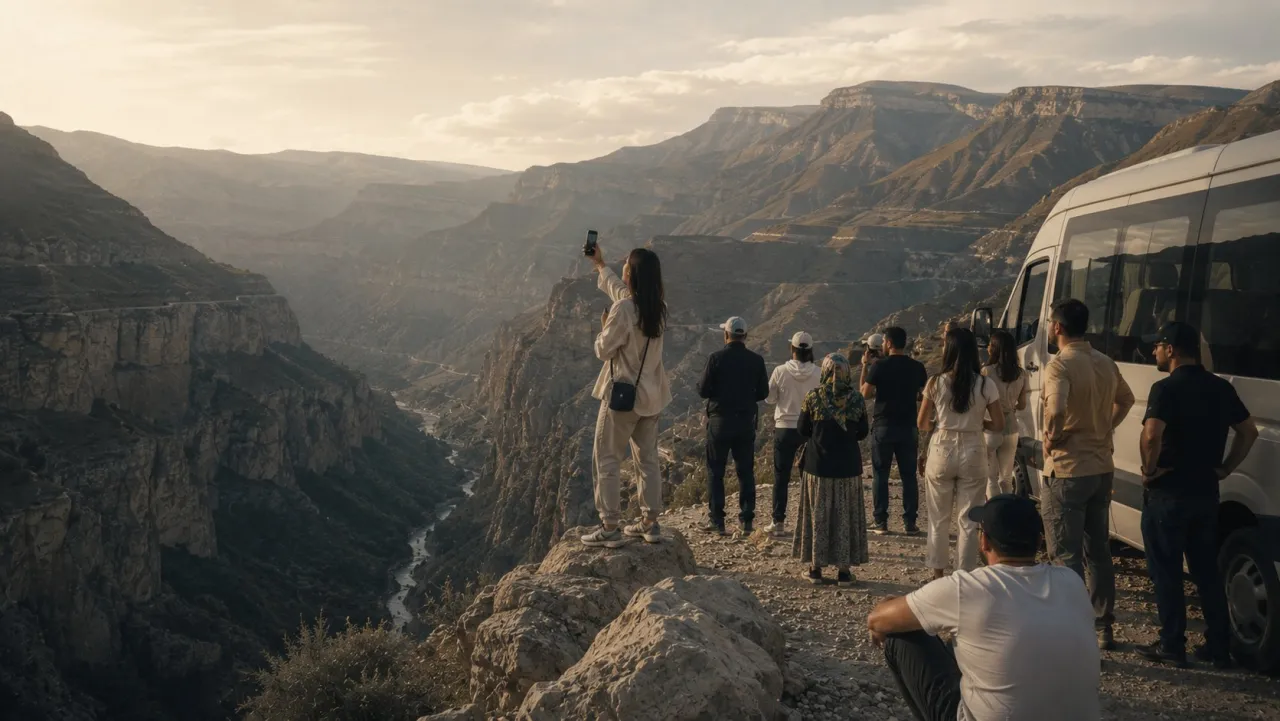
The boom does not resolve the tensions between the centre and the region. It can deepen them, if local communities get mainly price pressure, strained resources, seasonal work and the subordination of their own space to other people's expectations. Some writing on Dagestan describes this process outright as colonial exploitation: the centre discovers the region not in order to understand it but in order to consume it and describe it in its own language. Russia's tourism boom does not fill in the old chasm between centre and periphery. It builds a more comfortable bridge over it for those going there for the weekend.
2026: the season in which the model chokes
2025 gave a record; the summer of 2026 shows the ceiling. For the first time since the boom began, domestic bookings fell — by 15 per cent in June, by 10 per cent in July and August, with a fifth cancelled. The cause is systemic and belongs to the war: weakening purchasing power, drones on refineries, fuel rationing (30 litres a day), airports closing to the rhythm of air-raid alerts. The substitute resort turns out to be exactly what Kuban warned of — a construction dependent on fuel, electricity and the sky, none of which the state controls. You can deliver sand to a beach. Barrels and a quiet sky, no longer.
This is not a prediction of collapse. The traffic still runs to hundreds of millions of trips, and some of it is simply moving closer to home — to the Golden Ring, to the Moscow outskirts. It is something narrower and more important: the first season in which the enforced concentration begins to collect its own bill.
Tourism and the sealing of isolation
The most important consequence of this process is not economic. It is social. In theory the development of domestic tourism could teach Russians a more complex picture of their own federation. In practice, alongside the simultaneous cutting-off from Europe, it works as a mechanism for sealing the bubble of experience.
Precision is needed here. The point is not that Russians have stopped travelling abroad. Part of the traffic has shifted to Turkey, the UAE, Egypt and Asia, and outbound travel has partly rebuilt itself after the pandemic collapse. The point is something narrower: the shrinking of Europe as an everyday reference point for a broad layer of the middle class. A few years ago Russians were receiving around 4 million Schengen visas a year. In 2025 we are talking about an order of 620,000. That is not merely a statistic of border traffic. It is a statistic of the shrinking opportunity for Russian clichés to collide with life outside the Russian media space.
In such an arrangement domestic tourism does not so much open the country as seal its walls. An ever larger part of society looks at different landscapes but remains inside the same information infrastructure, the same political language, the same mechanisms for selecting the image. A trip to Dagestan, Sochi or Kamchatka can be fascinating. It will not replace the experience of foreignness that undermines one's own certainties. And without that experience propaganda clichés live longer, because they more rarely meet a reality capable of disarming them.
Russia is developing domestic tourism today not only to make money from its own regions. It is developing it because a politically closed country needs new forms of normality — and a country that meets other people's everyday life ever more rarely finds it easier to keep its own simplifications. A symbol that was meant to replace open borders has begun to entrench their absence.
First published: X Article (in Polish), 24.07.2026
Cite as: Denis Salnikov, “A country as a substitute resort”, Analiza Wschodu, 24.07.2026, https://analizawschodu.pl/en/articles/substitute-resort.html
Text © Denis Salnikov. Quotation with attribution and a link is welcome. To reprint a full text or reuse a chart, write to ds@analizawschodu.pl
* Graphics marked with an asterisk are mood images and may contain AI-generated elements. Charts, timelines and tables carry no asterisk — their figures come from the sources named beneath them.