"We don't abandon our own": the story of the Old Believer returnees
· Denis Salnikov
"We don't abandon our own." That sentence has been painted on the sides of Russian tanks since 2022. It is the justification of the war in three words. The doctrine of a state that explains an invasion as care for its own people.
I want to tell the story of people who are "our own" in the most literal sense. Russian to the root. Orthodox of the old rite. Speaking the language spoken in a Russian village before the revolution. The state invited them itself — under a special programme, with simplified citizenship, land and credit. They came back. And then they were left alone.
We know about them because Alexey Pivovarov watched them for six years — a Russian journalist with three million subscribers, the creator of the channel Redaktsiya. Not a Western think tank, not a politician, not a front-rank émigré activist. In 2022 Moscow put him on the list of "foreign agents", and he goes on working from inside Russia all the same. He keeps the subject ethnographic and peasant rather than overtly political — and not once, in any of the four films, does he utter Putin's name when he talks about how the war strikes his protagonists. It is the journalistic diplomacy of someone who writes about Russia without leaving it. A Polish audience barely sees it.
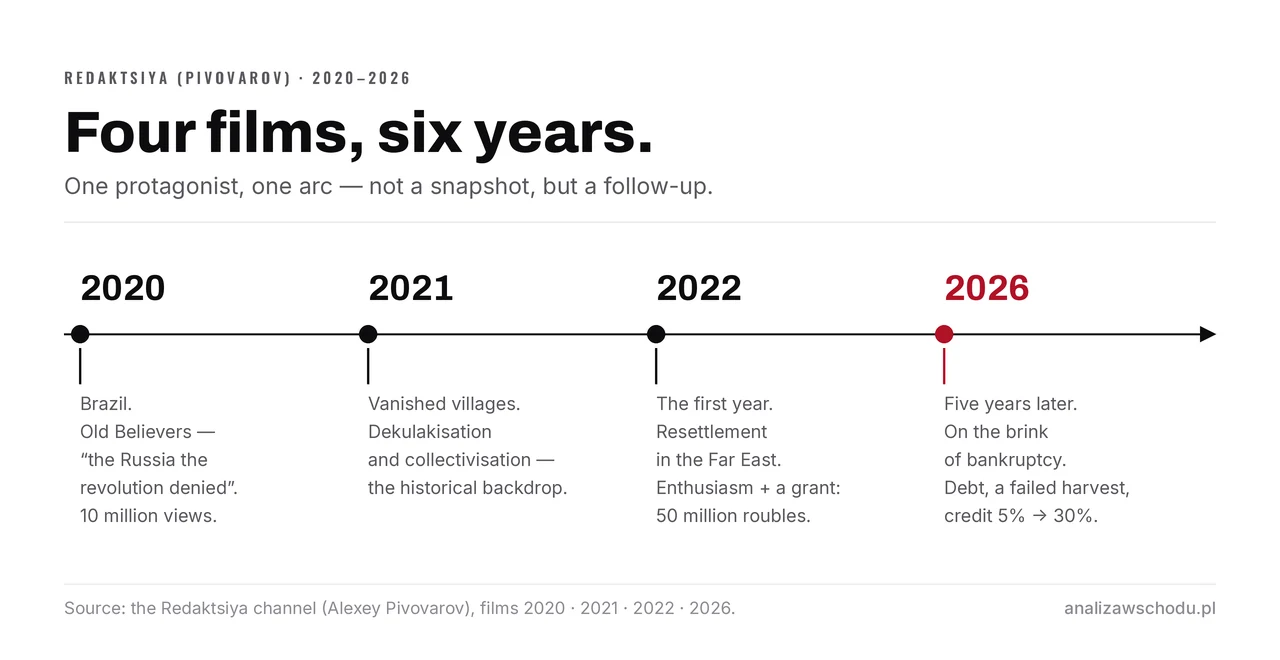
Four films, six years. The first in 2020 — Brazil, ten million views. The second in 2021 — on where the Russian villages went. The third in 2022 — the first year of resettlement in the Far East. The fourth in June 2026 — five years later, the film this text is heading towards. Together they give something rare: not a snapshot, but a return to the same people after years. The West rarely does this — it loses the continuity of the story. Pivovarov went back three times.
Betrayal by individuals is too narrow a word for what happened to them. This is about a structure — and to understand it, one has to go back a hundred years.
The Russia that no longer exists
Let us start with the film that is in the middle chronologically and, in logic, at the beginning of everything.
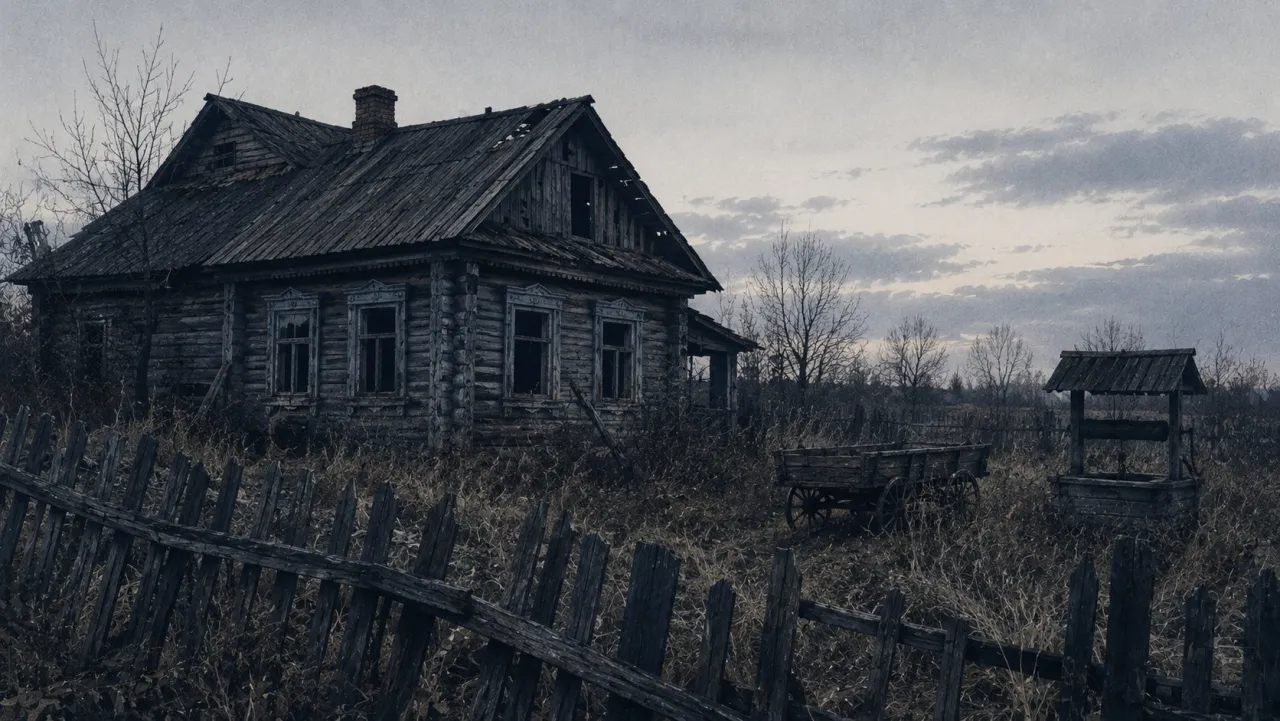
In the abandoned tract of Likhachevo, a hundred kilometres from Moscow, stand the ruins of the church of St Nicholas the Wonderworker. Before the revolution more than a thousand people lived here. Today, nothing. It is the model of the typical post-Soviet Russian village: absence.
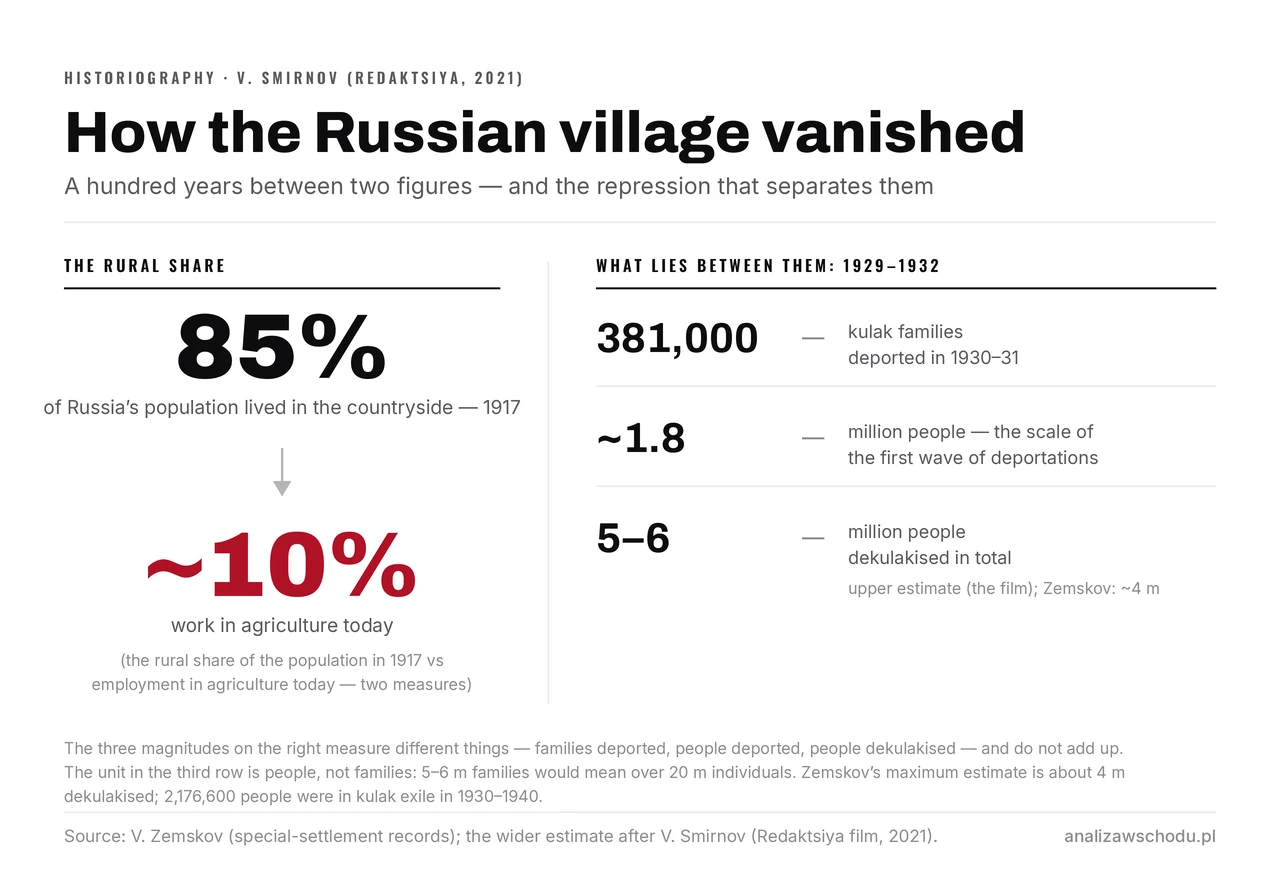
The numbers. In 1917, 85 per cent of Russia's population lived in the countryside. Today about 10 per cent work in agriculture. Between those two figures lie the dekulakisation and collectivisation of 1929–1932. Three hundred and eighty-one thousand kulak families were deported then — more than 1.8 million people. In total, according to the historians Pivovarov cites, five to six million peasant families were dekulakised. It is the largest Soviet repression and the least discussed. The reason is simple and brutal: peasants did not write memoirs.
Who was a kulak? The myth of the kulak as a usurer is party propaganda. In practice a kulak was a man with two horses, a dozen or so head of cattle and a few hired hands at harvest. A rabotyaga, a grafter. Soviet power extended the word to anyone with initiative, a hired labourer or a lease — and to priests.
And now the most important thing: why. Because it explains all the rest. Collectivisation followed from industrialisation. The state needed grain to sell for hard currency and buy Western factories. The Great Depression of 1929 closed off credit — the West would not lend, and they did not make advanced technology themselves. What was left was the confiscation of food as currency. Stalin, in Kamenev's record of it, put it without ornament: "Capitalism grew either through colonies, or through loans, or through the exploitation of workers. We have no colonies, loans are not given to us — so our foundation is the tribute from our own peasantry."
Tribute from our own peasantry. Our own as raw material. And a relationship older than the Bolsheviks. In the patrimonial Russia Richard Pipes described, the peasant was never a citizen — he was a resource of the state, property of the throne on a par with the land. The revolution did not invent the tribute. It inherited it.
There was another road. The abolition of serfdom in 1861 freed the peasants but granted the land not to the individual but to the commune, the village obshchina; the peasant stayed bound to it by redemption payments spread over nearly half a century. The missing step — the move into ownership — was completed only by the Stolypin land reform of 1906, which for the first time genuinely allowed a man to leave the commune and set up a holding of his own, a khutor, and which cancelled the redemption payments. The historian Smirnov, in Pivovarov's film, puts the counterfactual hard: "If the Stolypin reform had been carried through to the end, no October could have happened." That road was not finished. The tribute was chosen instead.
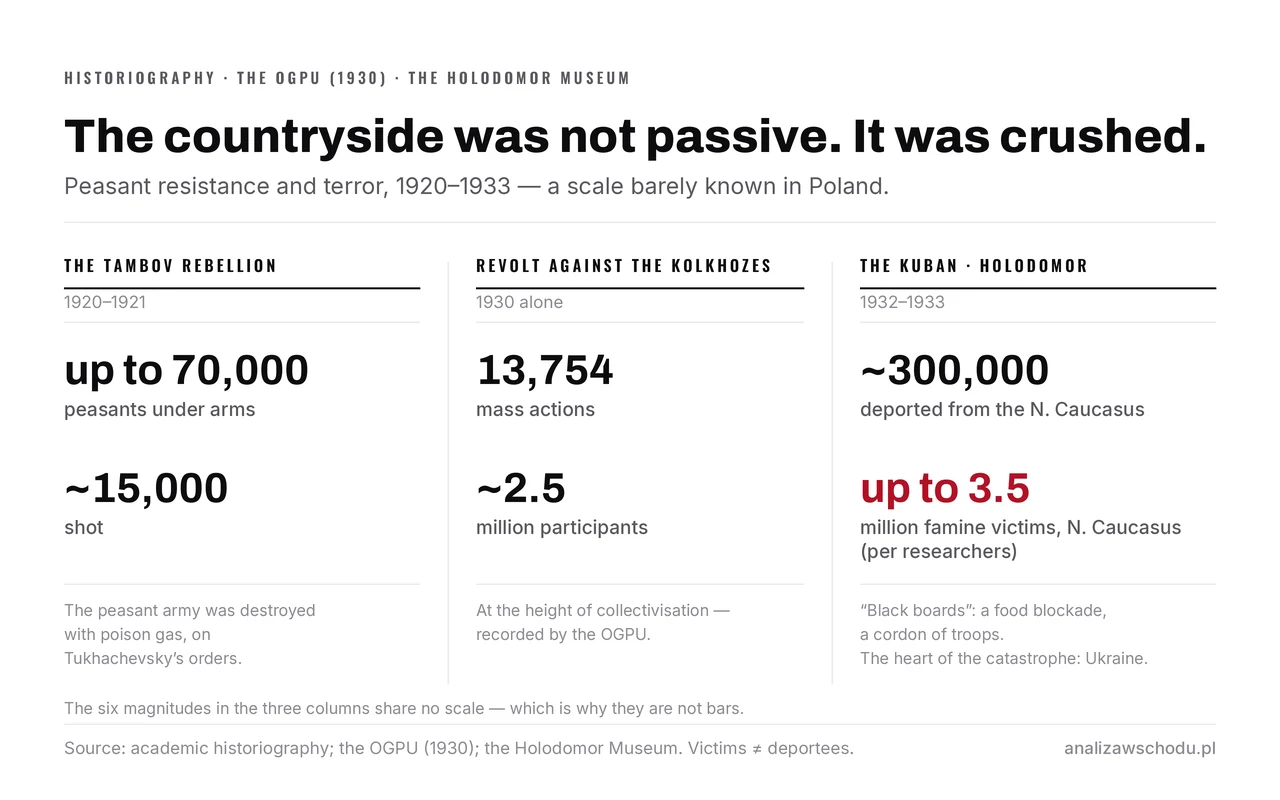
And the peasants did not give in without a fight — this is the part of the story barely known in Poland. When the Bolsheviks began taking grain by force, the countryside took up arms. The Tambov Rebellion of 1920–1921 put a peasant army of up to seventy thousand men into the field; the Red Army crushed it with poison gas, on Tukhachevsky's orders, shooting around fifteen thousand and deporting their families to camps. And that was only the overture. In 1930 alone, at the height of collectivisation, the OGPU counted 13,754 mass peasant actions — close to two and a half million participants. The countryside was not passive. It was crushed.
Where resistance was hardest, the punishment was heaviest. In the Kuban, rebellious Cossack stanitsas — the large Cossack villages — were entered on the "black boards" — a total food blockade, a cordon of troops, a ban on leaving the village. A stanitsa surrounded and stripped bare was sentenced in this way to death by starvation; famine stopped being a disaster and became an instrument. Some three hundred thousand people were deported from the Kuban and the North Caucasus, and the great famine of 1932–1933, whose heart was Ukraine — the Holodomor — killed millions, including, according to researchers, up to three and a half million in the North Caucasus alone, chiefly in the Kuban. De-Cossackisation and collectivisation are one and the same tribute, collected down to the last grain.
Let us remember that mechanism: when the state faces a choice between developing initiative and squeezing it out for a higher priority — it chooses the squeeze. That reflex belongs not to one leader but to the whole structure. We shall come back to it a hundred years later, in the soya fields of Primorye.
The Russia preserved abroad
The peasants who were liquidated in Russia could be seen alive in 2020. In Brazil.
The Old Believers fled in waves. After Nikon's schism in the seventeenth century — eastwards. After 1917 — to China. After the communists came to power in China — to Brazil, Bolivia, Argentina. In South America they put down roots and preserved what no longer existed in the homeland: the language of the early twentieth century, the faith, the structure of the community and — this is the heart of it — a kulak, almost Protestant way of thinking about economics.
Pivovarov says it outright twice in the first film: I did not fly to Brazil, I flew to Russia. To the one that vanished a hundred years ago with the revolution.
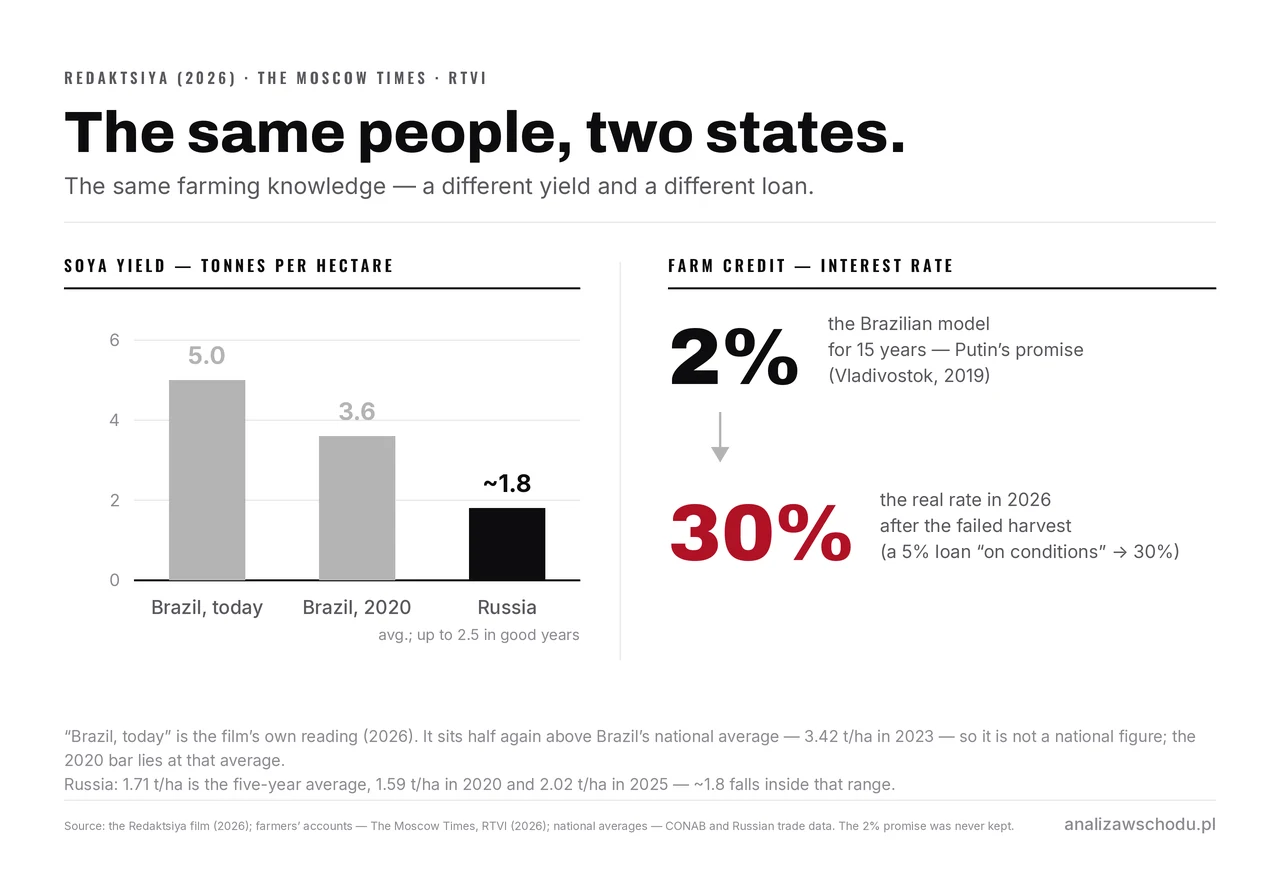
The strongest proof is the soil. Land in the state of Goiás was worthless in the 1970s — acidic, and an agronomist ruled that it was unfit for sowing. The Old Believers brought lime from Paraná, twelve hundred kilometres, and spent twenty years deacidifying it. Today land in Goiás costs more than in Paraná. Soya — 3.6 tonnes a hectare in 2020, five today. The father of one of the farmers once told his son: in ten years this land will be worth as much as it is there, or more. It took twenty. But it happened.
That is a twenty-year investment cycle. Thinking in generations, not in seasons. The ethnographer Olga, whom Pivovarov quotes, names the thing: "Self-reliance — which Soviet power finished off completely."
In one country it was finished off. In the other it survived in a few dozen families. And those families decided to come back.
The return
From the 2010s some Old Believer families began returning to Russia under the resettlement programme for compatriots, tailored specifically to them: simplified citizenship, land in the Far East, agricultural credit. In 2017 Putin met Metropolitan Korniliy, the head of the Russian Orthodox Old-Rite Church — and the programme accelerated. Governors began to intervene personally. Avraam Kalugin, the central figure of the whole cycle, was given the Primorye governor's personal number.
It is worth pausing here. The state is using a minority Church as an instrument of soft power. A photograph with the Metropolitan, an accelerated programme, a telephone line to the governor — all of it is the symbolism of our own coming back. Our own are coming home. In image terms, priceless. On the scale of the country it is a handful: more than fifty families came to Primorye from Brazil, Uruguay, Bolivia and the United States, around a hundred children. That is enough for a television story about a historical homeland.
In 2019, at a meeting in Vladivostok, Putin personally promised these people special support — credit at two per cent a year with deferred repayment. Exactly the Brazilian model. Five years later those two per cent will have become thirty.
Avraam moved into the village of Zharikovo in the summer of 2021. He spent two months looking for a place, travelled the country and chose a village with Old Believer lineage. He said he felt at home there, though he had never lived there. He and Polikarp Anfilofyev received a grant — fifty million roubles, non-repayable, for machinery, on condition that yields rose by ten per cent a year.
The purest voice of this ethos is not Avraam but Agrippina, a cheesemaker outside Blagoveshchensk who came from Bolivia. Forty-five to eighty kilograms of cheese a day, three people, twenty-hour days. She said one sentence worth hanging over every conversation about the Russian mentality: "I came from a country where nobody ever gives anybody anything. And here, for some reason, people are forever waiting for something from the state."
That is the anti-paternalist ethos in its pure form. You took the land — you have a plan for it. And that ethos is about to hit a wall.
The collision
The second film, 2022, four months after the invasion. Alongside Avraam's enthusiasm Pivovarov shows a family that arrived a decade earlier — the Murychevs, from the cut-off village of Dersu. And here falls a word Pivovarov coined that is worth remembering — not because it explains anything, but because it exposes a trap: russkaya khton, the Russian chthonic. "Why do Russians find it so hard to get along with one another, why does it always spill over into a heap of entirely unnecessary conflicts," he asks, and admits himself: "It does not often happen that I have nothing to say about the causes — but these I have not understood for myself to this day."
Let us stop on that. Here is a sharp, structurally minded Russian journalist — and standing over a specific fraud and a specific debt, he reaches for "the chthonic", the vague fatum of the Russian soul. This is not his weakness but a reflex Russians share with the West: to explain Russia by its mystery when patience with institutions runs out. The myth of "unknowable Russia" is so effective that even those who know it from the inside are caught by it.
And it is enough to look one level down. What sounds like fate has concrete names: a court that sides with the stronger party, a bank that raises five per cent to thirty, an arrangement in which one man's initiative turns into another man's capital. No chthonic anything — a structure. And it comes into view at once.
What happened to the Murychevs. Their cows were poisoned. Their house was set on fire twice — the case was closed, "children were playing". But the key figure is Mikhalov. A businessman from Vladivostok, who presents himself as an Old Believer, talked them into a joint business — leasing machinery, credit, a cooperative. All the paperwork on his side, the Murychevs only worked. When the loans began to fail, it turned out that it was they who were down for a hundred and forty million roubles of debt. Mikhalov went to court: I am taking everything. Yelisey Murychev died of a heart attack brought on by the stress in early 2022. The debts passed to his sons.
This is a figure worth naming: the post-Soviet predator-businessman, who turns a newcomer's initiative into capital of his own and leaves him the risk. Pivovarov's comment is short: Primorye, we all remember what went on here in the nineties.
And one more image from that film, because it says more about the system than ten analyses. For aid to reach the Old Believers in Dersu in 2017, a helicopter belonging to a Rosneft vice-president had to fly into the village with forty-five million roubles for machinery. In a gigantic state, for aid to reach a few dozen families, an oil company's helicopter is required. Aid here works not like a system but like a lottery of patronage.
Five years on
June 2026. Pivovarov promised to come back after three years and came back after four. And a few months before his arrival the thing nobody wanted to say aloud in 2022 happened: Avraam Kalugin and several others came to Moscow to ask for help. Not for money. Not for a write-off. For the restructuring of their debt to be spread over time. They also recorded a public appeal — among others to German Gref, the head of Sber — which went round the Russian media: The Moscow Times, RTVI, the Primorye press. So we do not know this story from Pivovarov's film alone; it is a documented crisis, independently described.
Avraam's balance after five years: seventeen million roubles of debt plus twenty-three million of investment credit. In 2024 the flood came — forty days of rain, the biblical forty days — and the soya did not yield. It was not only his bad luck: the downpours destroyed crops across Primorye, where soya is two thirds of what is sown, and to the losses were added low world prices and a twenty per cent Russian export duty. There was nothing to repay the loan from. Rosselkhozbank agreed to a restructuring, Sber did not. "I am losing everything, absolutely everything," Avraam says of what he arrived with in 2021.
Denis Kuznetsov took a loan at five per cent. On conditions. When, after the failed harvest, he began to miss the deadlines, the loan jumped to thirty per cent. And this was not an isolated case: in accounts from early 2026 all these farmers speak of rates "above thirty per cent a year", and nobody mentions the two per cent promised in 2019 any more. Altogether the family carries sixty million roubles of obligations. Soya is cheap on the world market, the Chinese are not buying, Brazil has a surplus. A combine with a hopper costing almost sixty million "looks like it is made of gold".
And here all the threads come back at once. Denis Kuznetsov, looking at his own acidic fields giving 1.8 tonnes of soya a hectare where Brazil gives five, says exactly what Brazil did a quarter of a century ago: "In Brazil they gave credit at 2 per cent a year, for 15 years, for deacidifying the soil. And it helped raise yields, and it helped the farmers grow rich. I think a plan like that would do the whole of Russia good."
A soil deacidification programme existed in the USSR. Brazil has one today. Russia does not. Not because it cannot. The Soviet Union could, Brazil can, an economy far poorer than Russia's can. The capacity is there. The decision is not. Which means the absence is not fate — it is a choice. The same choice that a hundred years earlier ordered the tribute to be squeezed out instead of khutors to be built.
The youngest of them, thirty-year-old Kalin Kuznetsov, settled in the dead village of Grushovoye — five hundred metres from the fields, nobody to get in the way. Someone poured sand mixed with ash into his tractor's engine through the filler cap. The engine seized. Five hundred thousand roubles to repair. Earlier his windows had been shot at with an air rifle. The police "know who, but won't say". Kalin explains it in one sentence that is the title of the invisible chapter of this whole story: "In Russia they don't like people with initiative." Pivovarov adds: there was a separate episode about that.
In the background — the war. The local young men have gone to the front, the village empties faster still. The big agricultural holdings make money, the small ones do not. The army jams GPS, so the Old Believers go back to marking rows with a chain, the method of a century ago. And the Old Believers' sons are not being conscripted for now — thanks to a letter from Metropolitan Korniliy to the Ministry of Defence, with names, every six months. Except that, as they say themselves, the programme "starts slowing down every time". "They have plenty to worry about in Moscow with this whole situation," they shrug. A protection that depends on one letter and one meeting from 2017 is exactly as durable as the attention of a state that now has other priorities. Our own are safe for as long as they are convenient.
Not everything is decay. In the village of Dersu, a hundred per cent Old Believer, there is only one telephone — a payphone wired to a satellite dish. The inhabitants deliberately do not want the state to put up a mobile mast. Pivovarov addresses the operator directly: "If any representatives of Rostelecom are listening to us now — we very much ask you not to switch off that payphone, because it helps the Old Believers preserve their hermetic quality." The village is growing, they are putting up new houses, the prayer house is open every day. Digital detox as a condition of a culture's survival.
But the language is already going. The children are shifting to urban Russian. The Old Believer zdorovo zhivyosh ("well may you live") is giving way to the townsman's dobry den ("good day"). After five years "at home", what survived a hundred years in Brazil is starting to dissolve in Russia.
Our own as raw material
Let us put it together. A hundred years ago the Russian state treated its own peasantry as tribute — raw material to be squeezed out for the sake of a higher goal. It liquidated initiative at the source and never rebuilt it. A handful of that initiative survived at the other end of the world. The state brought it back — because, in image terms, "our own are coming home" is priceless — and left it to the same structure that finished off its forebears a hundred years earlier. Banks raising five per cent to thirty. Courts on Mikhalov's side. Sand in the engine. The absence of a programme that any serious economy can afford. Protection dependent on a single letter.
"We don't abandon our own" is a sentence off a tank. In the soya fields of Primorye it means the opposite: we bring our own back when they are a symbol, and abandon them when a cost has to be borne.
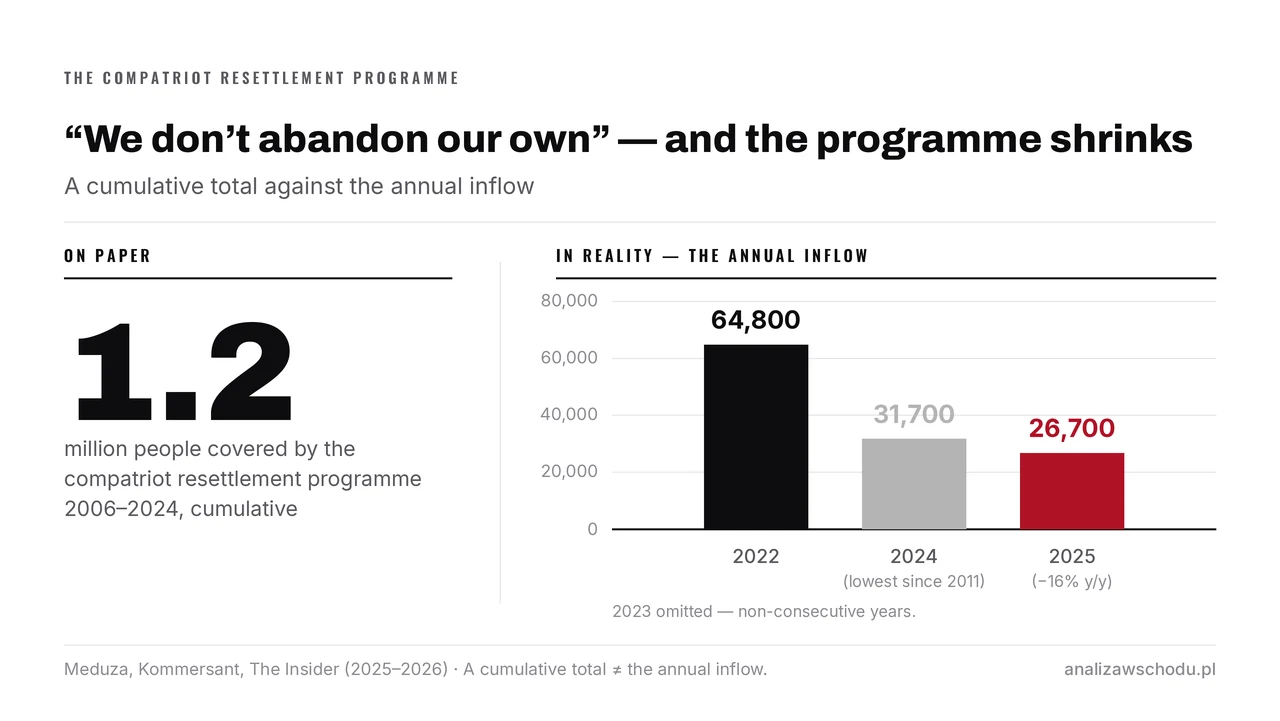
The scale tells the rest. Since 2006 the resettlement programme for compatriots has covered more than one million two hundred thousand people — impressive on paper. But in 2024 thirty-one thousand people came to Russia under it, the fewest since 2011. In 2025 — twenty-six thousand, sixteen per cent fewer. A state that brands its war as care for its own has a programme for bringing its own back that shrinks year after year. Avraam Kalugin is not an exception to that statistic. He is its face.
Three things, so as not to overstate. There is no conspiracy here — nobody planned Avraam Kalugin's downfall; a structure is at work, not an intrigue, because institutions that can service RusAgro were not built for a farmer with sixty million in debt. And since the state has the capacity to do otherwise, its inaction has to be read as a decision, not as bad luck. The Old Believers are not angels either: they have ordinary faults, part of the conflict with the locals is also their own doing, and Pivovarov honestly does not smooth that over. Finally — this is a diagnosis, not a programme. Pivovarov does not write policy demands and neither shall I.
And yet the counterfactual question remains, and it is as hard as the soil of Goiás before the lime. These same people, with the same cultural capital, turned worthless land in Brazil into some of the most expensive in the country in twenty years. What they needed for it was two per cent over fifteen years — and a state that does not get in the way. They got both. In Russia they got thirty per cent, a flood with no insurance, Mikhalov and sand in the engine.
Russia does not need to bring its own back from Brazil. It needs to stop grinding down the ones it already has.
First published: X Article (in Polish), 13.06.2026
Cite as: Denis Salnikov, “"We don't abandon our own": the story of the Old Believer returnees”, Analiza Wschodu, 13.06.2026, https://analizawschodu.pl/en/articles/old-believers.html
Text © Denis Salnikov. Quotation with attribution and a link is welcome. To reprint a full text or reuse a chart, write to ds@analizawschodu.pl
* Graphics marked with an asterisk are mood images and may contain AI-generated elements. Charts, timelines and tables carry no asterisk — their figures come from the sources named beneath them.