The Code of the Woods: how the Russian state issues football hooligans a licence for violence, and takes it back
· Denis Salnikov
The Russian state does not allow an organised group capable of violence to have agency of its own, whether the group is football hooligans, "Española" or Wagner. It needs such groups all the same, because formally non-state violence gives it what the army cannot: deniability abroad and a picture of grassroots commitment at home. So the group is given exactly enough freedom that the state can disown it or call it the voice of the people, and nothing beyond that. I call this arrangement a licence, and football hooligans are its least described case.
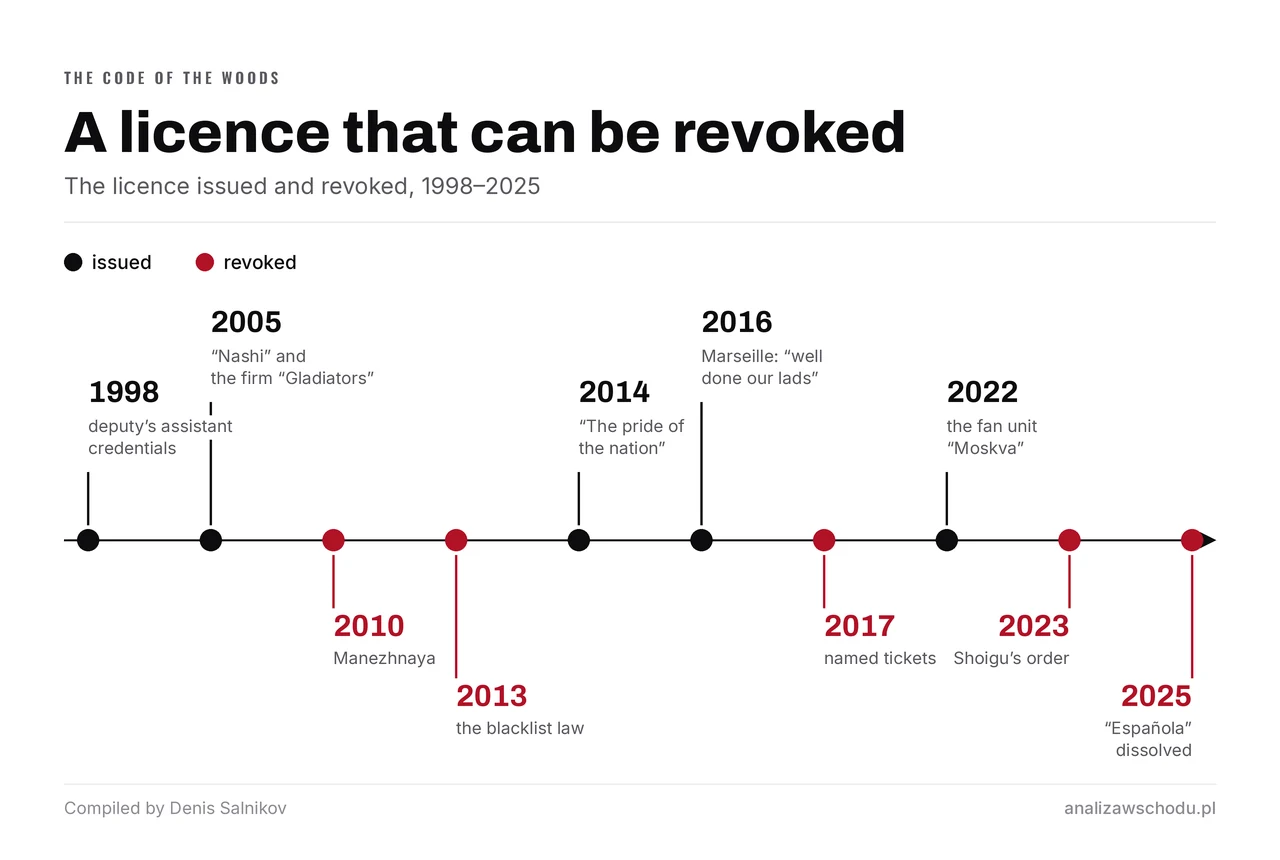
In March 2017 the deputy speaker of the Duma, Igor Lebedev, proposed turning football hooligans' arranged fights into a sporting discipline: twenty against twenty, no weapons, in an arena, "Russia would be a pioneer of a new sport". Eight years later the best-known hooligan formation of this war, "Española", was dissolved, and in December 2025 its commander died at his dacha in Sevastopol during an arrest by armed officers. Over those years the state tolerated the hooligans, then praised them, then throttled them with blacklists, named tickets and the attention of the FSB, then sent them to the front, and finally began taking back what it had given them itself.
The cult of clean hands
In the late 1990s Russian firms fought each other with rebar. The CSKA hooligan Sergey Plynin recalled in 2020 ambushes "with bars" — lengths of reinforcing rod — and said that after the riots around the match against the Ukrainian national team in 1998 "this gradually began to fade", and later fights went "without arguments" — the movement's word for weapons.
On 15 April 2000 in St Petersburg, during a clash between fans of Dynamo Moscow and Zenit in which, according to its participants, "there were many hurt by stones and bars", the fifteen-year-old Vitaly Petukhov was killed. Vladimir Kozlov, in his 2008 book Fans. The past and present of Russian okolofutbol ("Фанаты. Прошлое и настоящее российского околофутбола"), treats that date as the turning point. From then on the scene settles into what Kozlov's interviewees call "the cult of clean hands": you fight with fists and feet, no knives, bottles or stones, and a firm that reaches for a weapon loses its reputation with the rest. Ivan Katanayev admits that the slogan "the Russian style" ("Русский стиль") was easier to sell to the young than the English "fair play".
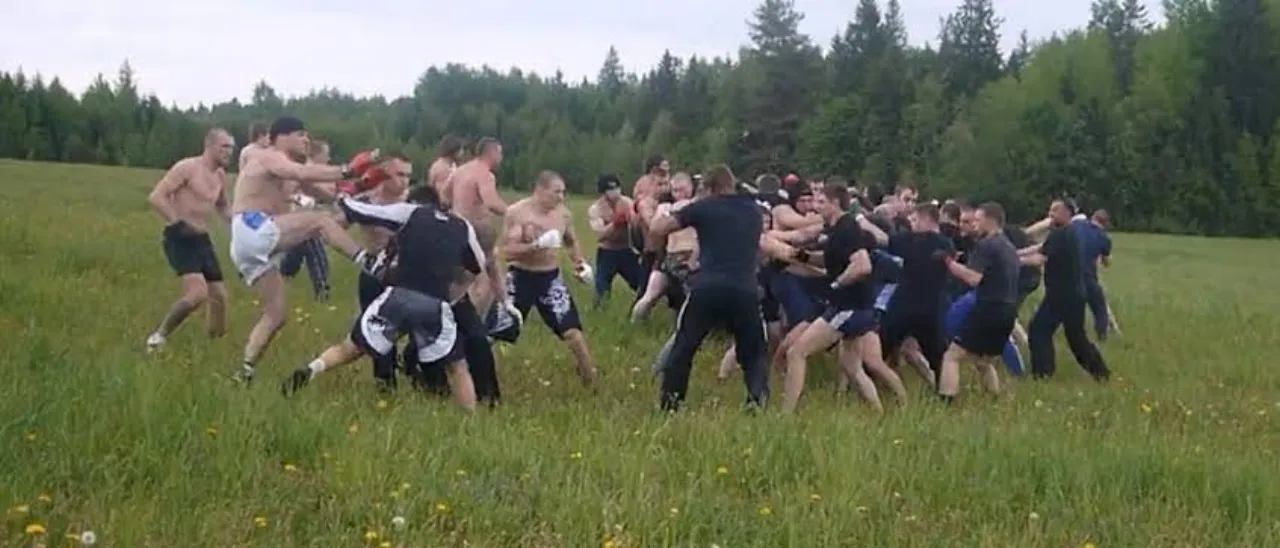
The code did not hold everywhere. The report Xenophobia in the youth milieu, prepared in 2009 with support from the Moscow Helsinki Group, describes the Volgograd firm "Nordland" as "famous" for rubber-bullet pistols: after its clash with the Rostov firm "UNG88", five Rostov residents ended up in hospital with gunshot wounds. Firms like that usually became persona non grata in the scene and took beatings even from their own side.
An arranged fight in the woods has equal numbers, an agreed place, a recording and a ranking, so a passer-by stops being a target. The line-ups draw people from boxing, wrestling and combat sports, and without regular training nobody stands in the front line. Julia Glathe, a sociologist at the Institute for East European Studies at the Free University of Berlin, describes that shift as a move towards a subculture that rejects alcohol and drugs and practises an intense cult of fitness; the earlier violence of the terraces went hand in hand with heavy drinking. A drunk lost in the woods and made his whole firm look ridiculous, so drinking was dropped for practical reasons. The portal ftbl.ru wrote in 2013 that members of firms "most often go to work or study" just as their peers do.
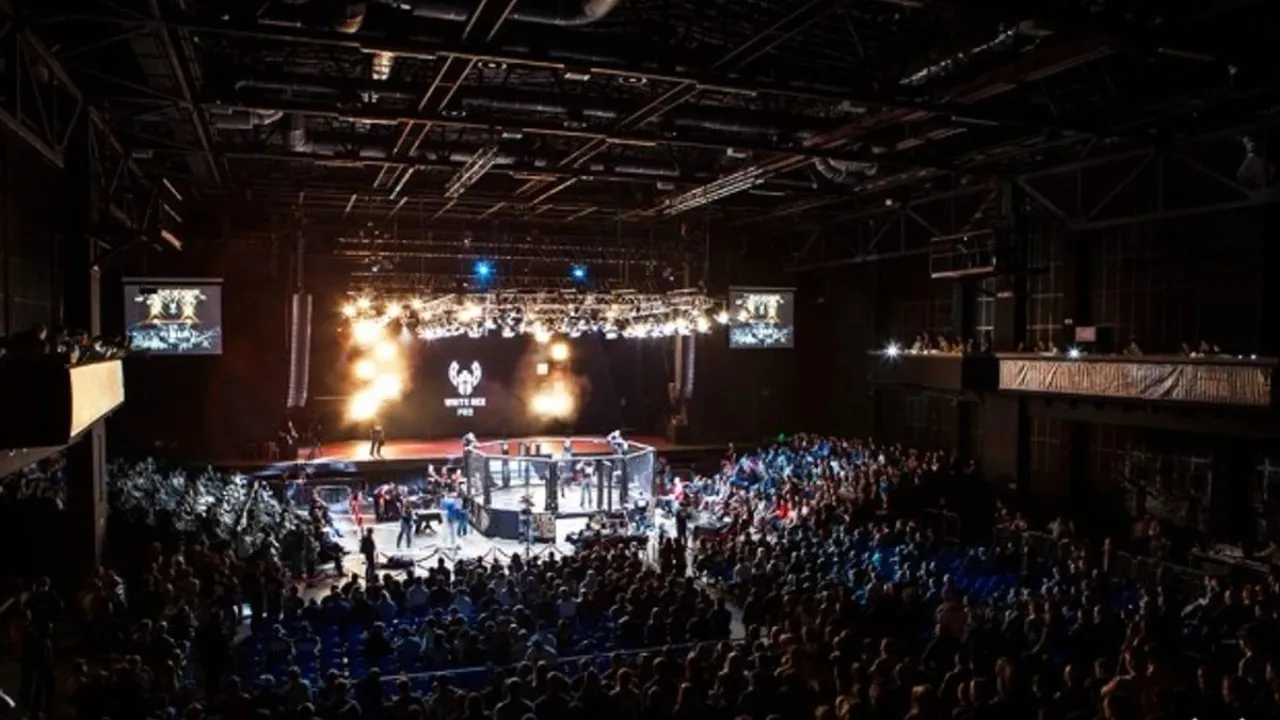
The same ideal of the strong, sober man was promoted by the far right. The clothing brand White Rex, founded in 2008 by Denis Kapustin — raised in the hooligan milieu of Cologne, and in Moscow in "Yaroslavka", CSKA's leading firm — ran MMA tournaments called "Spirit of the Warrior" ("Дух Воина") from 2011. The first, according to Kapustin, drew up to two thousand spectators, and later events were already being shown on Russian television. Glathe describes how by 2014 the MMA tournaments were promoted among hooligans on the fan network Fans Edge. The researchers Rene Nissen, Kiril Avramov and Jason Roberts write that MMA professionalised street violence and turned it into a spectacle. Men who fought at "Spirit of the Warrior" were, a dozen or so years later, commanding "Española" assault troops — among them, according to Kapustin, Mikhail "Pitbull" Turkanov.
A firm with nothing to sell
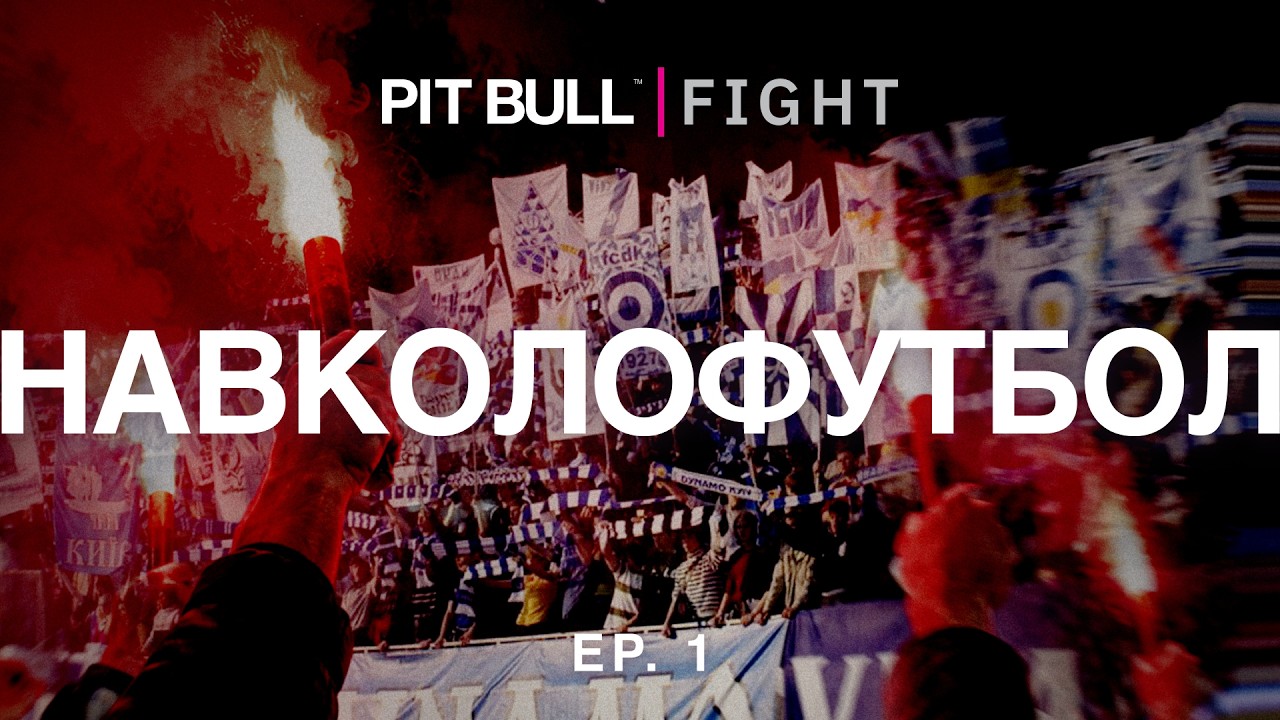
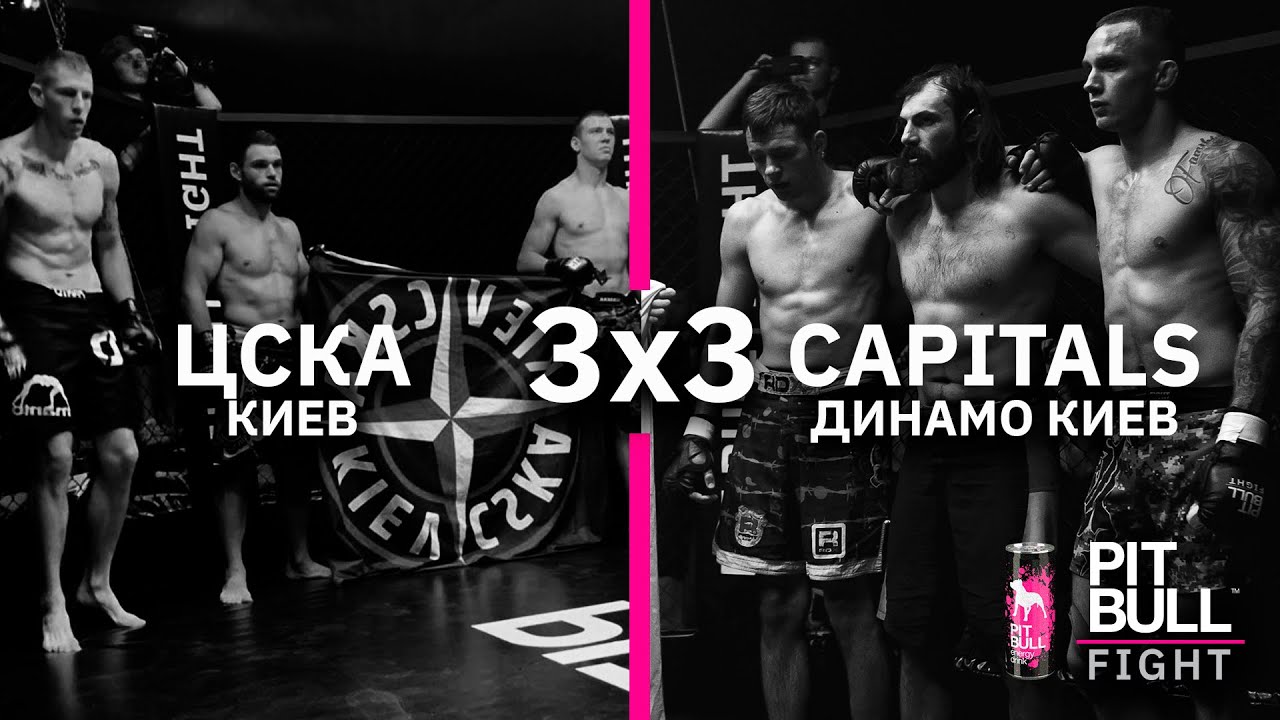
Ukrainian hooligans in the documentary series "Pit Bull Fight", released in autumn 2026 by a Kyiv combat-sports promotion, tell the same story in almost the same words: fifteen-against-fifteen fights, wrestlers in the front line, "a drunk does not go out to fight", a sport that "sifted out" the casual ones. The Code of the Woods applied across the whole post-Soviet space, and the paths diverged later, depending on what the state did with the scene.
 RecordingYouTube
In several countries of Central Europe and the Balkans, the milieus that grew out of the terraces moved into the drug trade, debt collection and the protection of venues. This went furthest in Serbia. According to a 2022 report by the Global Initiative Against Transnational Organized Crime, groups that grew out of the capital's terraces cooperated with a Montenegrin cocaine clan, a gang war claimed more than 60 lives after 2016, and in 2021 thirty people from the circle of one of the leaders were arrested on charges of murder and drug trafficking. The same people maintained contacts with the police and sometimes worked as security at state ceremonies.
I have not heard of comparable sentences for Russian firms, and the academic and journalistic work I have reviewed does not take the subject up either way. In conversations with people from several Russian firms I did not come across one that lived off drugs or off protection. A firm without its own money and its own muscle has to look for a patron. A movement with a business of its own the state deals with through the prosecutor's office; a movement without a business it can offer something in exchange for obedience.
Patrons
Aleksandr Shprygin, the leader of the Dynamo Moscow fans, joined the LDPR in 1998. After Zhirinovsky's death he recounted that the party leader had met at the time with the leaders of the Dynamo, CSKA and Spartak fan movements, and that "each of them had the credentials of an assistant to deputy Zhirinovsky", which protected them from the police. Dynamo, he said, Zhirinovsky helped in particular. In 2007 Shprygin took charge of the All-Russian Fans' Union, created under the aegis of the Russian Football Union, then chaired by Vitaly Mutko, who a year later became minister of sport. He did not hide his views. In 2015 he said he would like to see "Slavic faces" in the national team, and according to Novaya Gazeta he argued in the media that "all fans like the idea of white power".
In 2005 the fans also found a patron for beating up the opposition. On 5 March the Spartak firm "Gladiators" wrecked the Moscow headquarters of Eduard Limonov's National Bolshevik Party, and Oleg Kashin wrote in Afisha, citing anonymous skinheads, that the firm "joined in full" the pro-Kremlin youth movement "Nashi" ("Ours"), run by Vasily Yakemenko.
On 29 August masked men with sticks and rubber-bullet pistols attacked National Bolsheviks near the Avtozavodskaya metro station. The police stopped their bus and took down the names of 25 people, whom they then released on orders from above, leaving the driver, Roman Verbitsky of "Gladiators", off the list because, as the officers put it, he "very convincingly promised to have us stripped of our epaulettes". Kommersant later established that Verbitsky and the "Gladiators" leader Vasily "Killer" Stepanov had served for several years in the "Voluntary Youth Druzhina" of "Nashi", and that Verbitsky was still running it in 2009. The same paper noted that "nobody has managed to prove the involvement of the leadership of 'Nashi' in these actions".
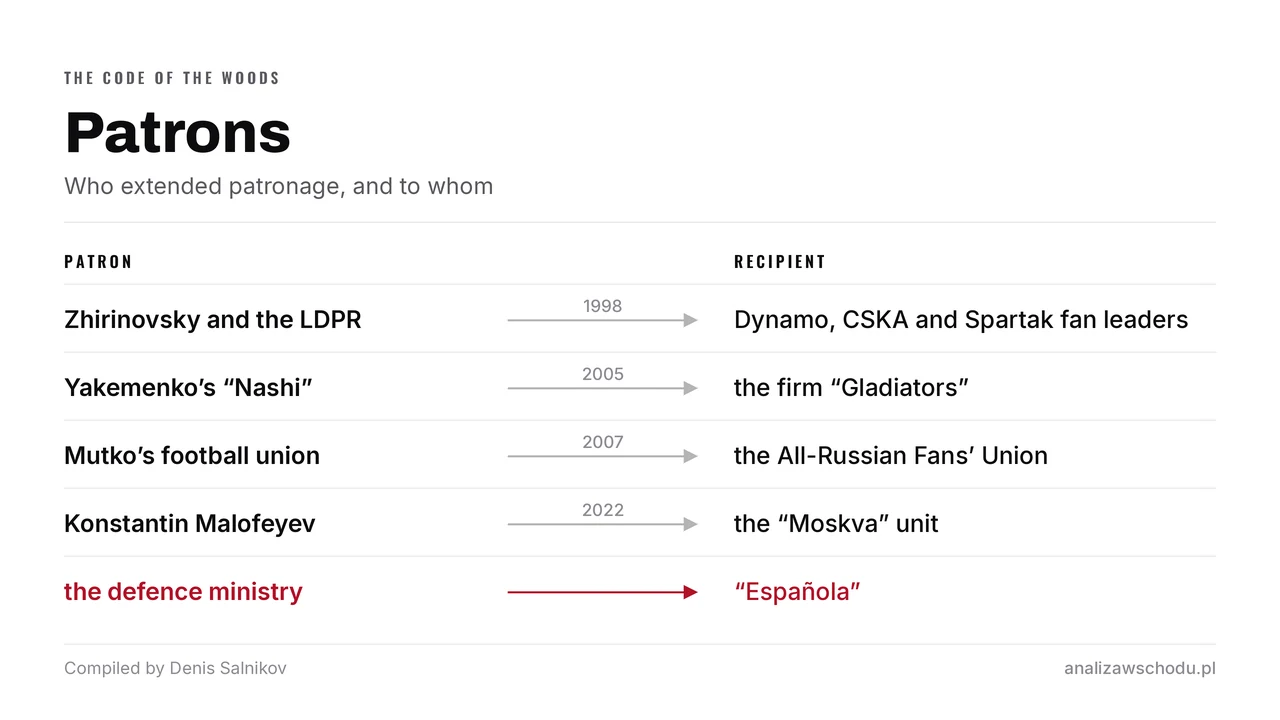
On the CSKA side, a similar role was attributed to Aleksey Mitryushin of the firm "Gallant Steeds". An anonymous Kommersant source close to the presidential administration called him in 2006 a commissar of "Nashi" who "is responsible for contacts with fans and provides security at events". His name came back in the testimony of Nikita Tikhonov in the case of the neo-Nazi group BORN, but Novaya Gazeta wrote in 2015 that it had not been possible to confirm that he directed the attacks, and that he was never questioned in that case. Yakemenko himself, as Kommersant reported in 2010, told students in Kursk in the spring of 2005 that if he had to solve the question of the Maidan he "would solve it very simply": he would bring Spartak fans to Kyiv by train. Nobody proved that any order was given, and that is precisely why such violence suited the authorities: it could be disowned.
Ultras made the choreography, had open structures and talked to the club, and through Shprygin's Union also to the ministry. Hooligans fought in the woods and had no address. The state came to terms with the terrace and tolerated the woods.
A megaphone and a wall of photographs
On 6 December 2010 in Moscow, in a fight between Spartak fans and men from Dagestan, Kabardino-Balkaria and Chechnya, the Spartak fan Yegor Sviridov was killed. The shots came from a rubber-bullet pistol fired by Aslan Cherkesov from Nalchik, and the five other men detained were judged by investigators to have no connection to the killing and released, as Radio Svoboda (@SvobodaRadio) reported.
Sviridov belonged to the firm "Union", and in July another Spartak fan, Yury Volkov, had been killed in a fight in Moscow, for which Akhmedpasha Aydayev and Bekhan Ibragimov were charged — so the anger took in the whole scene. On 7 December between five hundred and a thousand fans marched from the prosecutor's office along Leningradsky Prospekt. The day before Manezhnaya, as an anonymous participant in the riots told Kommersant, the police leadership held a conversation with the leaders of the fan groups and "it was said clearly that nobody was to take part".
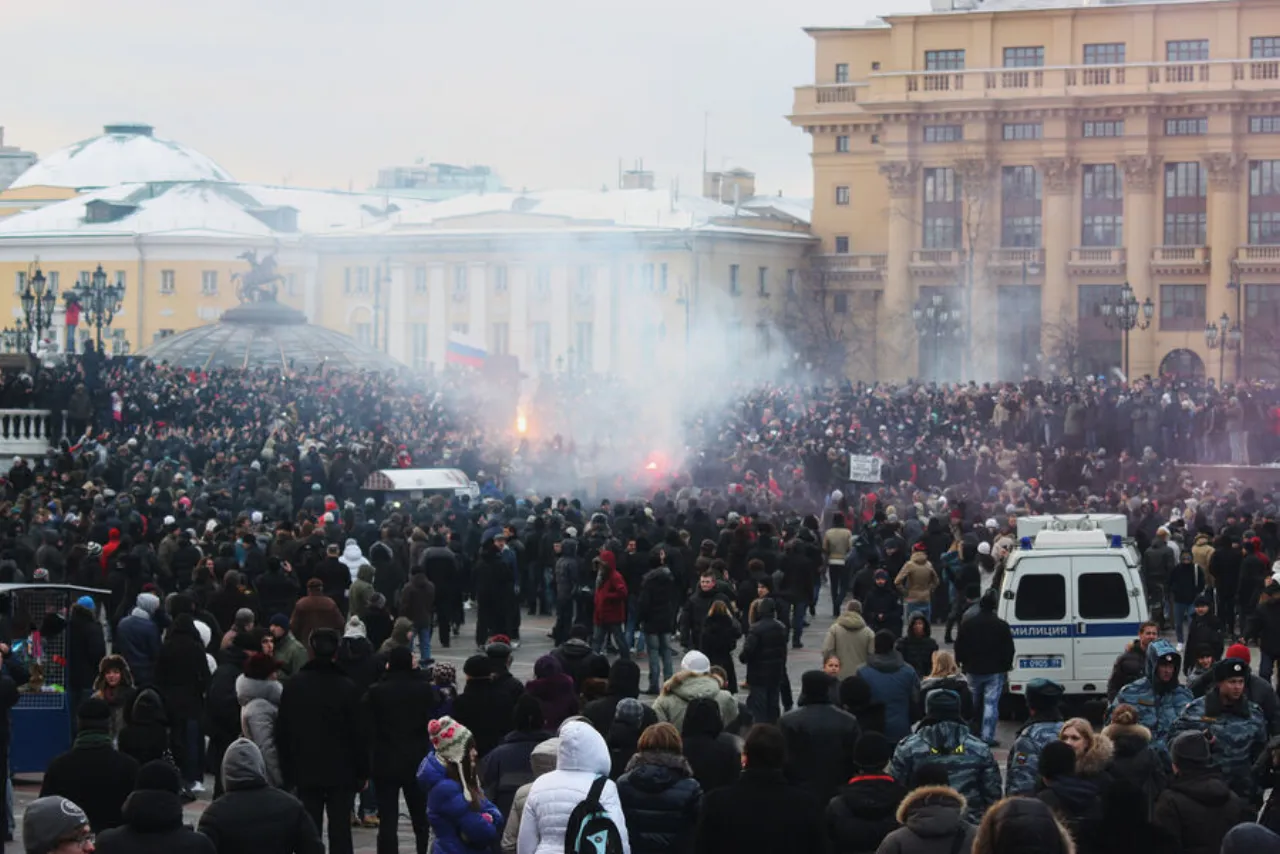
On 11 December the firms laid flowers at the site of the killing, "all the firms, all the unions", as Shprygin recalled in Meduza (@meduzaproject), and as organisations they went no further. An interior ministry officer told the same outlet that the conversations had been "held with everyone" and that on Manezhnaya "there was not a single leader, not a single fan group".
On Manezhnaya Square beside the Kremlin, five thousand people gathered according to the police, by unofficial estimates as many as ten times that, mostly — as Shprygin, who did not go to the square himself, put it — "young people from the suburbs and from outside Moscow" and nationalists, although some rank-and-file members came against the decision of their leaders. Nationalist slogans were chanted, and the crowd beat random people who looked Caucasian; according to the mayor's office 32 people were injured, eight of them OMON officers.
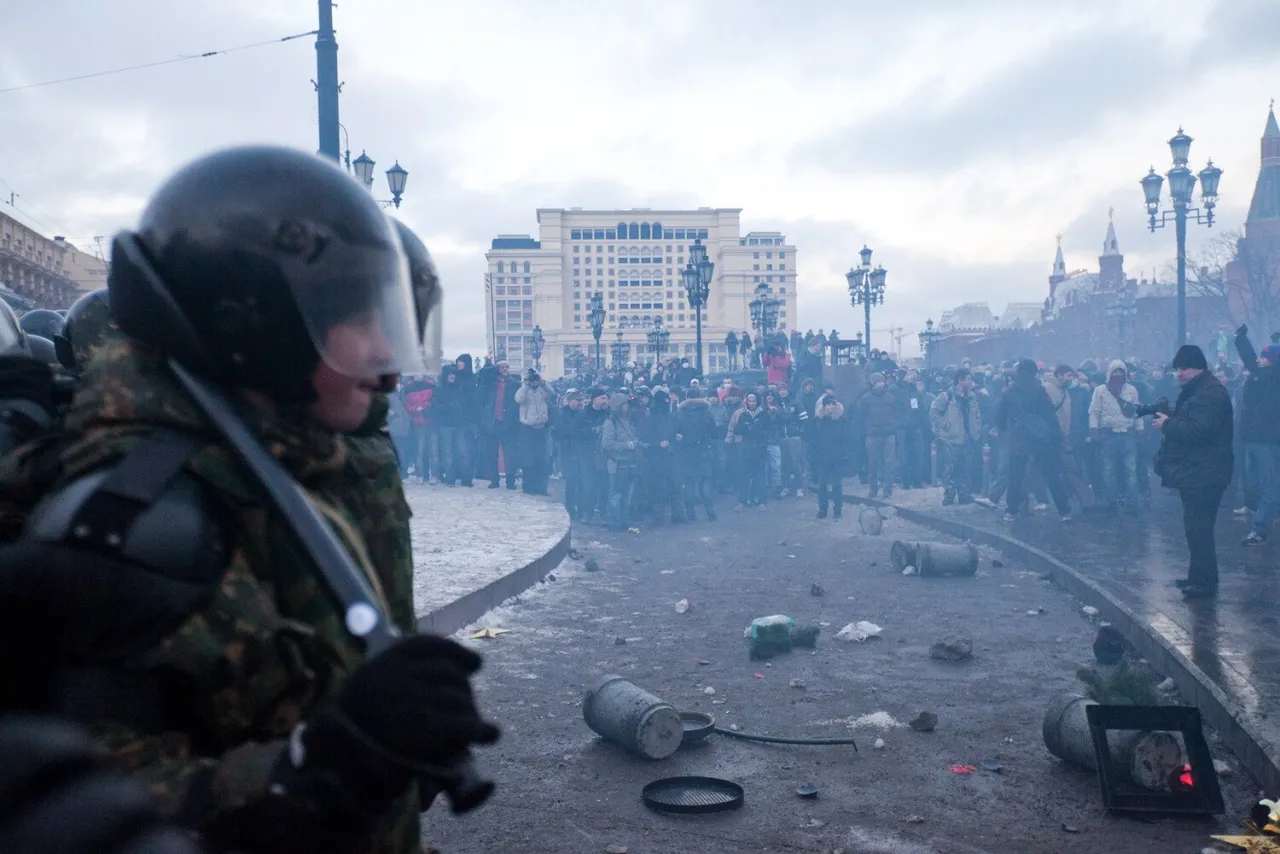
The head of the Moscow police, Vladimir Kolokoltsev, went out to the crowd with a megaphone, and on 21 December prime minister Vladimir Putin appeared unannounced at a meeting of fans at the ministry of sport. He began with a minute's silence, told the fans "I believe you are a force", warned that if they ran around the country with that force "like madmen with a razor" they would destroy it, and rode with them by bus to Sviridov's grave. Shprygin maintains that no conditions were set in return, although afterwards, he says, an instruction was in force: "don't touch the fans".
The Yabloko politician Ivan Bolshakov was already writing then of "grounds to suspect collusion between the authorities and certain fan groups". Nobody produced a written agreement. One of the interviewees in Roman Yuneman's film calls it a strategy of "smothering in an embrace". In those same days investigators occupied a school whose walls held thousands of photographs from the square with names written under them, and officers were visiting the homes of the holders of named metro cards used at the stations by the Kremlin. For riots involving thousands of people, nine people were convicted, among them three activists of Eduard Limonov's The Other Russia, as Mediazona (@mediazzzona) counts. Cherkesov was later given twenty years in a penal colony.
Yuneman is a nationalist politician, a co-founder of the movement "Obshchestvo.Budushcheye" ("Society.Future"), and his film explains Manezhnaya by "ethnic crime" and ends on the claim that Fan ID serves to destroy the fan movement. In my view, in December 2010 the state for the first time openly, at the highest level, treated the fans as a party one talks to — and in the same week drew up a list of them.
The list worked immediately. On 15 December the police detained around a thousand people in Moscow who were trying to repeat the riots, and in February 2011, when the "Committee of 11 December" called for rallies on the eleventh day of every month, the square was ringed by a cordon, as Kommersant reported. The screw was tightened in the city, though. In the woods they went on fighting, and hooligan groups on VKontakte published daily tallies of fifteen to twenty arranged fights in the parks of Moscow and the surrounding region, as one of the interviewees says in Ilya Varlamov's 2022 film — Varlamov being an opposition blogger whom the authorities entered in the register of "foreign agents" in March 2023.
Kyiv in the mirror
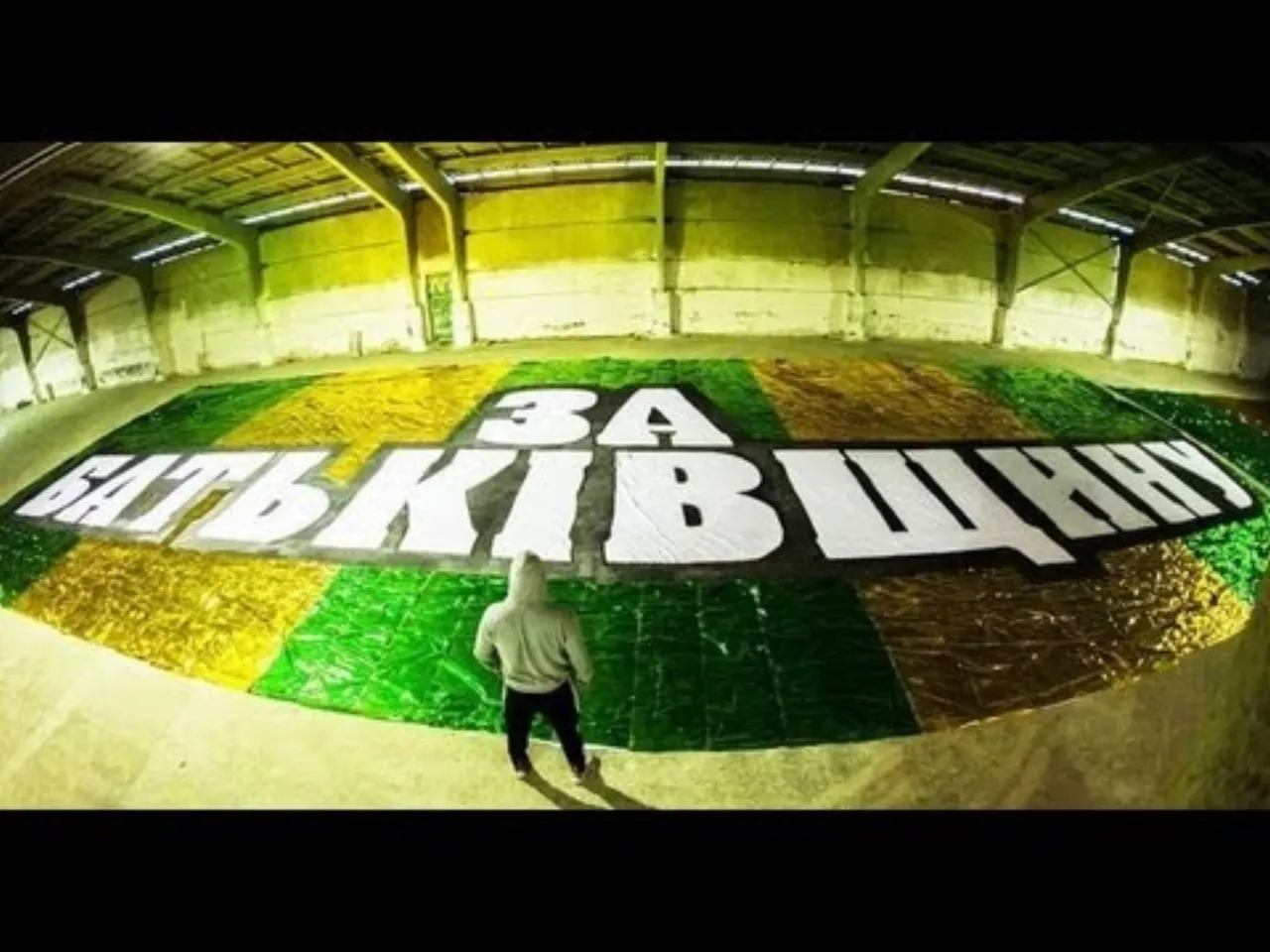
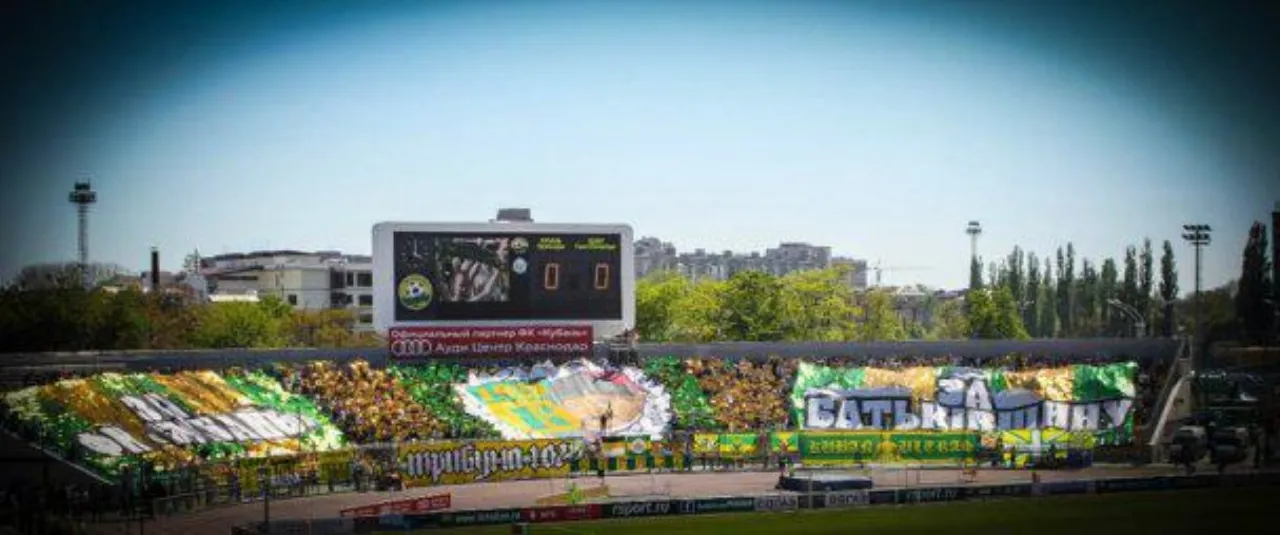
Before 2014 the border with Ukraine was permeable on the terraces. Kuban Krasnodar and Metalurh Donetsk were kept by the same man, Oleh Mkrtchan, co-owner of the Industrial Union of Donbas. His company financed Kuban from 2007, and he was more deeply involved in the affairs of Metalurh Donetsk than its formal president Serhiy Taruta, as a Sports.ru blogger described in 2019. On 28 April 2013, at the match against Zenit, Kuban ultras unfurled a banner reading "For FC Kuban, for the Motherland" ("За ФК «Кубань», За Батькiвщину") in Ukrainian, with a heart and a Cossack, and at the time nobody had a problem with it. The phrase grew out of balachka, the dialect of the Kuban Cossacks, and there was no politics in it.
The Rostov rapper Plotka, from one of the strongest firms in southern Russia, described in 2023 in an interview for the channel "Это Основа" ("This Is the Basis") how in 2012 he travelled with forty men to EURO 2012 in Donetsk and how he fought several times on the side of Metalist Kharkiv, because "they were yellow-blue, we were yellow-blue". At the Kharkiv scene's anniversary three hundred people knew his album by heart, and Ukrainian fans were, he says, closer to him than some Moscow hooligans. The warm relations survived even Crimea, in his account, and ended only around 2018. Today the same man says the Maidan was made by people who were "made dependent on the dollar", and calls Ukrainian propaganda "the highest level of marketing", while still insisting that Ukrainians are "brothers by blood". This is the message of Russian television told in his own words.
In July 2013 the Duma passed the law on safety at mass events, with blacklists and named tickets. On 12 December 2013, at the match against Rapid Vienna, Dynamo Kyiv ultras hung a banner reading "We need a European spring", and afterwards organised night patrols against the titushky — the regime’s hired street muscle — and guarded local Maidans in other cities. Shakhtar ultras called for a boycott of Rinat Akhmetov's club, and on 13 February 2014 rival groups from all over Ukraine signed a truce — a ban on street fights and on burning each other's flags. When the war came to Donbas, and the enlistment offices turned volunteers away, the hooligans went to the volunteer battalions, most often to "Azov". The Ukrainian state first sent them away and then absorbed them through those battalions, and in the eyes of society the "hooligans" became heroes.
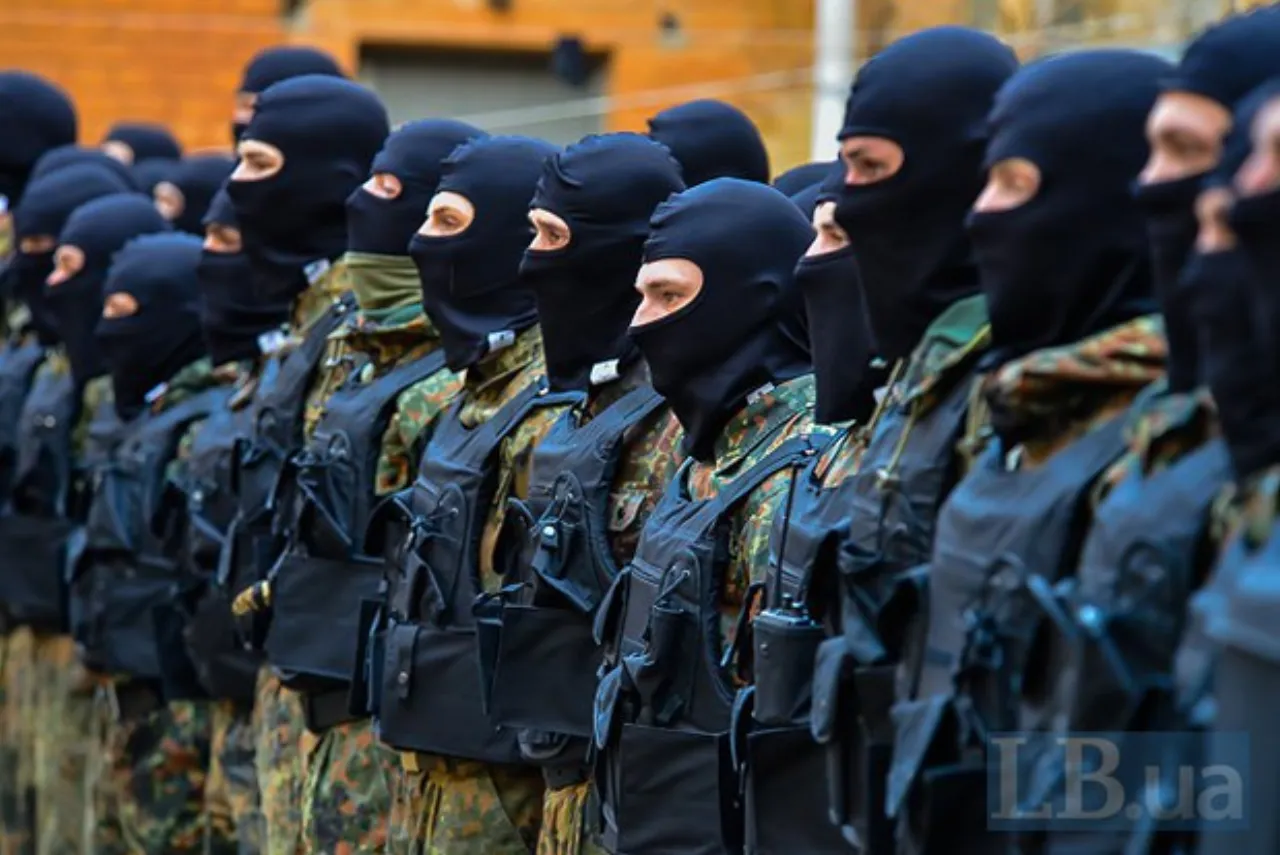
Shprygin later explained the change of approach by events in Ukraine, because in his view the fans had been the strike force of the Maidan. That explanation suits him, because it takes the responsibility off the scene itself, and the law with the blacklists was passed six months before the Maidan. After the Maidan, however, the state began to see in an organised fan a potential participant in a coup.
The Russian scene split in 2014 along a line that had already divided the terraces. CSKA fans were paying UEFA fines for far-right symbols in Pilsen and racist chants aimed at Yaya Touré in 2013, and Zenit had to its name the manifesto "Selection 12" of December 2012, demanding a team without black players. That line, however, also ran through the middle of a single terrace.
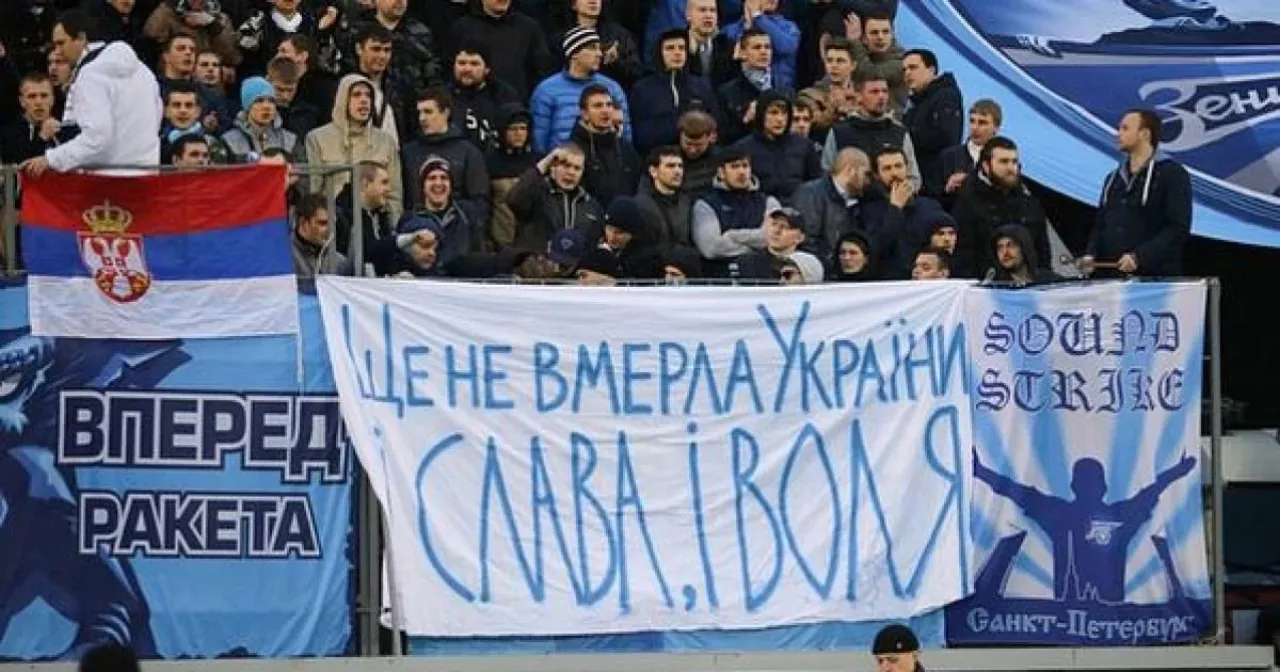
In March 2014 just under twenty Zenit fans flew to Crimea for the referendum, as one of the leaders of the St Petersburg scene recalled in 2024, insisting that "nobody paid them". A week after the referendum, on 24 March, at the match against Krylya Sovetov, a banner appeared on one of the Zenit stands with the words of the Ukrainian anthem, "Ukraine has not yet perished" ("Ще не вмерла Україна"), as the Ukrainian broadcaster TSN reported. Later Zenit fans were taking aid to the "DPR" and "LPR", and Aleksandr "Schumacher" Alekhanov of the firm "Nevsky Front" called Donbas "the Russian Kosovo". From May the first Russian far-rightists were joining "Azov", as Pavel Nikulin wrote in Mediazona.
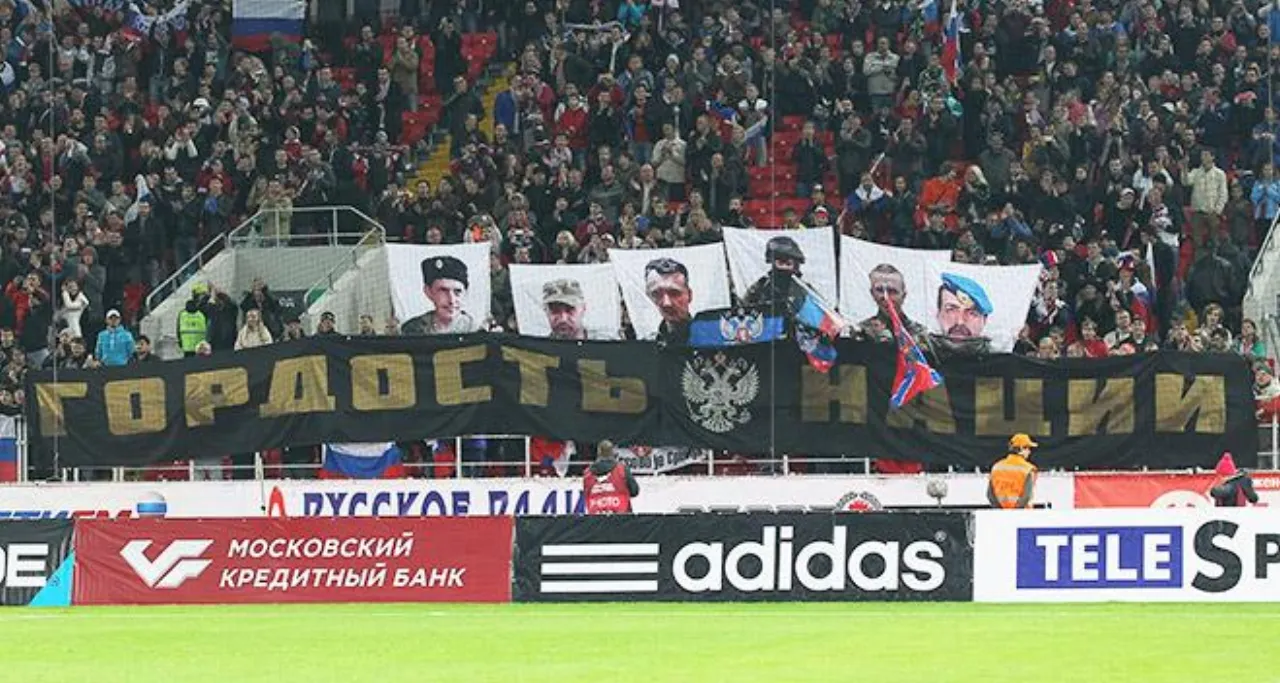
Six months later, support for "Novorossiya" was displayed on the national team's stand — that is, on a state stage. On 12 October 2014, at the match between the Russian national team and Moldova at Spartak's stadium, fans raised in the front row of the stand large portraits of the commanders of the "DPR" and "LPR" formations, among them Igor Girkin, Valery Bolotov and Igor Bezler, under a banner reading "The pride of the nation". Beside them hung the flags of the "DPR" and Novorossiya, as the pro-Kremlin portal Life reported that same evening. After that match, sympathy for Ukraine on a Russian terrace began to be called treason. From what I know from people on the Kuban terrace, Kuban ultras later had to explain themselves over the banner from 2013, although before that nobody had any questions about it.
Outside the stadium the same division lasted longer. The SOVA Center did not record fan groups at the marches of 4 November 2014, but the same nationalist milieu that had stood on Manezhnaya four years earlier was marching. The march against "Novorossiya" was, according to SOVA, one and a half times larger than the march in support, although the two together gathered around three thousand people, while the official rally "We are united" drew, according to the police, seventy-five thousand on the same day.
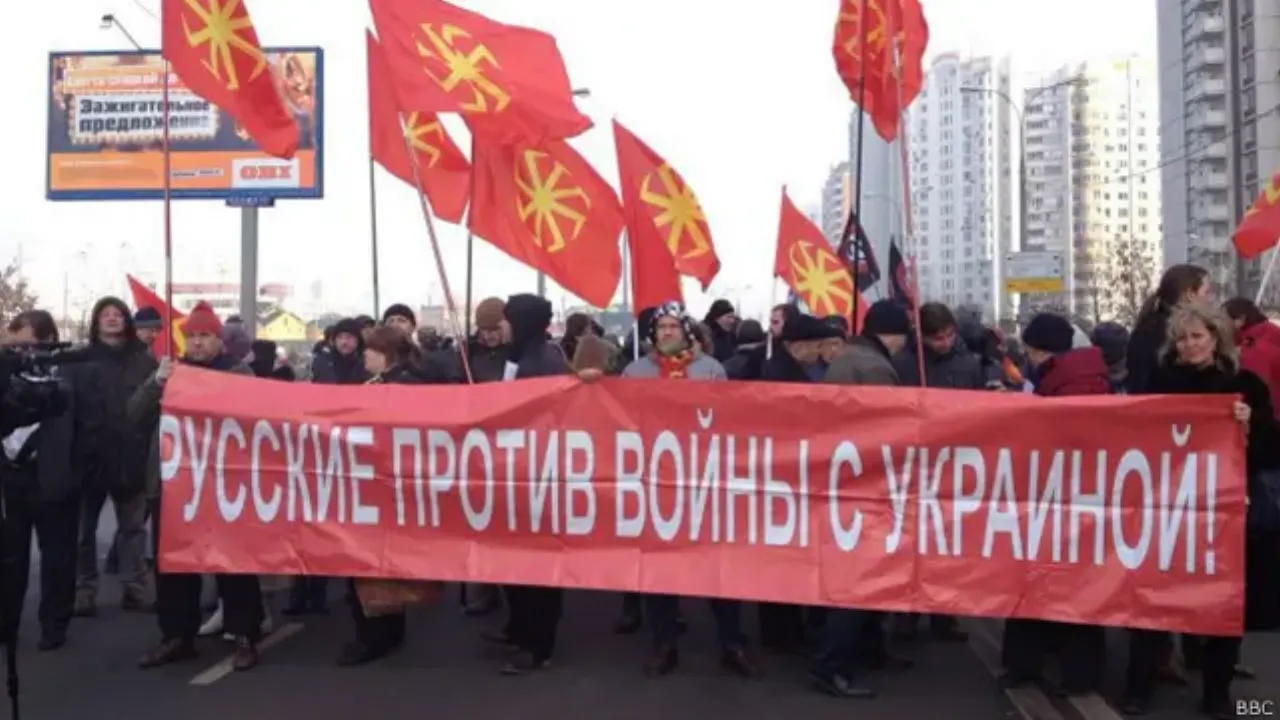
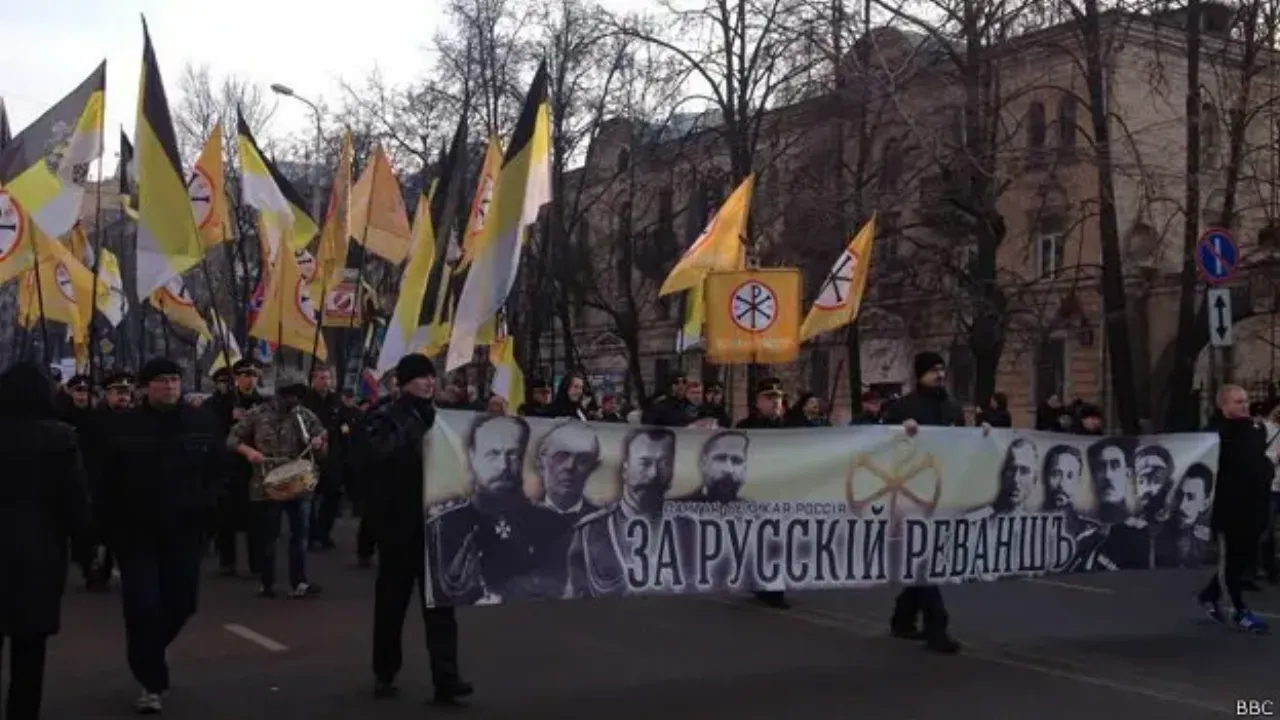
In those same years, commanders with a base of their own were dying one after another in Donbas: "Batman" Bednov on 1 January 2015 during an "arrest" by the LPR prosecutor's office, Mozgovoy in May 2015, Motorola in October 2016, Givi in February 2017, and Zakharchenko in August 2018. The last four died in attacks whose authorship is disputed, as Novaya Gazeta counts. In Moscow the other side of the same argument went behind bars: Dmitry Dyomushkin, leader of the movement "Russkiye" ("Russians"), who in November 2014 spoke on behalf of the organisers of the march against "Novorossiya" in the Moscow district of Lyublino, received a colony sentence in 2017 over photographs from a march. Neither side got a licence.
A swan song in Marseille
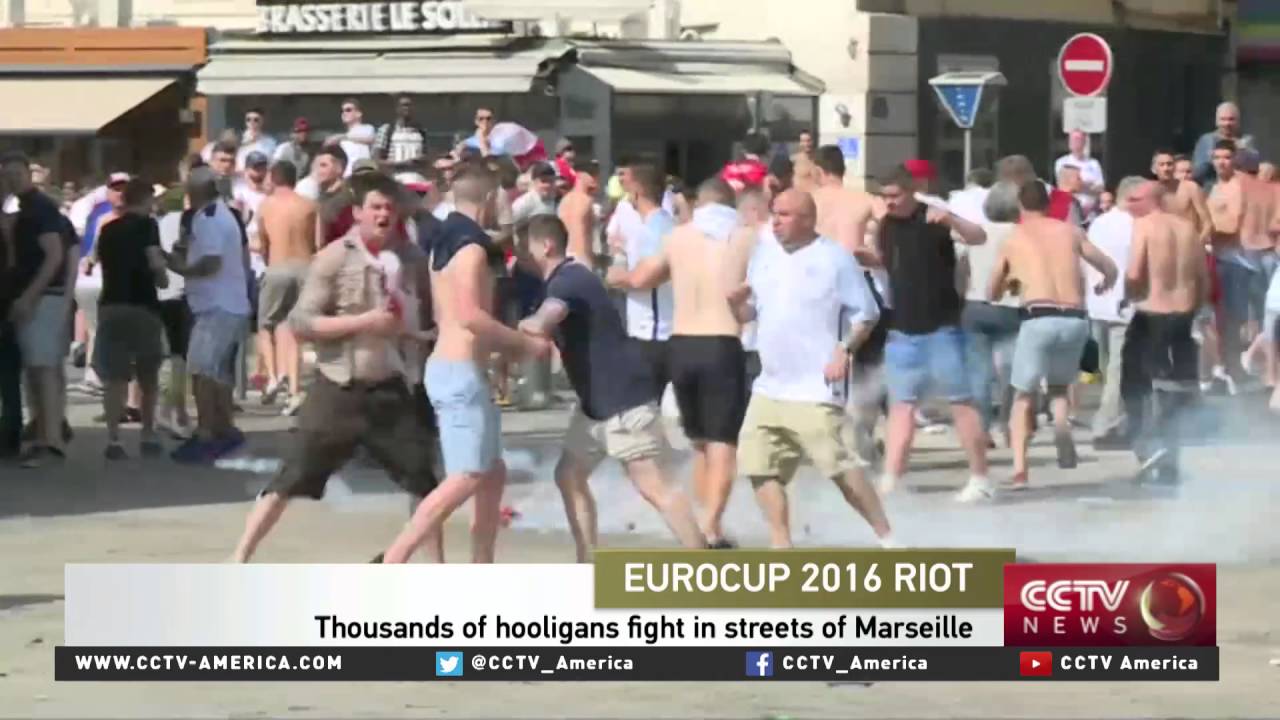
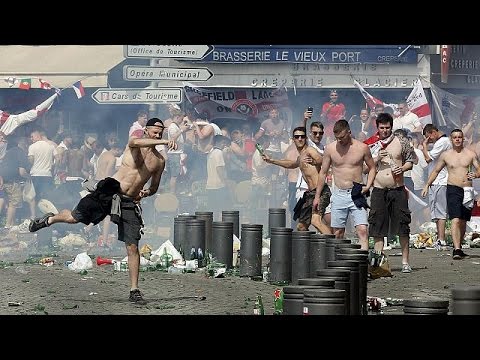
In June 2016, in clashes at the port in Marseille before the Russia–England match, more than 30 people were injured. The Marseille prosecutor spoke of around 150 trained Russians, and the head of the British police at the tournament, Mark Roberts, of mouthguards, gloves and the best-coordinated attacks he had seen in ten years. Denis Kapustin led one of the groups in Marseille and today, as commander of the Russian Volunteer Corps fighting on the Ukrainian side, which he founded in 2022, lists alongside one another men from Lokomotiv, a Spartak firm from Oryol, Zenit hooligans and St Petersburg Spartak fans — clubs that are mortal enemies in the league. Five years later he called Marseille "the brightest page of Russian okolofutbol" abroad, and its "swan song".
 RecordingYouTube
The participants were not building a legend but announcing a sequel: in the BBC film Russia's Hooligan Army of February 2017, the leader of the firm from Oryol promised the English violence "guaranteed one hundred per cent" at the 2018 World Cup, and a fan from Rostov spoke of a "festival of violence".
On 13 June the deputy speaker of the Duma, Igor Lebedev, wrote: "I see nothing terrible in a fight between fans. On the contrary, well done our lads. Keep it up!" Lebedev was Shprygin's boss at the time, as Shprygin worked as his assistant. The same day the spokesman of the Investigative Committee, Vladimir Markin, commented on European outrage with the words: "A normal bloke, the kind he ought to be, surprises them." On 17 June, at the economic forum in St Petersburg, Putin called the fights "a complete disgrace", but in the same speech admitted that he did not understand how "two hundred of our fans" had thrashed several thousand Englishmen. The foreign ministry summoned the French ambassador after a bus carrying 43 Russians, Shprygin among them, was stopped, and Sergey Lavrov spoke of a breach of the Vienna Convention.
When the British press wrote about security-service officers among the fans, the Kremlin spokesman Dmitry Peskov called it "Russophobic hysteria". Nobody confirmed those reports, and the British official quoted admitted himself that Kremlin sanction was hard to prove. In France three Russians were sentenced to 12, 18 and 24 months in prison, and twenty were deported.
 RecordingYouTube
After Marseille the pressure clearly accelerated. Shprygin says outright that "Marseille was the last straw". In December 2016 the interior ministry proposed lists of foreign hooligans; from January 2017 entry to matches required a named ticket verified against a passport; in April the fine for breaching a stadium ban rose to 50,000 roubles; and in June there were 191 people on the banned list, as Julia Glathe counts in an analysis for the Berlin-based ZOiS. Shprygin's association had already been thrown out of the Russian Football Union in July 2016.
Shprygin later said that the FSB had never taken such an interest in the scene before, and that every incident triggered the full procedure. Markin, who a year earlier had praised Marseille, in 2018 — as head of the football union's security committee — was warning foreigners about the discomfort of Russian prisons. Before the World Cup the police, as Shprygin told Al Jazeera, came to people's homes or summoned them "for a conversation". He and Vasily Stepanov had their Fan ID cancelled in 2017, when it was still a pass for the tournament rather than a season-long requirement. By April 2018 the interior ministry's list held 454 names. The editor of the fan portal OFnews later said that inconvenient fans had been "cut off from oxygen by means of Fan ID". The national team played its own World Cup with practically no organised support. Russia wanted to show the world a World Cup without hooligans, and there was no longer any permission for fights abroad.
 RecordingYouTube
Lebedev's idea did not disappear. The Ukrainian promotion "Pit Bull Fight" staged team fights between Dynamo Kyiv and Metalist hooligans as a commercial spectacle in 2020–2021. In Russia it was a patron who realised it. On 30 July 2022, at the "Gulyay-gorod" festival outside Moscow, two teams of five to six hundred people each fought with fists "wall against wall", and in one of them were activists of Konstantin Malofeyev's monarchist society "Double-Headed Eagle". The festival was praised by the governor of the Moscow region.
A turnstile instead of a conversation
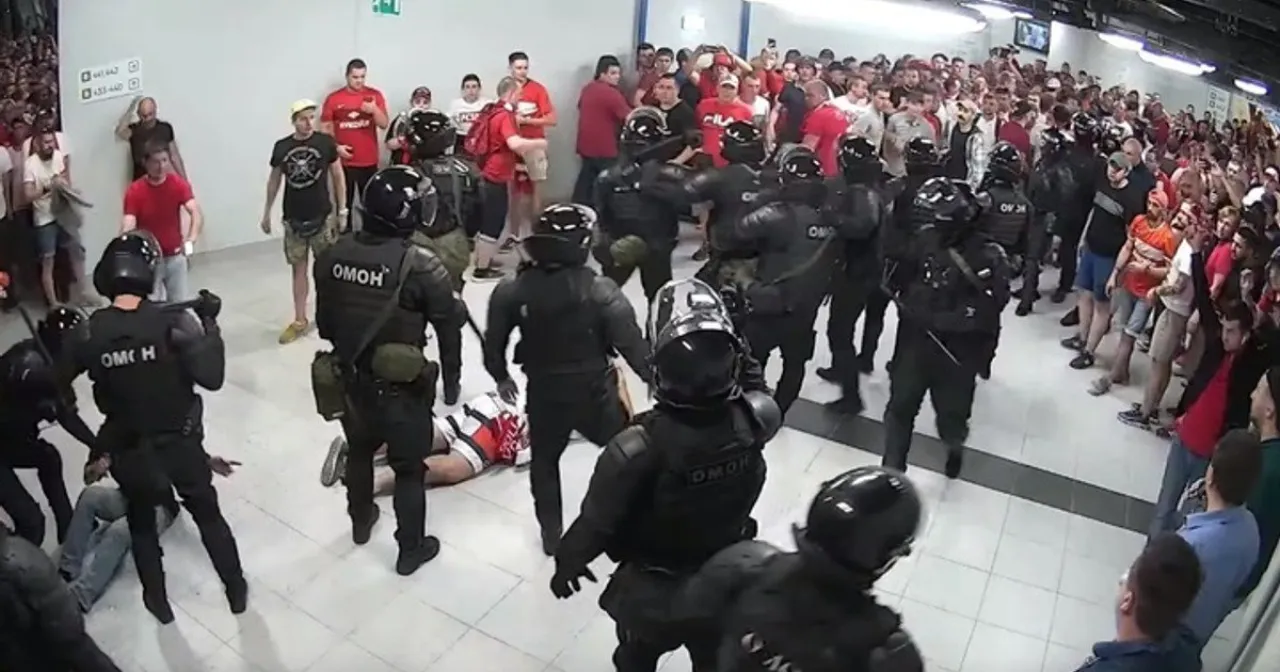
After the World Cup, the politeness of the police ended quickly. On 20 July 2019, after the Rostov–Spartak match, Rosgvardiya officers ran into a room under the stand and beat away-fans with batons — fans who on the footage are standing with their backs turned and offering no resistance, as @meduzaproject reported. On 1 December in St Petersburg, before the match against Zenit, 86 Spartak fans were detained, pulled out of hotels and bars long before kick-off, according to Novaya Gazeta. Twenty years earlier, in June 1999 in Ramenskoye, a battle between Spartak fans and OMON on the stand was stopped only by an appeal from the coach Oleg Romantsev, as Sport-Express recalled. In 2019 nobody fought back.
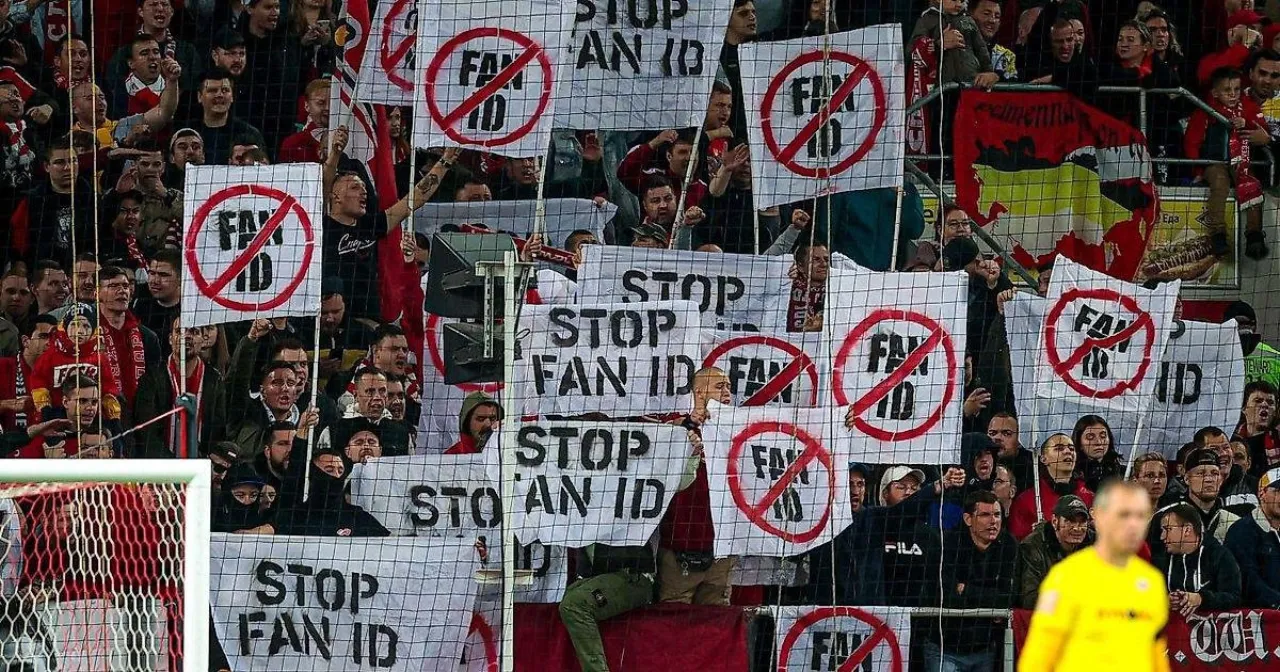
Since the 2022/2023 season, entry to Premier League matches requires Fan ID, a digital fan pass. In 2010 fans were listed from photographs in an occupied school, in 2017 from named tickets; now a turnstile does it. The fan associations of every club in the league except Akhmat announced a boycott, attendance fell by 31.8 per cent against the pre-pandemic period, and at Spartak it became three times emptier. In the first half of the 2025/2026 season the average is 13,610 spectators against 16,819 in the 2018/2019 season, according to calculations by Vedomosti. The public has largely come back, the ultras have not, and the Spartak fan association goes to cup matches but still boycotts the league. The terrace the state once talked to has been closed by a turnstile.
Volunteer, battalion, brigade
The woods emptied differently. Andrey Rakhov, "Arni", went to the war as an ordinary volunteer. For fifteen years he was a firefighter in St Petersburg, fought in the Zenit firm "Music Hall" and recorded rap, among others with the band 25/17 — the same band that in December 2010 dedicated a song to Sviridov during a concert in Moscow. In 2022 he gave up his job and signed up for the "Vostok" ("East") battalion of the so-called people's militia of the "DPR", in order, as he put it, to "defend Russia's interests in Donbas". He was killed near Vuhledar on 14 February 2023 together with a colleague from the same fire service, who had gone to the front without a contract, on "leave".
A fighter of "Española" said afterwards that "from the Zenit scene very many people made up their minds straight away" and went to the war. In September 2024 St Petersburg held the second tournament in memory of fans killed at the front, and from the stage they were listed as serving in "Española", in the 106th's reconnaissance unit and in "Redut" ("Redoubt"), a formation linked to the defence ministry that is usually described as a private military company.
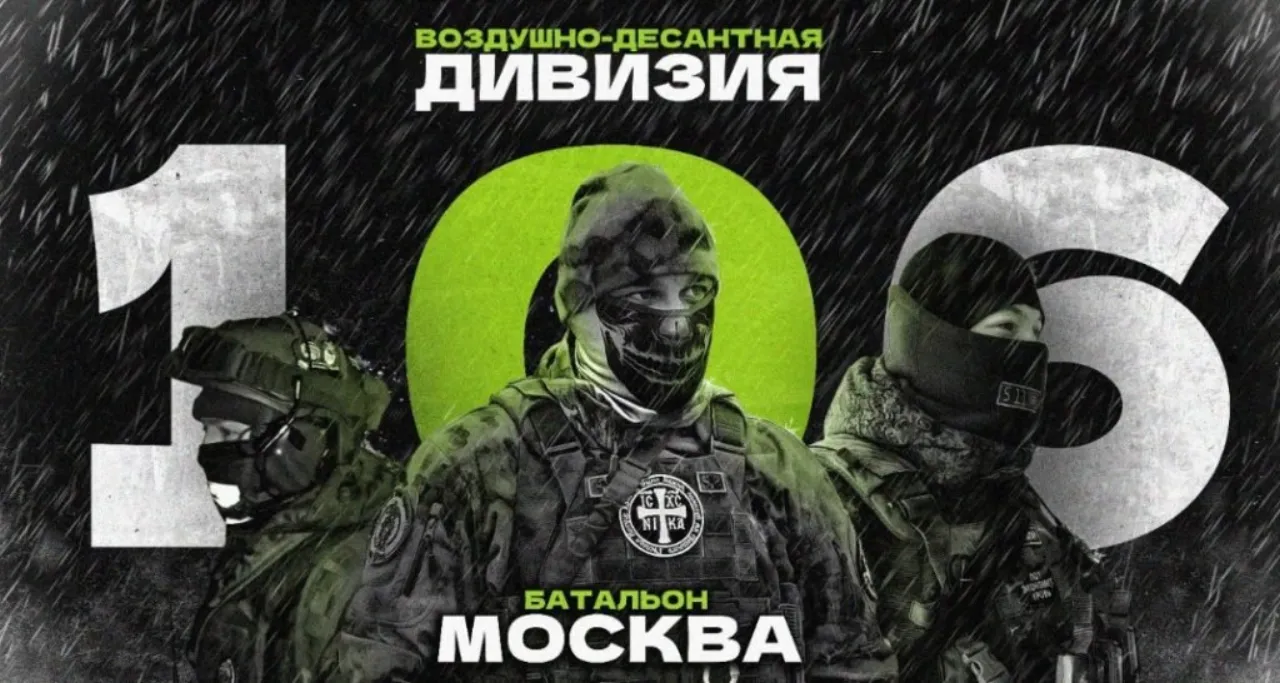
Some of the fans went straight into the army. The reconnaissance unit "Moskva" ("Moscow") of the 106th Airborne Division, which fans today simply call the 106th's reconnaissance battalion, was formed in September 2022 out of fans of CSKA, Spartak, Zenit and other clubs. The defence ministry was initially against it, but by April 2023 the unit already numbered around five hundred men, and Malofeyev, as the unit's spokesman Dmitry "Frank" Rumyantsev — himself a member of "Double-Headed Eagle" — put it, "supported it and essentially sponsors all of this". Rumyantsev later said on camera for the channel "Conversations about everyone" ("Разговоры о каждом"), whose author calls his reports from the unit "propaganda of love and devotion", that his main job was "media amplification of the battalion". The recruitment film for "Moskva" used footage from the port in Marseille, which Kapustin commented on with the remark that he had known many of them by name before they left for Tula.
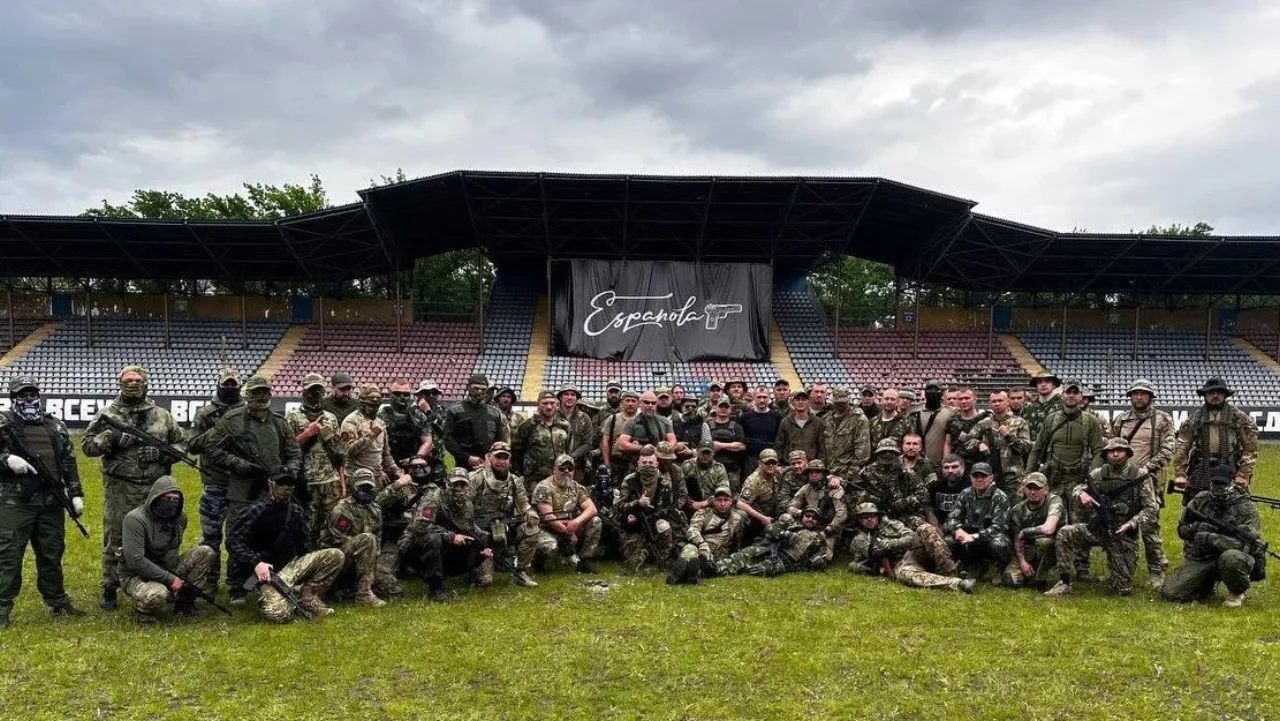
"Española", founded by Stanislav Orlov, "Ispanets" ("the Spaniard"), a CSKA fan from the firm "Red-Blue Warriors" who had been fighting in Donbas since 2014, brought together fans of different clubs. Orlov wanted to make it, as Novaya Gazeta Europe wrote, "a Russian military-patriotic movement for fans, without swastikas". According to Kapustin, who here too is describing an opponent, a good many of its men came from "Yaroslavka" — the same firm he came from himself — so the split of 2014–2022 ran through the middle of a single firm as well. The unit's base was in Mariupol after the city's occupation — according to Kapustin and the vice-president of FC Mariupol, at that club's stadium. Argumenty i Fakty wrote in November 2022 about a battalion in which "disputes between fans of different clubs are forbidden". Orlov announced on the sports channel Match TV, on behalf of all fans, that they had "accepted Fan ID with gratitude" — although active fans of 15 of the league's 16 clubs were boycotting matches at that very moment, as Novaya Gazeta Europe noted in August 2023. Fans of all colours in one trench gave propaganda a picture of a people's war that a conscript army could not provide. Kapustin believes "Española" was meant to be "a Russian Azov", but "Azov was possible only in a free country".
A licence that can be revoked
On 11 June 2023 the defence ministry announced an order from Sergey Shoigu under which all volunteer formations were to sign contracts with the ministry by 1 July, officially in order to give them the "necessary legal status". The Chechen "Akhmat" signed first, Prigozhin refused, on 24 June the mutiny broke out, and on 23 August Prigozhin died in a plane crash. In July Igor Girkin was detained — the man whose portrait had been carried on the national team's stand nine years earlier as "the pride of the nation" — and in January 2024 he was given four years in prison for incitement to extremism. Chechnya remains the exception. Ramzan Kadyrov has a force of his own, because his agency is the price the state paid for the end of two wars, and nobody issued it in exchange for a service. Even he was the first to sign a contract with the ministry.
"Española" ended up in the ministry's Volunteer Corps. One of its fighters said in Mariupol in 2024 that they were the armed forces of the Russian Federation but had no contracts and could go home at any moment, and that their drones were financed by fans and clubs, because "if we had the defence ministry's budget…".
Tula is the home of the 106th Division, and the firm of Arsenal Tula, "Kiborgi" ("Cyborgs"), first sent its soldiers aid, then its members went off to fight — according to the pro-Kremlin Mash, in full strength to the 106th's fan unit, which that outlet calls "Svetloyar" — and one of them was killed in an assault in January 2024. In March the group announced its own dissolution, and on 20 January 2025 the Tula Regional Court declared it an extremist organisation founded "among other things on Nazi ideology".
In September 2025 at an "Española" tournament in Kerch, Shprygin — an LDPR official since May — handed Orlov the leadership of the All-Russian Fans' Union, while the crowd chanted "Let’s go, Ispanets, we are with you". Shprygin added that in Marseille "all the Englishmen should have been finished off", and demanded the rehabilitation of those who took part. The deputy commander for political affairs, Aleksey Zhivov, put the offer plainly: "Half of us died in the war, half are still fighting, we have honestly earned a certain forgiveness from the state. Abolish Fan ID." The assault commander Turkanov called Fan ID "the killer of football" and insisted that the new organisation had "no political subtext". For the first time since Marseille, the scene was setting the state conditions.
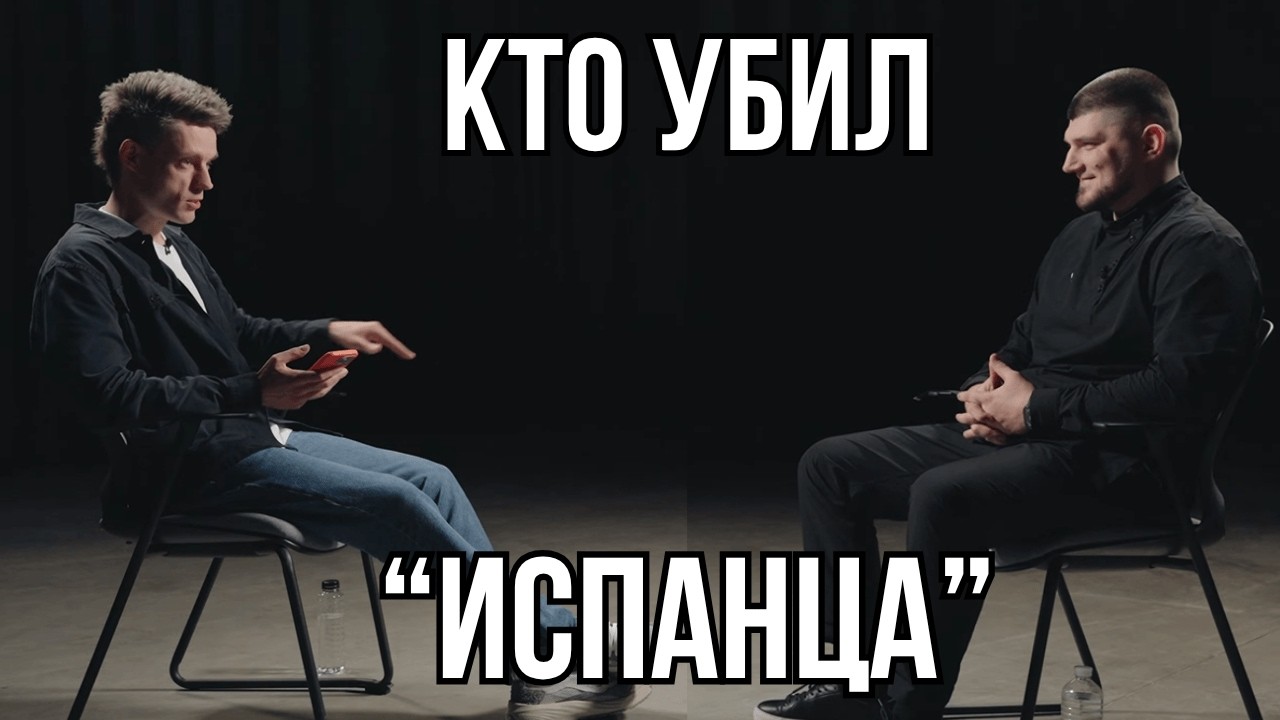 RecordingYouTube
On 3 October "Española" announced its dissolution, which Orlov called a "restart". A few weeks earlier the former commander of its naval unit had been arrested over weapons found in a garage. On 4 December armed officers came to Orlov's dacha in Sevastopol, and an ambulance took the body away about six hours later, according to the findings of the agency Astra and Vazhnye Istorii (@istories_media). According to RTVI, Orlov fired back during the arrest; Astra's witnesses maintain that he did not shoot. Former fighters speak of a case of illegal arms trafficking, and in May 2026 more "Española" men were arrested in Sevastopol under the same articles. I have no proof that the attempt to take over the fans' association caused the unit's dissolution, or that the dissolution led to the death of its commander, and officially this is a criminal case about weapons. If those charges are true, then Russian firms acquired a criminal hinterland only at the front, where weapons are close at hand — and the state reached for them at the moment they stopped being needed.
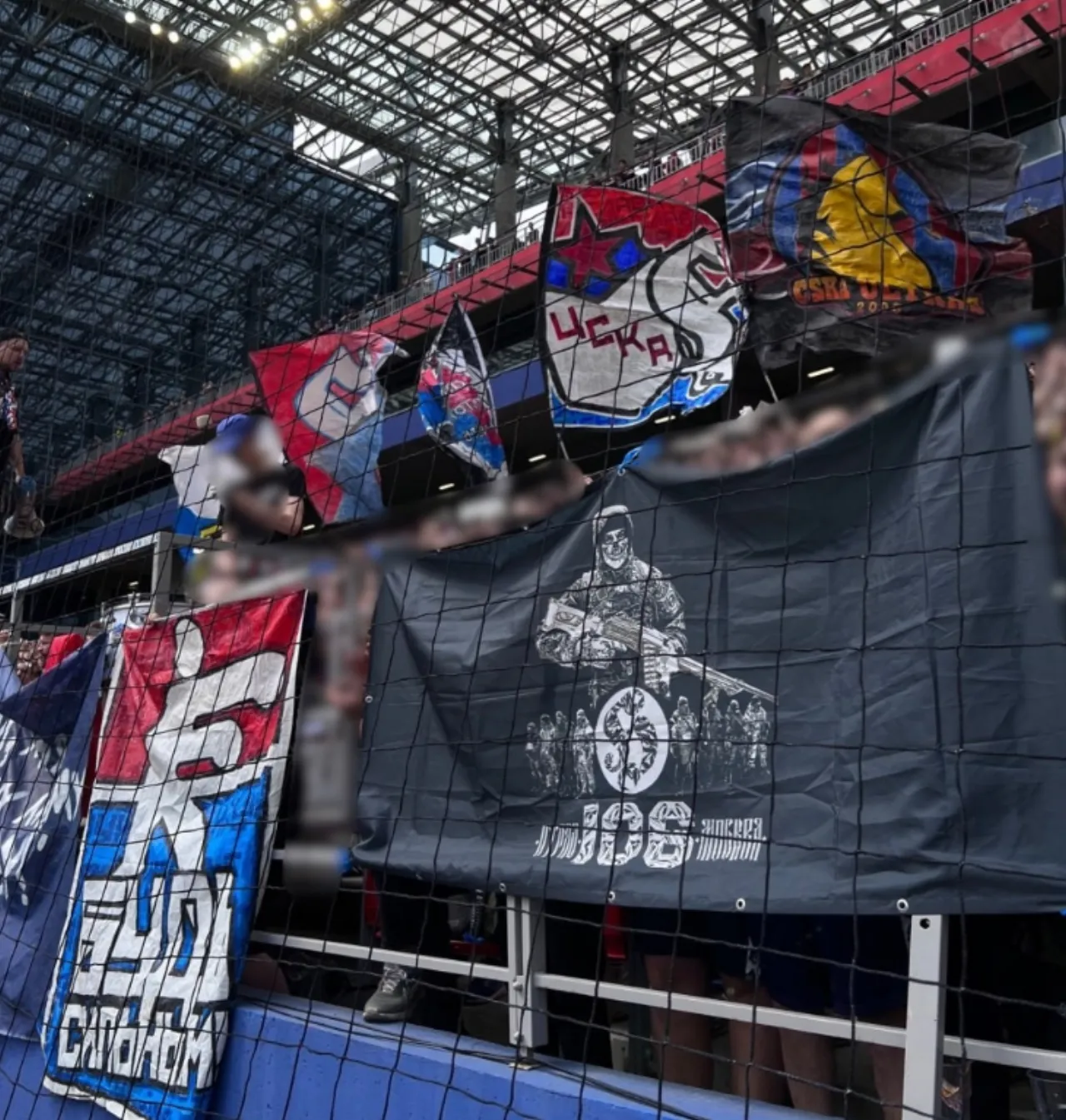
On 2 August 2026, at the match between the fan-revived Kuban and Belorechensk in the Krasnodar Krai league, a black banner hung on the stadium fence in Krasnodar showing a soldier in a skull mask, a hooligan symbol and the number 106, with the inscription "there was no retreat, the fight goes on". A similar banner has appeared repeatedly at matches of Moscow clubs as well. On that terrace, politics today appears essentially only as membership of the army. Beside it, on the same fence, hung a banner of a firm in the colours of Shakhtar Donetsk, whose provenance I was unable to establish. The Shakhtar ultras about whom anything is known are fighting, around a hundred of them, on the Ukrainian side, as Meduza wrote, and none are heard of in the Russian army. That banner fits neither of the two convenient stories about this war.
Who issued the licence to whom
The Code of the Woods really did reduce the number of random victims, so the state's tolerance of arranged fights may have been a straightforward public-order calculation. During the 2001 Russian Cup and the opening round of the league, 125 fans and eleven police officers were hurt, according to the deputy head of the interior ministry's public-order directorate. Nine years later the same ministry was reporting 3,067 people detained at sports venues against 7,200 the year before, and crediting the fall to its own preventive work, not to the code. The ministry of sport reports that the number of offences at stadiums fell by 15 per cent in 2024, and that result is true regardless of intent. I agree with that description, with one addition: the same tolerance raised a disciplined, trained cadre that the state later took over. The scene's decline was also helped along by generational change, because professional MMA events pay and the woods never did, and the thirty-year-olds of 2010 have families today.
A more serious objection is that the scene went looking for the licence itself. Shprygin joined the LDPR of his own accord, the "Moskva" battalion was formed on the fans' initiative and with Malofeyev's money, and in September 2025 Zhivov came to negotiate of his own accord. The editor of the OFnews portal told Meduza that relations with the state worked "up to a point" thanks to conversations with "not the last people in the state". All of that is true, except that a licence can be bought, but it is issued and revoked by one side.
Several thousand people came to Orlov's farewell at the Cathedral of Christ the Saviour. Behind the departing hearse they chanted the same thing they had chanted three months earlier, when he took over the fans' association in Kerch: "Let’s go, Ispanets, we are with you." The licence protected him exactly as long as a deputy's assistant credentials protected Dynamo fans in 1998: until the person who issued it changed his mind.
First published: X Article (in Polish), 19.10.2026
Cite as: Denis Salnikov, “The Code of the Woods: how the Russian state issues football hooligans a licence for violence, and takes it back”, Analiza Wschodu, 19.10.2026, https://analizawschodu.pl/en/articles/code-of-the-woods.html
Text © Denis Salnikov. Quotation with attribution and a link is welcome. To reprint a full text or reuse a chart, write to ds@analizawschodu.pl
* Graphics marked with an asterisk are mood images and may contain AI-generated elements. Charts, timelines and tables carry no asterisk — their figures come from the sources named beneath them.