The exodus that would have to outrun mobilisation
· Denis Salnikov
In September 2022, in the run-up to the largest emigration event in Russia's recent history, searches for the phrase "will there be mobilisation" sat at background level. Through June, July and August the monthly reading did not move off one or two on a hundred-point scale. It shot up only in September, to 49 — in the month that contained both the collapse at Kharkiv and the decree. Monthly resolution does not separate those two events and I will not pretend that it does. What it does settle is something else: through the three months preceding the largest emigration wave in Russia's history, nobody was asking about it. The wave that actually came was the one nobody announced.
Today the reading is higher than it was then. It was also higher in January 2023 and in March 2024, and on each occasion nothing happened. That does not mean nothing will happen now — it means that the level of anxiety has never been a good gauge in this matter, and twice turned out to be an inverse one.
Other instruments are needed, then, and they show three things. First, the two European entry channels have diverged so sharply that both sides of the argument can quote true figures and reach opposite conclusions: the loud channel was closed by decision, and the quiet one has returned to its pre-war size. Second, the residence registers across the whole region show nobody staying — they show rotation. Third, and this is the most important finding, over four years Russia has built a conscription register, automatic exit bans and year-round call-up, so a future wave would have to happen before its own trigger, or not at all. The road of September 2022, when people moved after the decree, is closed. I come back to that third point at the end, because only the first two show why it matters.
I base this on four series whose names are worth knowing, because the difference between them decides the conclusion. Geostat counts not papers but presence: an immigrant is someone who has spent 183 days in Georgia. Eurostat keeps two datasets whose confusion reverses the meaning — migr_resfirst is residence permits, that is, settlement, while migr_asyappctza is asylum, that is, one tenth of the channel. CBP publishes raw US border encounters by citizenship and month. Indicator 38480 in the Russian EMISS system, maintained by the FSB Border Service, gives quarterly departures of Russians by country. All are public and all require one discipline: do not confuse intention with action, or flow with stock.
Part I. What the data show
The record is real and means nothing
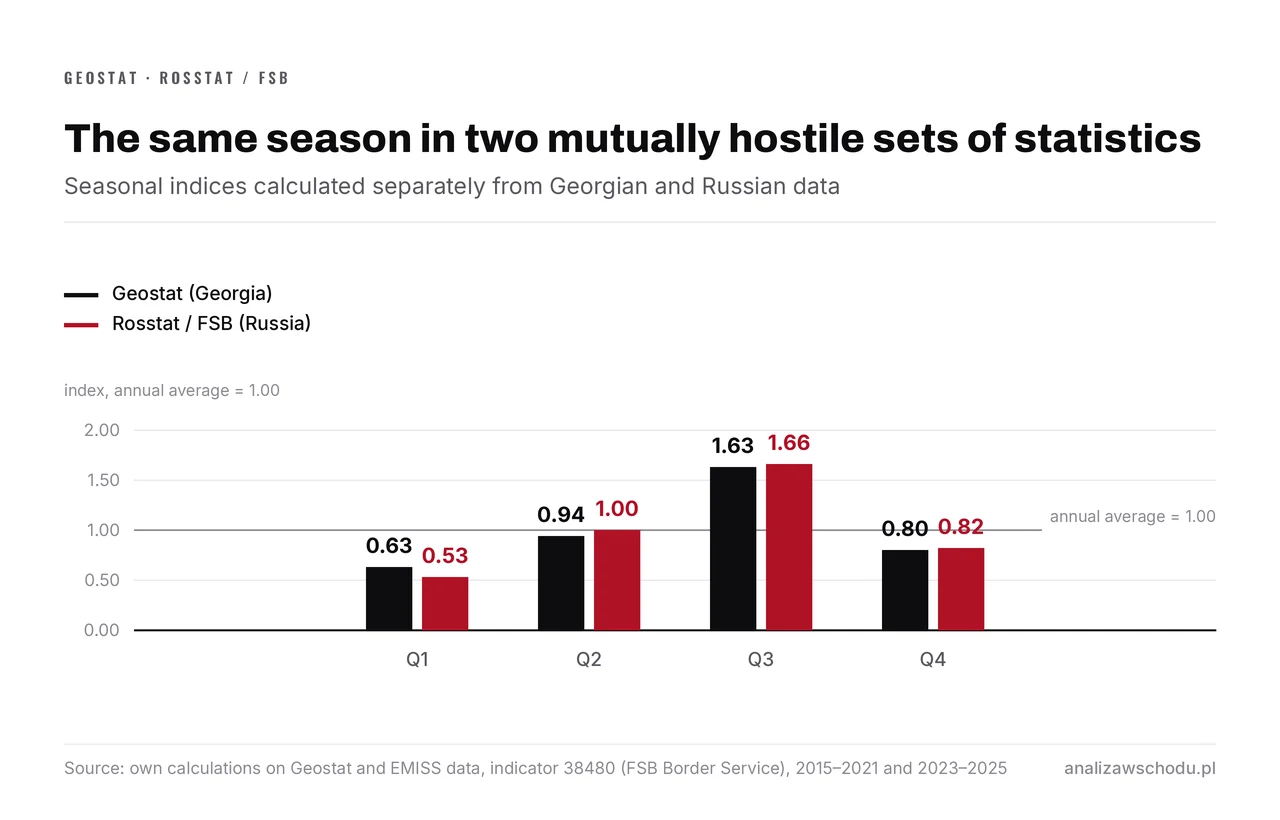
The August record at Verkhny Lars was genuinely set. The thing is that August is the highest point of the series every year. The ratio of the third quarter to the first runs, for Russian visitors to Georgia, between 2.76 and 3.02 — in every normal year since 2015, without exception. I calculated that ratio twice, separately from Georgian and from Russian data. The quarterly seasonal indices, where 1.00 is the annual average, come out at 0.63 / 0.94 / 1.63 / 0.80 at Geostat, and 0.53 / 1.00 / 1.66 / 0.82 at Rosstat on FSB data. Two statistical systems whose states call each other's bulletins disinformation agree on the shape of the season.
Two further explanations operate on different time scales and are worth separating, because mixed together they start to contradict one another. The crossing's capacity rose from 400 vehicles a day before 2021 to 2,500–4,000 across 39 lanes after the rebuild — and that explains why annual volumes today are not comparable with those of five years ago. Traffic jams explain something else: single days. The Russian embargo on goods from Armenia imposed from May, the single-lane road over the Jvari Pass with the Kobi–Kvesheti tunnel pushed back to 2028, and the weather can saturate the crossing regardless of how many people want to drive through it. When the crossing is clogged, the measured volume is a floor, not a measure of demand.
Direction does not settle this, but neither does it confirm it. On the single day measured directly, 19 August, the Georgian interior ministry counted 7,880 entries into Georgia and 8,406 exits to Russia — a balance negative by 6.7 per cent. It must be said at once how much that reading weighs: it is one day, one crossing and the end of August, the moment at which every seasonal pattern predicts a preponderance of returns. It would be inconsistent to demand seasonal adjustment of volume and exempt the balance from it. This measurement does not show an exodus — but neither is it proof that there is none.
There is, however, a calibration that disarms the whole category. September 2022 — the largest emigration event in Russia's recent history — raised Georgia's quarterly count of Russian visitors by 2.6 per cent above the corresponding quarter of 2018. Border volume did not answer this question even when the wave was actually passing through.
Rotation instead of settlement
There is something residence registers will not settle, and it is better said at once. The most recent annual series end in 2025; the Armenian and Turkish ones reach mid-2026. None of them will show a wave that began in July. They serve a different purpose: establishing a baseline — the state in which the end of the last full measurement found the region.
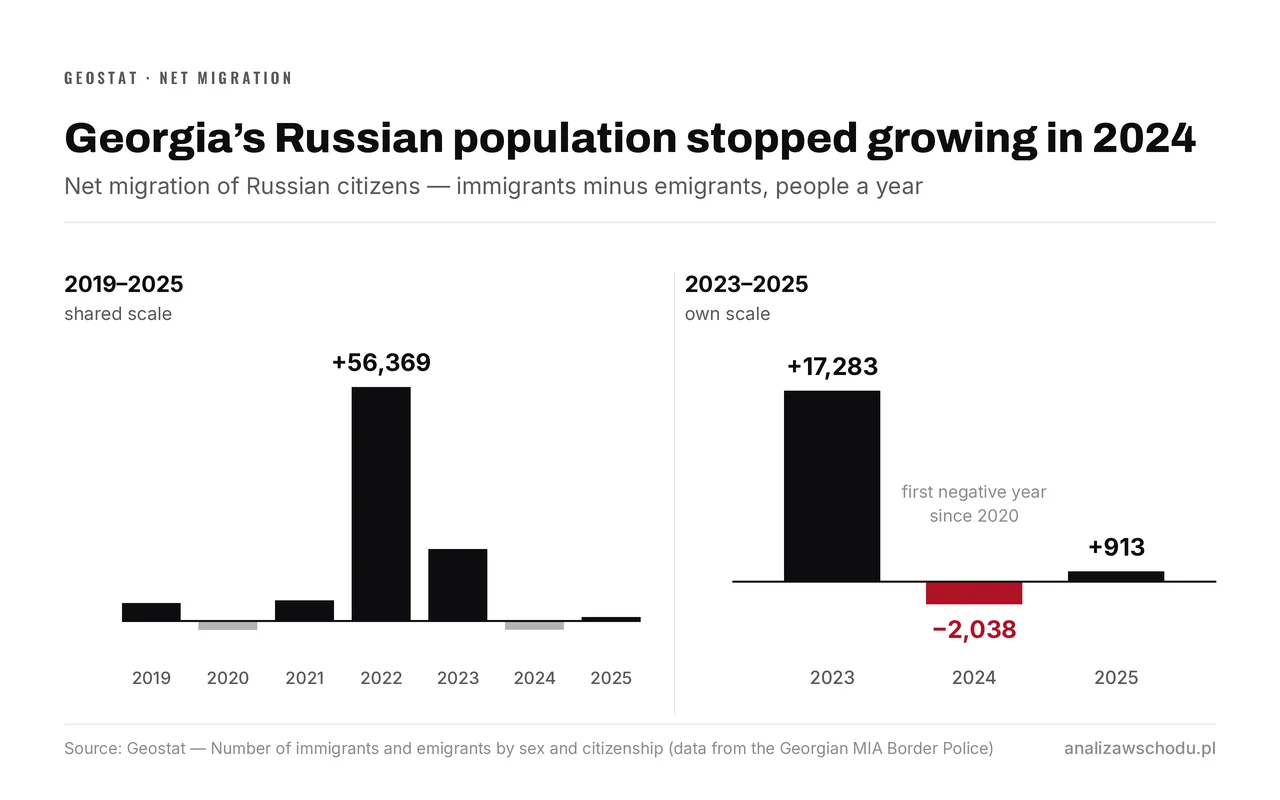
Georgia has the cleanest series, because Geostat measures presence, not paperwork. Net migration of Russian citizens: +56,369 in 2022, +17,283 in 2023, −2,038 in 2024, +913 in 2025. Georgia's Russian population stopped growing two years ago; the 2024 census counted 37,715 Russian citizens against an estimated 100,000–150,000 at the peak.
The same table, though, contains a finding that spoils the easy version of the thesis. Gross inflow in 2025 came to 20,139 people — still almost double the 2019 level. It is not the case that nobody is arriving. It is the case that just as many are leaving: between 2023 and 2025, 80,182 Russian citizens emigrated from Georgia. That is rotation, not exodus and not settlement.
It is worth saying where those people go, though, because the word "rotation" suggests return, and the data say otherwise. Georgia, Armenia, Turkey and Kazakhstan were for the most part a stopover, not a destination. The panel OutRush study shows that 58 per cent of those who ended up in Georgia left their original destination country, 47 per cent from Turkey and Armenia, 40 per cent from Kazakhstan — against 1 per cent in Germany, Spain, the Netherlands and the United States. This is an online survey on a self-selected sample, so I treat it as an order of magnitude, not a measurement. But the direction is confirmed by a second series, independent and official: in 2023, while 35,344 Russians were leaving Georgia, the EU recorded its all-time record — 117,641 permits, more than in 2022. Returns to Russia itself ran at about 8 per cent a year over that period, roughly as many as were leaving to take their place.
That changes the sense of the whole table. The Caucasus and Central Asia are not losing Russians to Russia — they are losing them to Europe. And if so, the EU peak of 2023 was not a new wave but the closing of the 2022 one: people who on first impulse landed in Tbilisi and Yerevan arrived where they had meant to arrive. The decline that followed therefore means that the stage is over and there is no further cohort behind it.
Serbia shows the mechanism that repeats everywhere. First-time permits for Russians fell from 24,068 in 2023 through 16,684 in 2024 to 9,003 in 2025 — by 63 per cent. The stock of valid permits over the same period grew by 32 per cent, to 54,917. Both statements are true, because they measure different things: the stock grows for as long as the permits of 2022–2023 remain valid, even as new ones dwindle. Anyone quoting "the number of Russians in country X" without saying whether they are measuring stock or flow will tell a story that is the reverse of the facts.
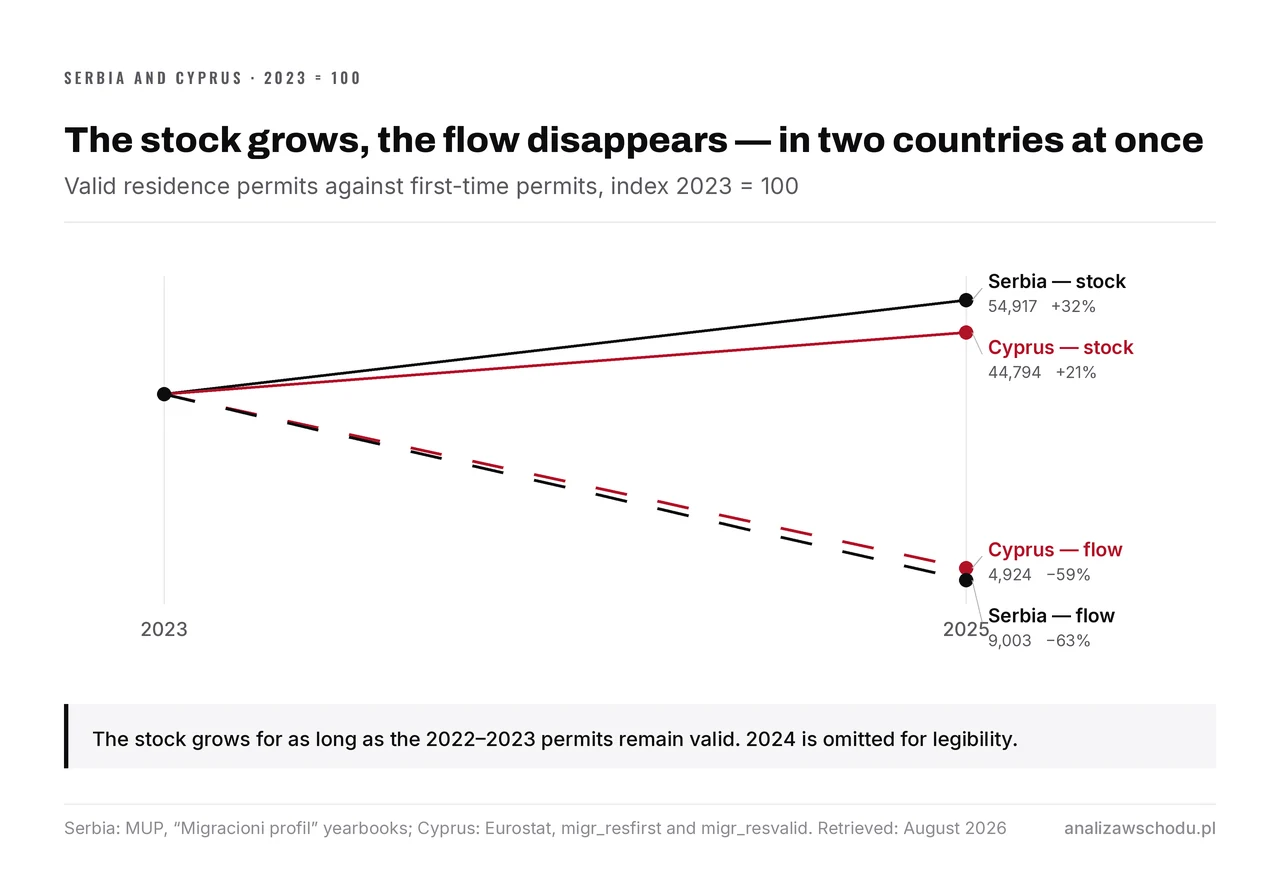
Cyprus, where the Russian presence traditionally rested on property and business and has in recent years also become a refuge for IT companies that left Russia, gives the same divergence from the EU register: first permits 12,029 in 2023, 5,833 in 2024, 4,924 in 2025, with the stock rising from 37,127 to 44,794. The Cypriot breakdown says what that divergence means: of the 4,924 permits issued in 2025, 2,055 were family reunification. Family reunification is a lagging indicator — it is the 2022 cohort bringing relatives over, not new arrivals coming. Exactly the same picture as in Serbia, where family reunification accounted for 55 per cent of all permits even though it fell by 47 per cent.
The rest points the same way. Turkey: 154,297 Russians with a valid permit in January 2023, 78,415 on 13 August 2026. Kazakhstan: temporary residence permits 138,259 in 2022, 112,685 in 2023, 77,542 in 2024, 69,894 in 2025, with the first quarter of 2026 running lower still. Israel: repatriation from the former USSR 63,112 in 2022, 39,490 in 2023, 22,628 in 2024, 11,018 in 2025. Montenegro alone moves the other way — from around 9,400 Russians holding a permit at the end of 2023 to 21,153 at the end of 2025.
The loud channel and the quiet one
The EU needs separate treatment, because it is usually measured with the wrong series.
Asylum applications from Russian citizens: 18,895 in 2023, 10,600 in 2024, 7,790 in 2025. The figures are true, but asylum is a narrow channel — in 2025 it accounted for one tenth of the Russian inflow into the EU. A programmer relocated by his company, a manager, a student or the spouse of an EU citizen does not apply for asylum. They get a residence permit.
And that fall is in large part an EU decision, not a Russian one. The recognition rate for Russian applications fell from 34.4 per cent in 2023 through 24.3 to 19.7 per cent in 2025, and dropping below the 20 per cent threshold triggers mandatory accelerated border procedures from June 2026. Germany alone accounts for 41 per cent of the entire fall, with its recognition rate collapsing from 23.6 to 6.2 per cent, and men of conscription age receiving 349 approvals on 6,374 applications.
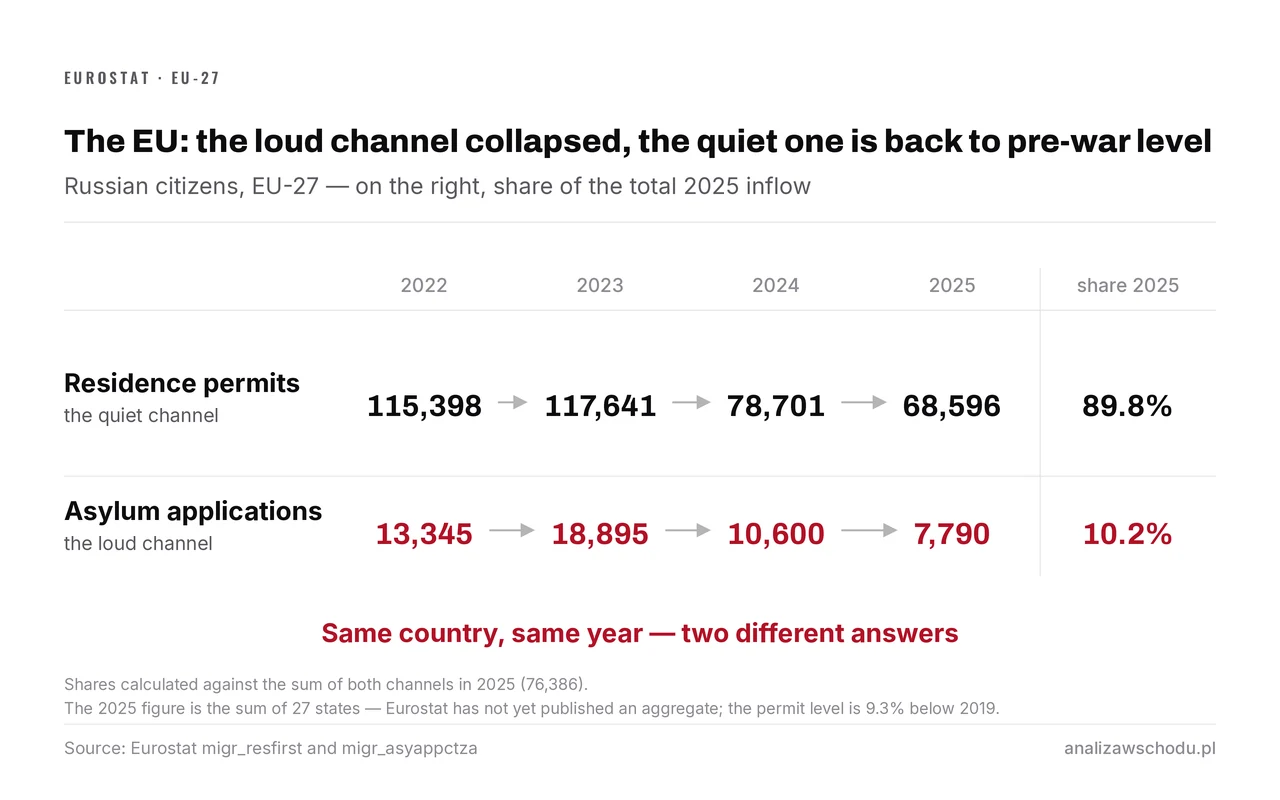
The proper measure looks different. First residence permits issued to Russian citizens: 75,665 in 2019, 115,398 in 2022, 117,641 in 2023, 78,701 in 2024 and 68,596 in 2025. The EU was the largest single settlement destination in this entire table — at the peak, more than Georgia, Turkey and Serbia combined. The peak fell in 2023, not 2022. And 2025 sits 9.3 per cent below the pre-war level, after a 42 per cent fall from the peak. I give the 2025 figure as my own calculation, because Eurostat has not yet published the aggregate; it is composed of twenty-seven national readings from the same dataset.
This is not a channel that "persists" — it is a channel that has returned to its pre-war size and dipped slightly below it. But the difference from asylum is enormous: one fell by 42 per cent in four years, the other was closed administratively in two. Look at asylum and you see a door slamming. Look at residence and you see a slow return to normal. Both are right about the numbers.
The biggest door, moreover, is not where people look for it. In 2025 Spain issued 15,246 permits, Germany 12,605, France 5,722, Cyprus 4,924, Poland 4,267, Portugal 4,076. The discussion revolves around asylum and Finland, and is settled in Spanish and German residence offices. The structure, meanwhile, repeats the Cypriot pattern: 40 per cent of EU permits in 2024 were family reunification, and work — 19,571 permits — is shrinking faster than any other category, by 43 per cent against 2022.
And here the convenient version ends. The two countries I am pointing the reader to move in opposite directions. In Germany the "work" category collapsed from 6,459 permits in 2023 to 2,404 in 2024 and 2,146 in 2025 — by two thirds. In Spain it has grown without interruption since the start of the war: 716 in 2021, 2,207 in 2022, 4,334 in 2023, 5,186 in 2024 and 5,467 in 2025, that is nine times the 2019 level. It is the only Spanish category that grew in 2025, and the country's second largest channel — 36 per cent of all permits issued there. Behind it stands a legal construction that goes unmentioned in this discussion: autónomo status and the digital nomad visa from the startups law, available since January 2023.
The United States gives the same shape in a different legal system. Border encounters by Russian citizens: 57,163 in fiscal year 2023, of which 43,210 at the southern border. After the CBP One app was closed on 20 January 2025, the monthly southern series collapsed from a peak of 7,912 to 230 in January, 81 in February, 18 in March and 12 in July 2026 — with no rebound in eighteen months. Overall the fall is 90 per cent, not 99, because the airport category is a different thing: people refused entry at inspection, today at the 2020 level. About the ordinary route nothing can be said today — green cards for people born in Russia ran at 9,820 in 2019 and 10,720 in fiscal 2024, but the 2025 yearbook will not appear until 2027. The American example therefore shows one thing: how fast a channel closes once the destination state makes a decision.
What these data do not settle
A line has to be drawn here, because without it everything above means less than it looks. The fall in residence permits has three competing explanations: Russians do not want to leave, Russians cannot leave, or destination states have stopped letting them in. The data I have given do not separate the three. Worse: I devote the next two sections of this text to arguing the second and the third, so I cannot simultaneously read the fall as proof of the first.
The contamination does not begin in 2026, either, as it would be convenient to assume. Turkey suspended "tourist" permits in August 2024. The United States closed CBP One in January 2025. Kazakhstan tightened its requirements in 2026, Georgia in March 2026. Which means that the series for 2024 and 2025 — precisely the ones carrying the argument — are in part a record of other people's decisions, not of Russian demand.
What survives of this. What survives is structure, not level. No supply-side explanation accounts for why 40 per cent of EU permits and 42 per cent of Cypriot ones are family reunification while the work category shrinks fastest: that is the signature of a cohort consolidating rather than renewing itself. With one breach, which must honestly be entered on the "against" side: the Spanish work category does exactly the opposite, and has done so for the fourth year running. Nor does any explanation account for why the stock grows while the flow falls — by 32 per cent in Serbia, by 21 per cent in Cyprus. People already present are staying; new ones are not arriving in their place. That finding survives all three explanations, and it alone carries further.
Part II. What the law shows
The doors this wave would have to hit
If a new wave were forming today, it would be hitting the most tightly closed set of doors since February 2022. It is worth distinguishing how much each of those closures weighs.
Two are the heaviest. Turkey cut the cap on foreigners' share of a neighbourhood from 25 to 20 per cent and closed 1,169 neighbourhoods to first-time applications, and in August 2024 suspended the issuing of "tourist" residence permits — that is, the route by which the majority of the 2022 wave came; the effect is visible in the series, which fell from 154,000 to 78,000. The United States closed CBP One in January 2025 and erased the single largest route of recent years — from 43,000 a year to a dozen or so a month.
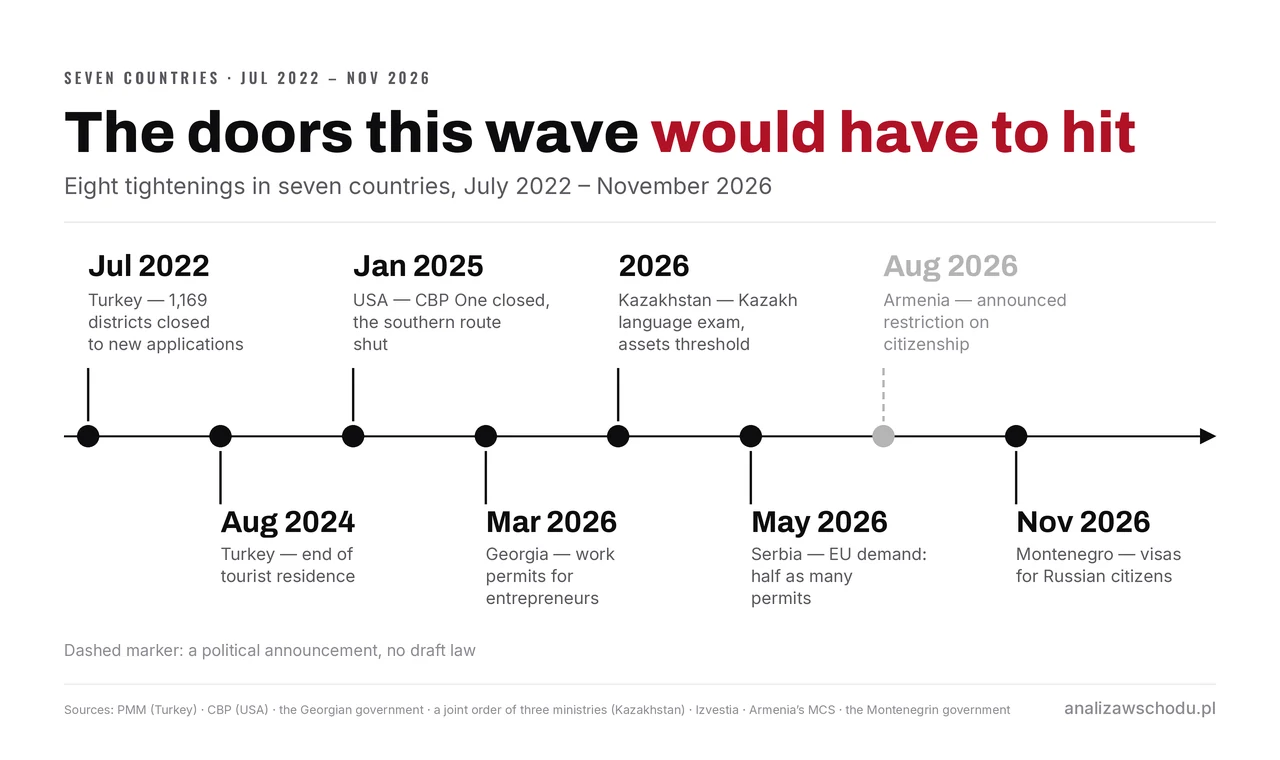
Three are of middling weight. Georgia, which for four years did not touch the visa-free year of residence, has since March 2026 required a work permit and has extended it to Russian sole traders on the 1 per cent tax — the basic legal construction of the local relocation economy. Kazakhstan demands of candidates for permanent residence 70 per cent on a Kazakh language exam and 5.7 million tenge a year for five years. Montenegro, the only growing destination, introduces visas on 1 November 2026.
Two are the lightest, and this has to be said so that the list does not look more menacing than it is. Brussels's demand of Serbia in May 2026 that it halve the number of permits for Russians is political pressure with no deadline. The Armenian announcement in August 2026 that it would restrict the fast track to citizenship does not even have a draft bill — it is an intention, not a law.
One door opened in this period and nobody has closed it. Spain's startups law launched the digital nomad visa in January 2023, and autónomo status remained available unchanged. The effect is visible in the figures from the previous section. The list of closures is therefore true, but it is not complete — and that particular omission works against my thesis, not in its favour.
The balance: within two years the routes along which the overwhelming majority of the wave travelled in 2022–2023 have been closed or narrowed. This argument is stronger than "nobody wants to leave", because it survives a possible rebound in the indicators — even if intention returned to its 2022 level, it would have nowhere to convert itself at that rate today.
Capability: what was built while nobody was watching
Here lies the strongest argument of the side saying "something is coming" — except that it is not the one usually used.
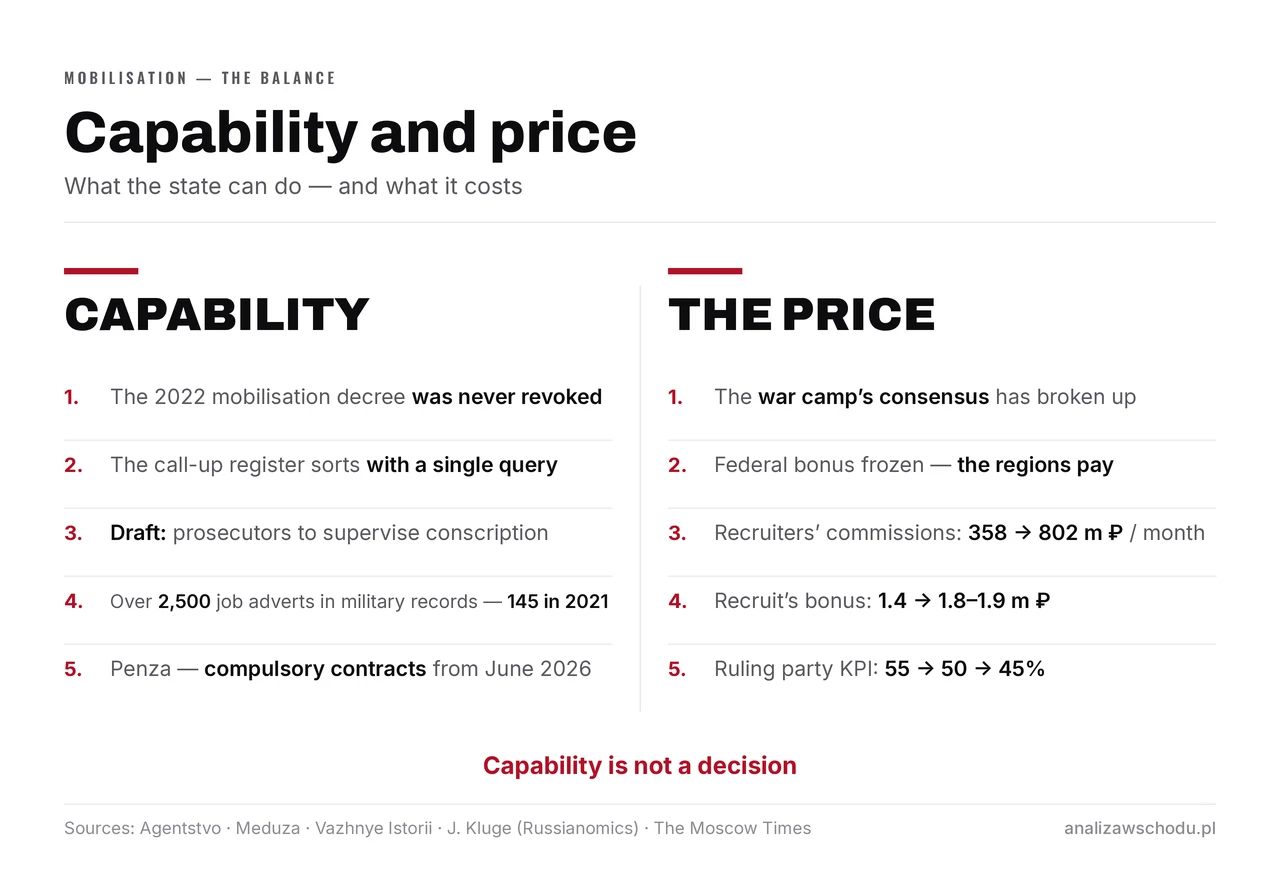
A new decree is not needed. The one of 21 September 2022 has never been revoked; its fourth point still blocks the discharge of soldiers "until the end of the mobilisation period". There is no missing legal act — there is a missing command. The register sorts. The electronic conscription register has operated since May 2025, a summons is valid from the moment of entry, and after fourteen days a package of five restrictions follows, with an exit ban at its head.
Employers have been briefed. In July 2026 three trade publications for HR officers issued instructions on the order of call-ups under mobilisation — with zero change in the law; the Glavbukh text is a refreshed version of a piece from 22 September 2022, the day after the decree. More than 2,500 job advertisements relating to military registration and mobilisation work are posted on the labour market, against 145 in the whole of 2021 — Agentstvo counted them on hh.ru at the end of July.
Coercion is already working locally: in the Penza region contracts have been forced since mid-June, in Bashmakovo residents organised night patrols, and the practice has spread to Omsk, Primorye and Tatarstan. What is missing from this description, and must be admitted: an order of magnitude. I do not know how many people are in the register, how many have an active exit ban or how many summonses have been issued — those figures are not published. "The road is closed" therefore remains a description of a legal construction supported by individual cases, such as the April detention at the Belarusian border of a conscript with a summons, rather than a finding of measured scale. That is a real weakness in this section.
Even so, the conclusion changes how Part I is read. In September 2022 the exodus followed the decree — searches about leaving stood at zero until 19 September. That road is now legally closed: the register, automatic exit bans since September 2025, year-round call-up since January 2026. A future wave would therefore have to happen before its trigger, or not at all — and that means it would be smaller and less visible, because those who most wanted to leave would be blocked before they reached the border.
The price: who would have to pay for it
Everything above speaks of capability, not intention. And the capability came into being for a reason that is mentioned least often: the administrative machine was built not as preparation for a decree but as a substitute for money.
For three years the state bought soldiers rather than taking them by force — contract, bonus, regional payment. That model works for as long as the price rises more slowly than the budget. When it stops doing so, two roads remain: pay more, or compel. The register, the instructions for HR officers and the round-ups in Penza are not preparation for a decree — they are a cheaper alternative to a bonus that has stopped being enough. And that is why the other side of the balance sheet is not a list of reassuring arguments but a list of bills.
The regions pay, not the Kremlin. The federal bonus is frozen; regional spending on recruiters alone rose in a year from 358 to 802 million roubles a month — Vazhnye Istorii calculated this from the budgets of the nineteen regions that disclose them, so it is a minimum estimate. Bounties for bringing in a recruit are now paid by 56 of some 85 regions against 31 in October 2025.
The price is rising faster than recruitment. This is the only part of this text where I have to be more cautious than I would like. Janis Kluge's reconstruction at Russianomics, based on regional budget spending, gives 79,000 contracts in the first quarter of 2026 and 93,000 in the second, 172,000 together. His own assessment of the year-on-year comparison is cautious: "slightly below last year's level" — and that, no more strongly, is how it may be quoted. A competing reconstruction by Vazhnye Istorii, counting federal bonuses only, gives 71,216 for the first quarter; the defence ministry declares around two hundred thousand for the half year. Three figures measure different things, and the divergence between them must not be treated as proof of a lie.
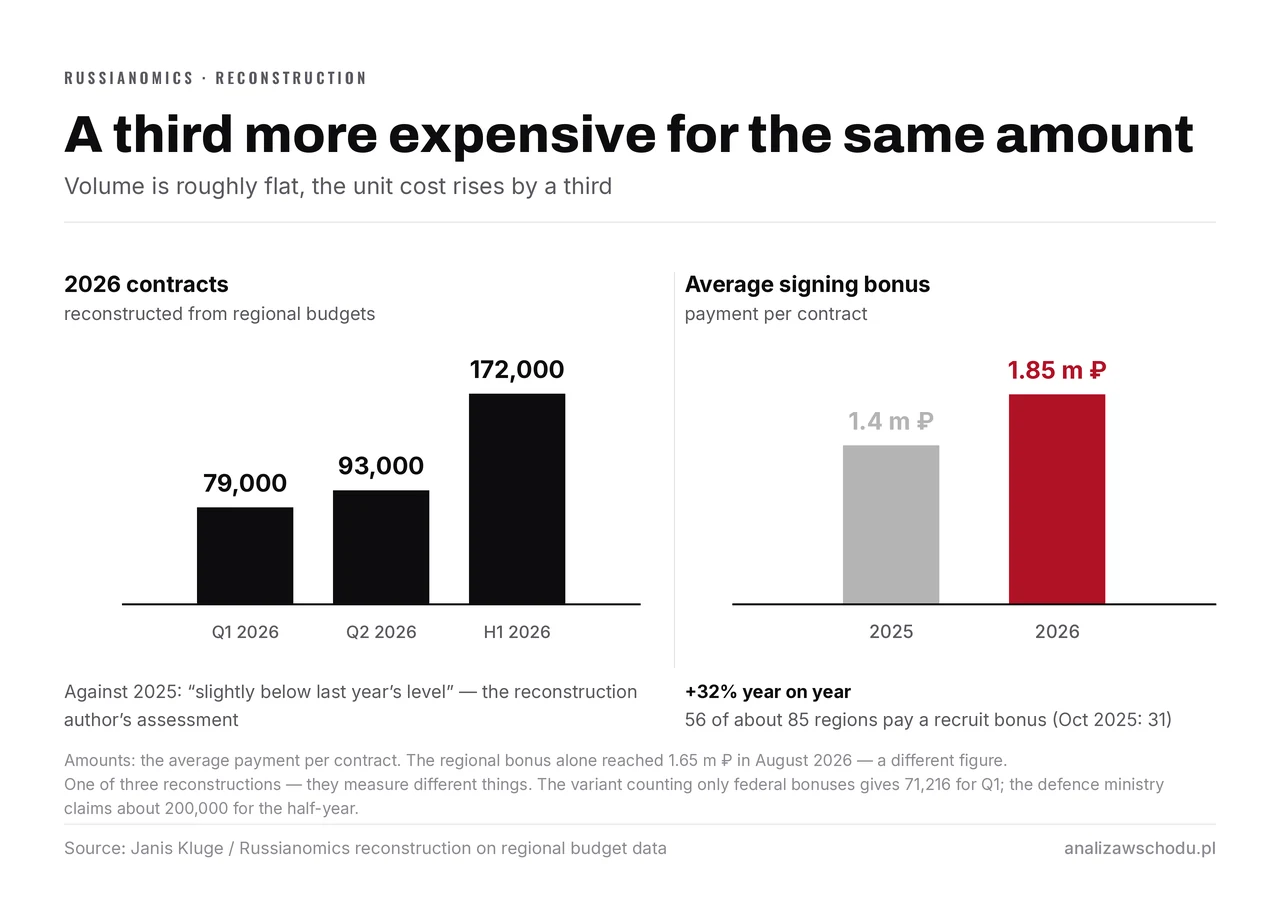
What is certain is the price. The average payment for a contract reached 1.8–1.9 million roubles by mid-2026 against around 1.4 million a year earlier, and the regional bonus alone hit an all-time record of 1.65 million in August. Volume is roughly flat, unit cost is up by a third. That is the whole argument of this section and it does not need stronger words.
What is not in that figure, and what weakens conclusions about capability: a breakdown by category. Assault infantry, drone operators and technical support are three different markets with different prices and different availability. The aggregate can hold steady while the decisive category collapses — or the other way round. Nobody publishes that breakdown, so "172,000" says more about money than about the army.
The war camp has stopped believing. Since January 2026 the prevailing view in the Russian pro-war space has been that the kill zone cannot be filled with bodies, and that all that would change is the number of Russians killed. This is said not by émigrés but by people who want a Russian victory.
The witness has changed his testimony — and this is the strongest argument against me. Leonid Volkov spent four years predicting that there would be no second wave, and he was right. At the end of July he wrote that he would no longer put money on it, because three brakes had stopped working at once: the sense of stability in society, the money for contracts, and Putin's conviction that the war is nearly won. Two of those three I confirm with my own data above. The third I can neither confirm nor refute.
And the elections are in September. Ratings fell to pre-war levels on the messenger blocking alone, and according to some reports the Kremlin has twice lowered its own expectations for the party of power: from 55 through 50 to 45 per cent. It would be hard to pick a worse moment for a decision that in 2022 tore up the unwritten contract with the "sleeping majority".
Part III. What follows
Part II set a condition. If the road of September 2022 — decree first, flight after — is closed, then the only wave possible today must outrun its own trigger. Such a wave looks different from that one: it is smaller, spread over time, and visible first in intention and only later in the registers. The rest of this text tests whether anything of the kind is visible.
What has actually moved
I start with Armenia, because the loudest figure of this summer concerns it. In circulation are 9,534 applications for temporary residence in the first half of 2026, from a press conference of the Armenian Migration Service. The figure is true, but it covers all foreigners, not Russians — nobody there gave a breakdown by citizenship. It can be reconstructed from the tables of the Armenian statistical office: Russians received 1,843 residence cards in that half-year against 1,509 a year earlier, that is 22 per cent more, while total inflow rose by 41 per cent. The entire excess was taken by non-Russians — the jump sits in the employment channel from outside the Eurasian Union, led by Vietnam, Iran, India, China and Indonesia.
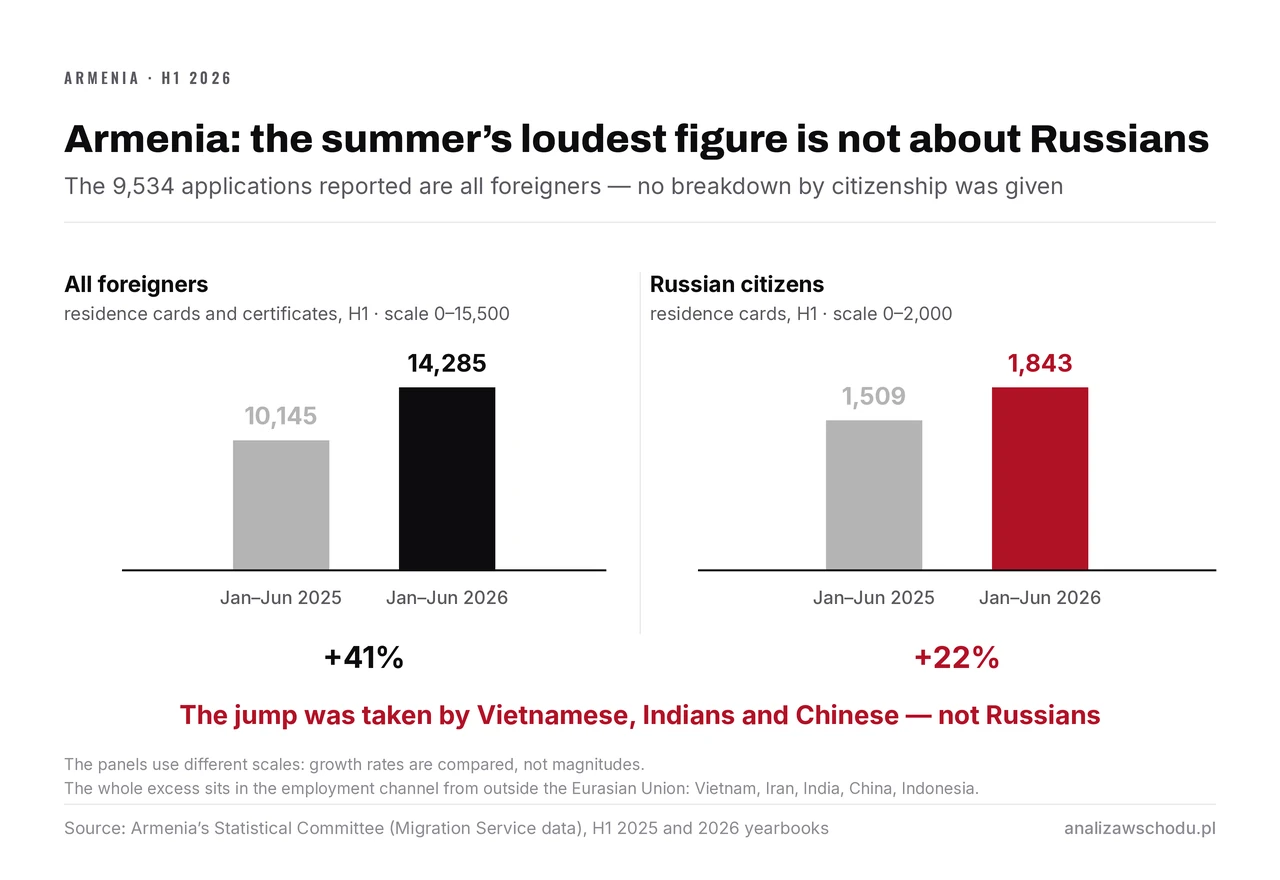
The context says the rest. First-time permits for Russians in Armenia: 8,660 in 2022, 3,350 in 2023, 3,381 in 2024, 2,903 in 2025. 2026 starts from a level lower than 2023. And from November the fees go up — from 105,000 to 150,000 drams for temporary residence — with the law passed in January, so throughout the half-year the incentive to apply before the rise was public and certain. Armenian citizenship does not say what is attributed to it either: of 25,670 grants in 2025, 19,367, that is 75 per cent, went to people displaced from Nagorno-Karabakh, for whom the state housing programme requires an Armenian passport. A passport is not a move.
The strongest signal of intention came not from a register but from an organisation that helps people leave. Kovcheg ("The Ark") — a support initiative, not a research centre — reported on 21 August that over twenty days of that month it had received 6.3 times more enquiries about leaving Russia than in the whole of May, and, counting the bot and the moderators together, more than eight times as many a day. That is markedly more than anything visible in the registers today.
Four caveats. Kovcheg is an interested party and admits itself that over the summer it switched on an anti-spam bot that purged accounts. These are enquiries, not departures. And the simplest point of all: it gave not a single absolute number, and eightfold from fifty is a different thing from eightfold from five thousand.
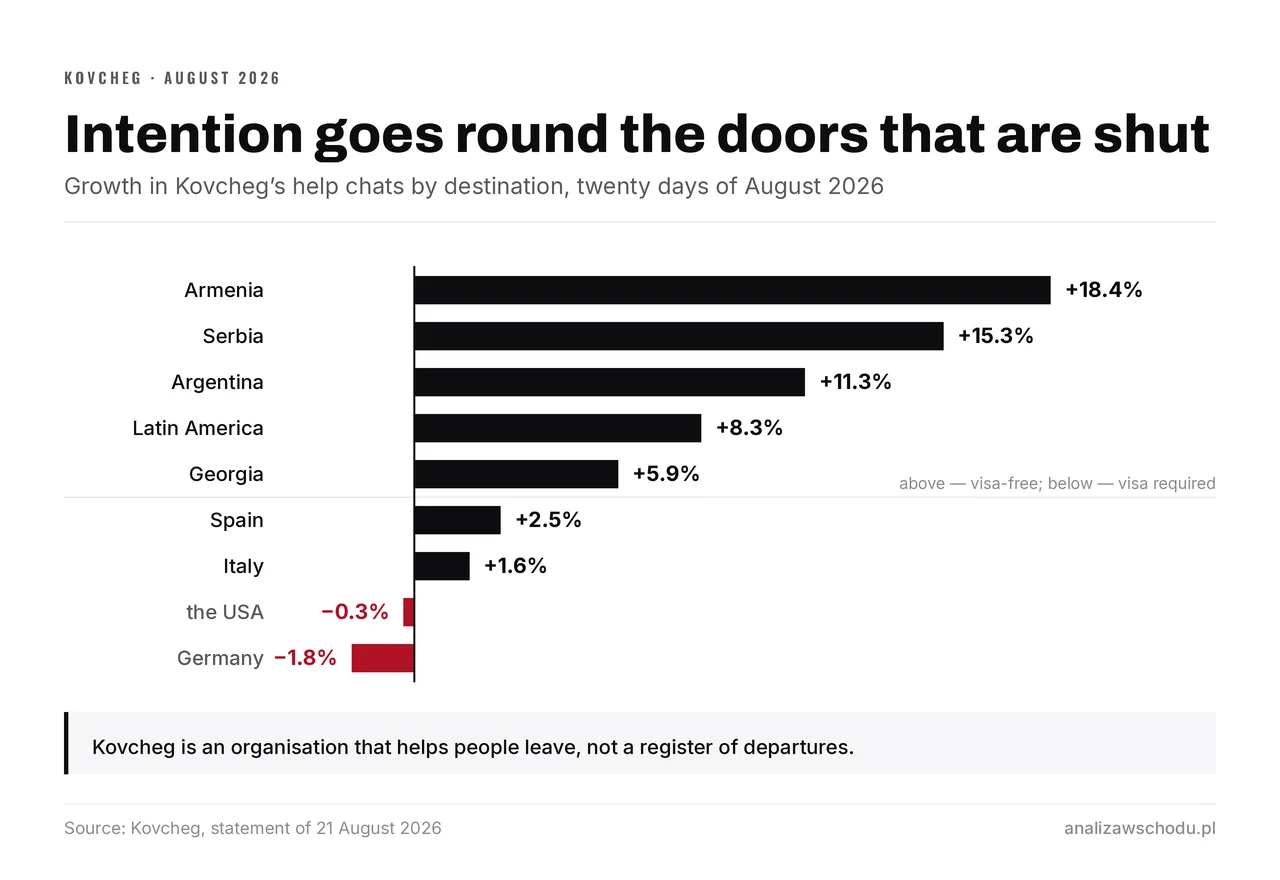
More important is where that intention is directed. Kovcheg's chats grew by 18.4 per cent for Armenia, 15.3 per cent for Serbia, 11.3 per cent for Argentina and 5.9 per cent for Georgia, while the Spanish one grew by 2.5 per cent, the Italian by 1.6, and the German and American ones shrank. Interest goes where entry is visa-free and legalisation simple, and avoids destinations requiring a visa — empirical confirmation of the thesis about doors, only from the demand side. With one catch: the whole of Latin America issues Russians around 4,000 residence permits a year, that is 5 per cent of the EU flow, and Argentina has had a negative balance since 2025. Intention is aimed at destinations whose combined absorptive capacity is a rounding error.
And here a contradiction emerges that cannot be swept away. Kovcheg shows interest in leaving up eightfold. Search engines show queries about leaving at 26 per cent of their January 2023 peak. Two gauges of intention, opposite results. The simplest reconciliation is this: Kovcheg measures a self-selected population — people already decided, looking for instructions. Search engines measure the whole population. A small group is mobilising sharply, the mass is not moving. Both figures can be true at once and that is, in my view, the right reading — but it is an interpretation, not a measurement.
The same goes for the series that is breaking an all-time record: "deferment from mobilisation" — 28,000 queries a month, against a previous maximum of 15,000–20,000 around the turn of 2022. I read that as the behaviour of someone who has a job that brings exemption and intends to stay. But in fairness: it can be read the other way, as evidence that society expects a decree and is looking for cover. I have no data that decide between those readings.
The wave came when nobody was expecting it
Since April 2022 I have counted at least ten episodes in which a coming wave was widely discussed. I give that number with a rule, because without one it is defenceless: by a cycle I mean a period in which a trigger with a date can be identified, the media wrote "will there be a new wave", and either the Kremlin or the Duma defence committee had to respond publicly. An eleventh candidate — May 2024, when the Financial Times wrote that new mobilisation was inevitable by the start of 2025 — existed in the press but left no trace in people's behaviour, so I do not count it.
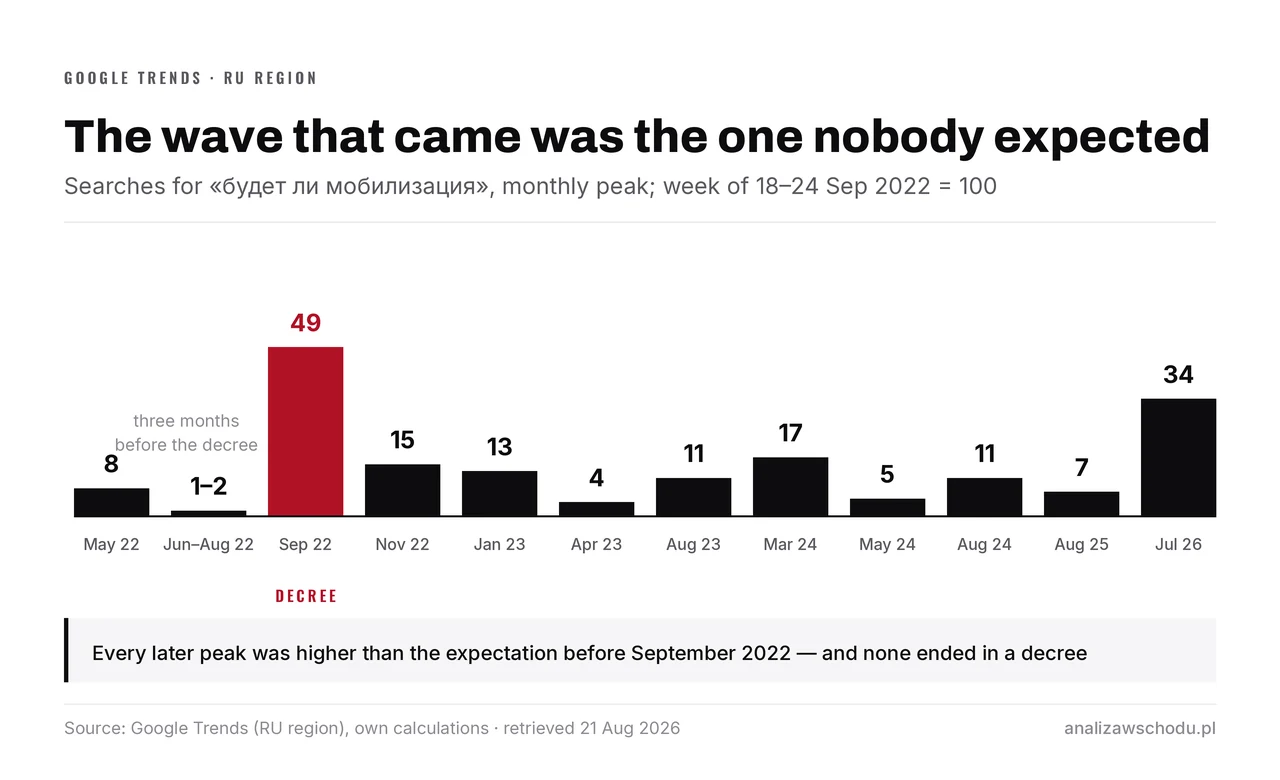
One of those ten ended in a decree. Two caveats about that proportion, because on its own it is not an argument. First, one in ten for an event with such consequences is a high number, not a reassuring one. Second, Part II of this text argues that the regime has changed structurally — and if so, the frequency from the previous regime carries over to today only in part. The proportion is therefore context, not a forecast.
Stronger is what the shape of the series shows: every later peak of expectation was higher than the expectation before September 2022 — and none of them ended in anything. January 2023, with a forged FSB order and four denials from Peskov in a month. March 2024, the structural twin of today: elections, an expected post-election window, Ukrainian intelligence forecasts, a forged Shoigu order in circulation, Grigory Sverdlin predicting 100,000–150,000 call-ups. July 2026 is the highest reading in four years.
The conclusion is not "nothing will happen". It is: the level of anxiety has never been a good predictor in this matter, and twice it was an inverse predictor.
What this means for Poland
Poland is not a first-choice destination in this story, and it is worth knowing where it stands. In 2025 it issued Russian citizens 4,267 first residence permits against 5,287 the year before — a fall of 19 per cent, faster than the EU average. That is fifth place in the EU, but a quarter of what Spain issues.
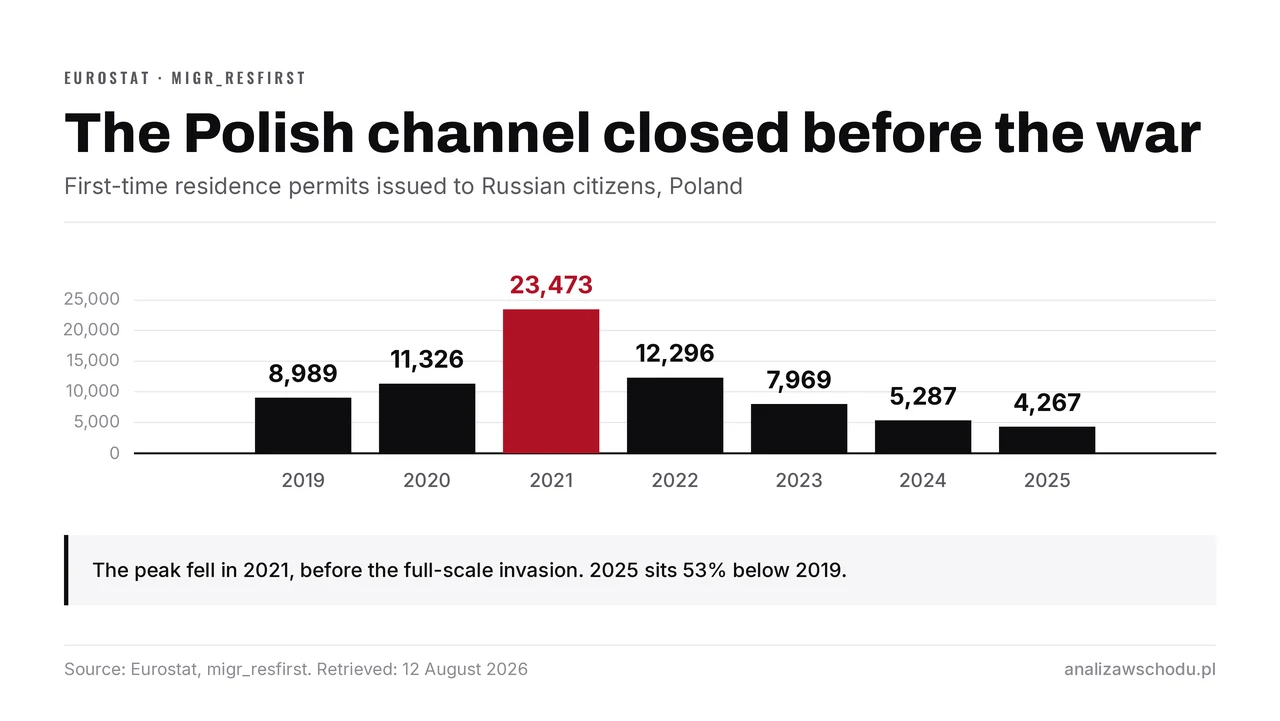
It is worth saying what specifically closed in Poland, because it was not the same channel as elsewhere. In 2021, 17,611 of Poland's 23,473 permits for Russians were issued on the basis of work; in 2025 that category gives 1,128 — 94 per cent fewer. Family reunification, which across the EU accounts for 40 per cent of permits, in Cyprus for 42 and in Serbia for 55, stands in Poland at 732 and has not moved in five years. The Polish channel was a work channel and it is the one that was switched off. A secondary wave, which elsewhere arrives through families, would have nothing to arrive through in Poland.
The second point matters more for whoever is making decisions. The instrument that actually moves the numbers is not national gestures but the recognition rate and EU procedures. Russian asylum recognition dropping below 20 per cent triggered mandatory accelerated border procedures across the whole EU from June 2026 — one technical figure changed the legal regime of twenty-seven states. The Polish debate about Russian migration revolves around symbols, and is settled in recognition statistics, Spanish residence offices and German case law.
What to watch
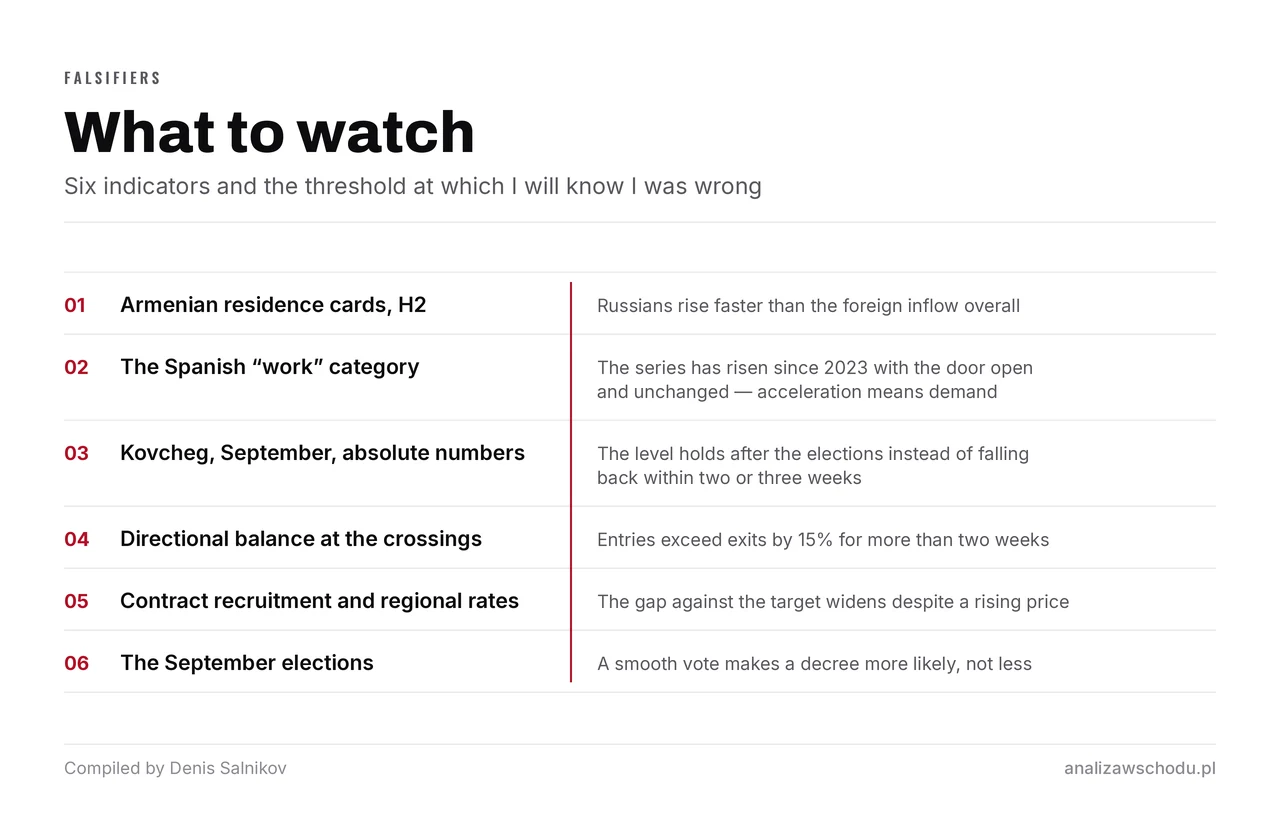
Residence cards issued to Russians in Armenia for the second half of the year, broken down by citizenship. They are published by the statistical office, not the Migration Service — and that difference overturned the whole interpretation this year. If Russians grew faster than total inflow, that would be the first hard settlement signal. Read it against the fee rise taking effect on 1 November.
The Spanish "work" category, dataset migr_resfirst. It is today the widest open settlement channel in the EU and the only one growing: 5,467 permits in 2025 against 575 in 2019. That door has been open and unchanged since January 2023, so movement in this series measures demand rather than an administrative decision — which cannot be said of any other residence indicator. An acceleration here would be the first hard trace of a new wave in the EU. German "work" serves as a control: it has fallen by two thirds since 2023, so if both move at once it will no longer be the effect of one national law.
Kovcheg's figures for September, preferably with absolute numbers. The only series with daily resolution that exists. Watch not the multiple but whether the level holds after the elections. A rumour cycle subsides within two or three weeks of being resolved; intention that turns into decision does not subside.
Directional balance at the crossings, not volume — and across a full quarter, not a single day. The threshold I adopt provisionally is entries exceeding exits by 15 per cent or more for more than two weeks. I note that it is uncalibrated: nobody published the directional balance for September 2022, so I do not know what a real wave looked like in this particular gauge. Plus a seasonal test: every normal year falls by roughly 45 per cent from the third quarter to the fourth, so holding August levels through October would be a break in the pattern.
Contract recruitment and regional rates. This is the causal variable of the whole affair. The third quarter will show whether the return to the 2024 pace can be sustained after the July increases. If the gap against the target widens despite the rising price, the argument for compulsion widens with it.
The September elections, counter-intuitively. A smoothly conducted vote increases the probability of a decree, it does not reduce it — because it is a test of how many people can be counted without resistance. Volkov puts this plainly, and it is a verifiable condition by which I will know I was wrong.
How I know this and what I do not know
The chart that started this discussion did not come to me from a media outlet or a research institute. It came in a reply under a post of mine, from a man who noted himself that the FSB data are quarterly, and left the analysis to me. He was right about most of it, and my first reaction was to reach for a figure about rents in Yerevan that turned out to be a survey of estate agents, not a statistic. Then I confused Armenian applications from all foreigners with Russian ones, and measured the EU by asylum instead of residence.
That is how knowledge about Russia circulates today. Not through forgery, but through reconstruction that loses the label, and through a figure repeated because it sounds specific.
Four years went into building a mechanism that can be switched on in a week. The only series breaking records today is about how to stay.
First published: X Article (in Polish), 22.08.2026
Cite as: Denis Salnikov, “The exodus that would have to outrun mobilisation”, Analiza Wschodu, 22.08.2026, https://analizawschodu.pl/en/articles/outrun-mobilisation.html
Text © Denis Salnikov. Quotation with attribution and a link is welcome. To reprint a full text or reuse a chart, write to ds@analizawschodu.pl