Armenia: the vote that will change the lives of people with no vote
· Denis Salnikov
On Sunday Armenia will be voting not only for parties but for a direction: a deeper anchoring in the European Union and Western security structures, or an attempt to hold a "balance" with Russia and the Eurasian Economic Union. For Pashinyan's government it is the moment when the move away from Russian security guarantees after Karabakh has to be balanced against the fact that Russia still accounts for a substantial part of Armenian foreign trade.
The familiar groups recur in the Armenian debate over the "pro-EU" and "pro-Eurasian" course: economic elites attached to the Russian market, a diaspora pressing for a Western turn, and an army and security services that have lived for decades inside the logic of alliance with Moscow. What is rarely discussed is a group with no right to vote that has visibly changed Yerevan since 2022 — the Russian arrivals, who often call themselves not emigrants but "relocants", as though their departure were a shift of coordinates rather than a break with Russia.
The Russian wave was above all a catalyst of processes already under way in Armenia. Rents in Yerevan had been rising for years, but after 2022 they jumped harder, because newcomers from Moscow and St Petersburg with bigger budgets and different expectations joined the competition for flats in the centre. In services, some of the new cafés, gaming clubs and small businesses were set up by relocants, raising the standard of service, but local entrepreneurs quickly copied those models and benefited from the increased traffic. In parallel with the inflow of people came a growing presence of Russian firms and platforms — from Yandex to the hundreds of Armenian SMEs using Wildberries and Ozon — which brought extra trade and jobs, but created a new channel of dependence on Russian digital infrastructure.

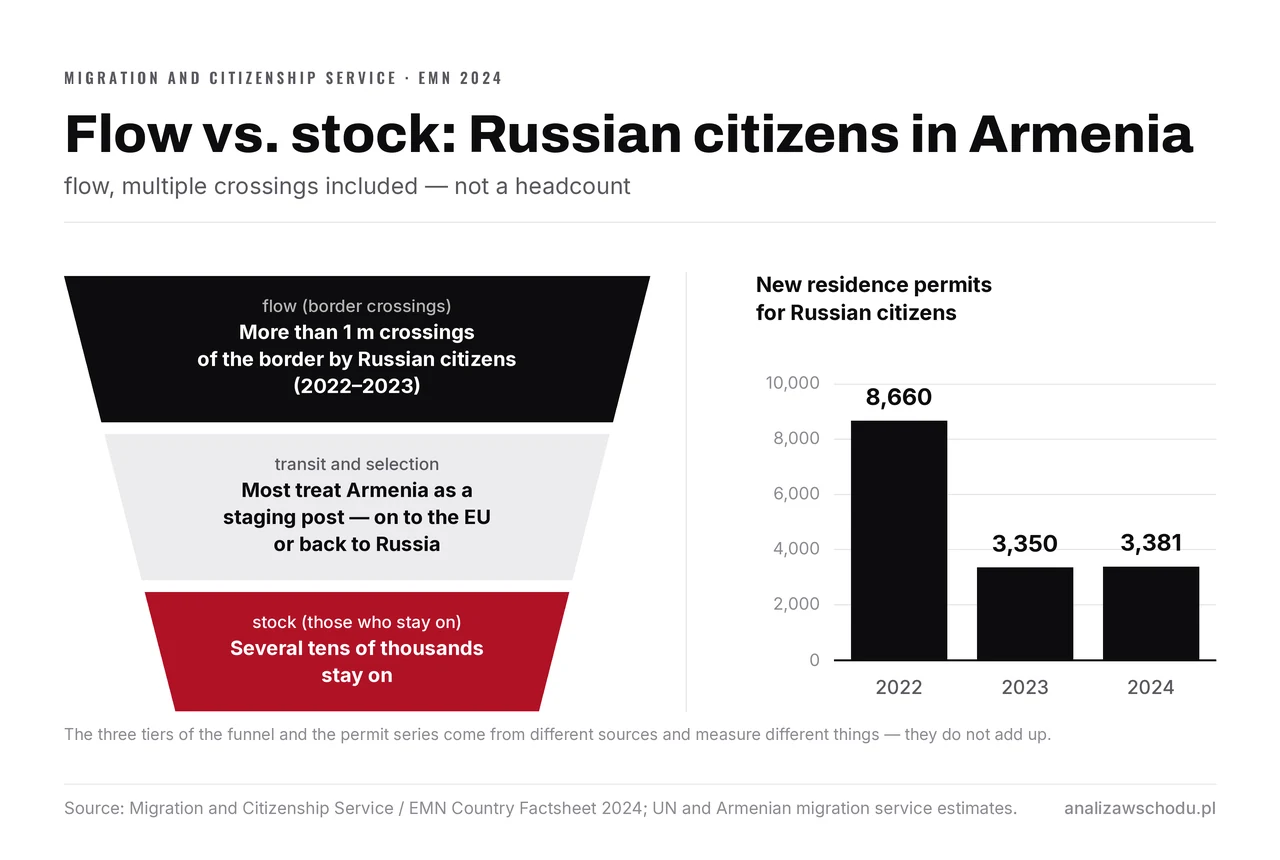
What has been happening in Armenia since 2022 is not an isolated phenomenon. Similar waves of Russian migration passed through Tbilisi and Batumi, and on a smaller scale through Baku, changing the housing market, the structure of services and the tensions around a pro-Western course across the whole Caucasus region. According to estimates by the UN and the Armenian migration service, more than a million Russian citizens came to Armenia in 2022–2023, of whom at least several tens of thousands stayed longer. Russians made up around 58 per cent of the people granted permanent residence in Armenia in 2022. In a country of fewer than three million inhabitants that means at one point every tenth adult resident of Yerevan may have been a new arrival from Russia — many of them from the anti-war opposition, with experience of protests, independent media and NGOs. These are people who genuinely help make today's Armenia and who will live with the consequences of Sunday's vote, though they have neither the franchise nor a party of their own in the campaign. This piece is about them, and about what their presence does to the Armenian state at the moment it is trying to leave Russia's orbit without cutting the last safety lines.
The city after the wave: what Yerevan looks like in 2026
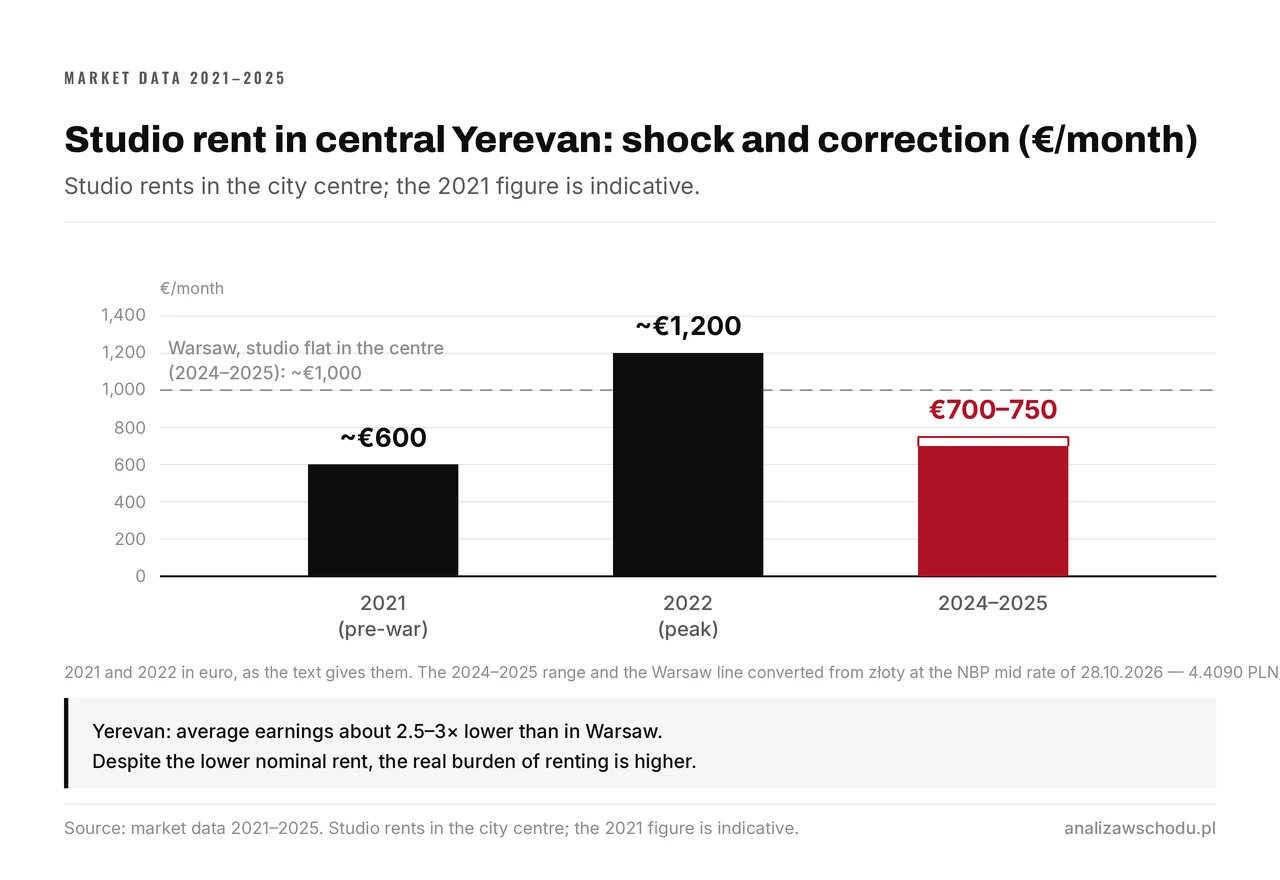
Yerevan in 2026 is a city where the effects of the 2022–2023 wave show up first in rental listings and only afterwards in election posters. Flat prices had been rising already, but the war and Russian migration meant that within little more than a year part of the market jumped into territory that had seemed unimaginable in 2021. Before the full-scale invasion, about 600 euros would rent a decent flat in central Yerevan; a few months after February 2022 the owners of those same flats were asking around 1,200 euros, and agents spoke of rates rising by 30–40 per cent in a single season. In 2023 the average rent for a one-room flat in the city centre reached almost 1,000 dollars, about 400,000 drams. The market remains unsteady — reports from 2025 describe a stabilisation and a slight correction after the peak, but not a return to pre-war conditions.
Market data for 2024–2025 show that renting a studio in central Yerevan has come close to Warsaw, despite earnings three times lower (chart below). In a city with average earnings three times lower, renting a flat in a good location has become only slightly cheaper than in the Polish capital. It is a housing shock much like the one Polish cities went through after 2022, having taken in millions of refugees from Ukraine. Earlier, on a smaller scale, the same was experienced by centres of mass migration from Russia, Belarus and Ukraine — Limassol in Cyprus, or Lisbon — where an influx of new residents quickly pushed rents beyond the reach of the local middle class.
That tension is easiest to see not in tables but on the streets in the evening. One of my long-standing acquaintances, resident in Yerevan since the autumn of 2022, says that in the autumn of 2023 "on a November evening in the centre you still saw a great many Russian faces", but a year later, after a wave of departures to the European Union and partly back to Russia, "there were visibly fewer of those faces". That observation chimes with the migration data: the number of new residence permits issued to Russian citizens fell from 8,660 in 2022 to around 3,350 in 2023 and 3,381 in 2024, while new people kept arriving. The city was not so much "left empty after the wave" as moved into a state of continuous rotation: some move on, others take their place, and the price burden on locals stays.
The map of services has changed too. Some of the new cafés, gaming clubs and small eateries were opened by newcomers, often aiming at a "Moscow" standard of equipment and service. It quickly turned out, though, that these are not exclusively enclaves "for our own". Young Armenians, Ukrainians, Belarusians and other arrivals from the former USSR, for whom Russian remains the language of everyday life, began frequenting many such places.
The way Yerevan organises daily life has changed as well. After 2022 Russian food delivery and shopping apps and marketplaces such as Wildberries and Ozon became, for many relocants and some locals, the main channel of purchase — from food to electronics and clothes. Their arrival made life easier for newcomers, imported new consumer habits into Armenia and made part of the economy dependent on platforms beyond the reach of the Armenian regulator. In parallel, local entrepreneurs began copying the relocants' solutions: a new type of café, a computer club with good equipment, a better-organised service — today these are not merely "Russian inventions" but an element of a broader modernisation of Yerevan's service sector.
Behind the new premises lie specific entries in the registers. Between the end of February 2022 and the end of March 2023, Russian citizens registered in Armenia 2,613 companies and 6,248 sole traders — for comparison, Ukrainians 70 and 67, Belarusians 101 and 129 — often in trade and urban services, including catering. This is a smaller scale than in Poland, where in 2022–2023 Ukrainians opened some 48,000 sole proprietorships in all, but the mechanism is similar: migration at a moment of crisis turns very quickly into entrepreneurship, which changes the structure of the market.
The scale of interest in these destinations shows even in the numbers on Telegram. The Russian-language group "Переезд в Армению: Поиск жилья" ("Moving to Armenia: finding a flat") currently gathers around 6,500 people looking for a roof over their heads in Armenia, while the chat "ИП в Польше" ("Sole proprietorship in Poland"), devoted to self-employment in Poland, already has around 12,500 members, and the channel "Работа в Тбилиси" ("Work in Tbilisi") around 18,500 subscribers. It is not a like-for-like comparison, but it shows well enough that Armenia, Poland and Georgia form a shared map of Russian-speaking migration: in one place people are looking above all for a flat, in the second for the rules on setting up a company, in the third for work on the spot.
Unlike Belgrade or parts of Tbilisi, the Russian bubble in Yerevan is less airtight. First, almost every Armenian in the city speaks Russian or at least understands it; second, whatever the politics, after 2020 many families have relatives in Russia, or experience of studying or working there. That absence of a language barrier means "Russian places" rarely stay hermetic — it is easier to walk into them and out of them. Which in turn means that some relocants, after a few years, speak of a natural integration. At the level of the city, then, a double change is visible: Yerevan has become more expensive and more densely built up with the symbols of a middle class, and at the same time more polyphonic — in the cafés, on the streets, in the co-working spaces and in the queue at the migration registry, Armenian, Russian and Ukrainian mix.
Waves, not one wave: 2022–2026
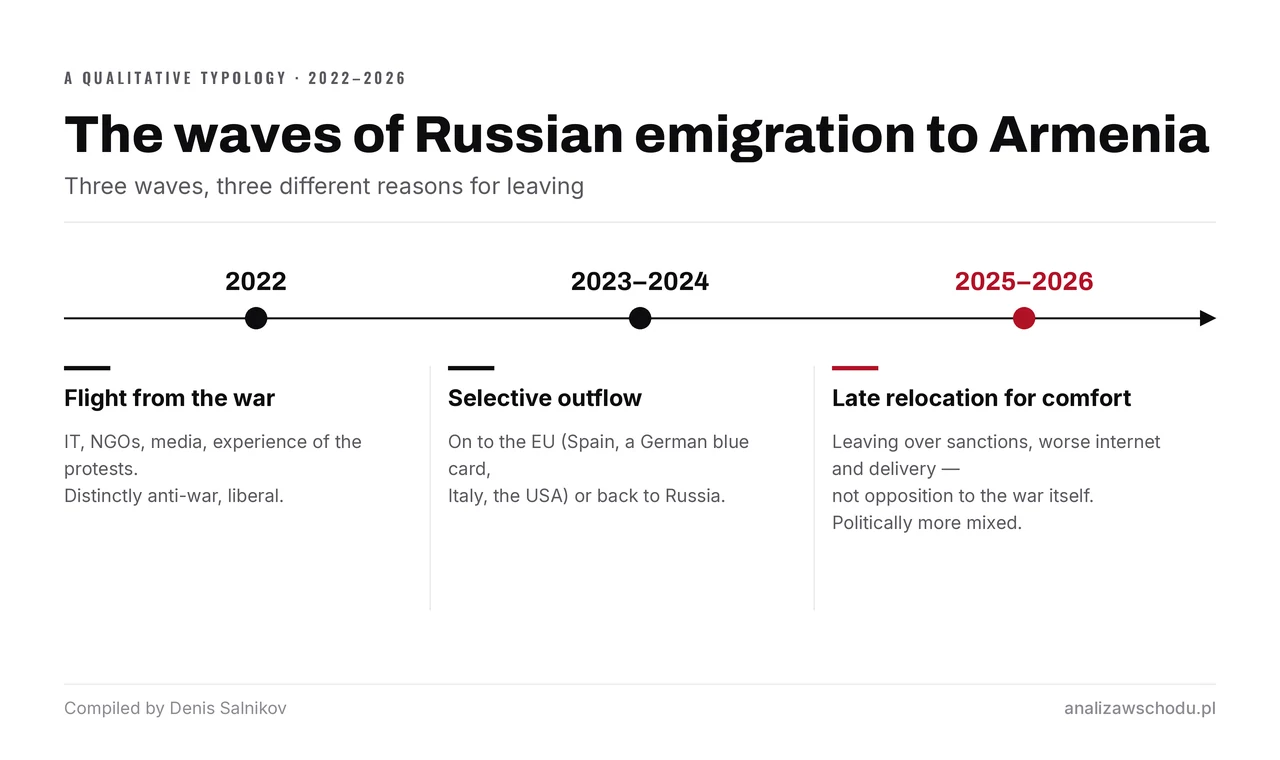
The first wave of Russian migration to Armenia in 2022 was above all a wave of flight from war. Tens of thousands of people crossed the border from Moscow, St Petersburg and other large cities, often from IT, NGOs and the media, with experience of protests and of work in opposition circles. A ZOiS study from late 2022, based on interviews with more than 1,600 Russian migrants in Armenia and Georgia, shows that in both countries young residents of large cities dominate, people from Moscow and St Petersburg are over-represented, and the level of education and of prior civic activity is markedly higher than in Russian society at large. In Armenia 25 per cent of respondents say they took part in anti-war protests before leaving Russia, around three quarters lay responsibility for the war unambiguously on the Russian authorities, and around 66 per cent have a positive view of Zelensky. This is the group easiest to mistake for "the liberal emigration" — and the one that became visible in Armenian cafés and co-working spaces immediately.
At the level of flows the scale was enormous. According to UN and Armenian migration service data, more than 600,000 Russian citizens crossed the Armenian border in 2022 alone, and over a million in 2022–2023 in total, some of them repeatedly. In some months Russians made up 40–45 per cent of all tourist and migration arrivals in the country, and Armenia came second among CIS states for the inflow of Russian tourists and relocants. It was this wave that produced the gaming clubs and cafés run by newcomers in Yerevan, and the housing market's price shock described above.
From late 2023, though, the picture began to change markedly. National migration statistics show a run of years with a positive balance: from around 6,100 people in 2022, through 41,400 in 2023, to 76,900 in 2024, when some 119,500 people came to Armenia and 42,600 left. From the point of view of Yerevan's residents, what was visible above all was the departure of the first wave. Already in 2023 many newcomers treated Armenia as a staging post: whoever sorted out papers for Spain, a Blue Card in Germany, visas to Italy or the United States, moved on during 2023–2024; others went back to Russia, because emigration turned out to be harder financially and psychologically than they had expected.
In 2024–2025 the change became visible in the fabric of the Russian community. One venue after another run by relocants closed in Yerevan — not because Russians had run out altogether, but because a key part of the regular clientele, or the owners themselves, had left, and new arrivals did not want or could not take the business over. In the statistics, registrations for longer-term residence fell after the 2022–2023 peak, and some of those living there operate in "visa-run" mode — cyclical border crossings with minimal bureaucracy.
Only against that background does the third wave make sense, the one that began to take clear shape in late 2025 and in 2026. The administrators of the large Russian-speaking migration communities in Armenia stress that the 2026 wave is the largest for several years, and Telegram groups of the "Moving to Armenia: finding a flat" type are swelling again with questions about flats, registration and taxes. This is already a different group from those of the war's first months: more people who stayed in Russia through 2022–2024 and were pushed into a late relocation only by sanctions, a deteriorating internet, problems with deliveries and mounting economic uncertainty — rather than by opposition to the war as such. Within the milieu of earlier arrivals that difference of motive is sometimes read with reserve: relocating "because the delivery works worse, not because there is a war" is seen differently from the flight of 2022. That, however, is a judgement formed inside the group, not an analytical finding — the boundaries between the waves remain fluid.
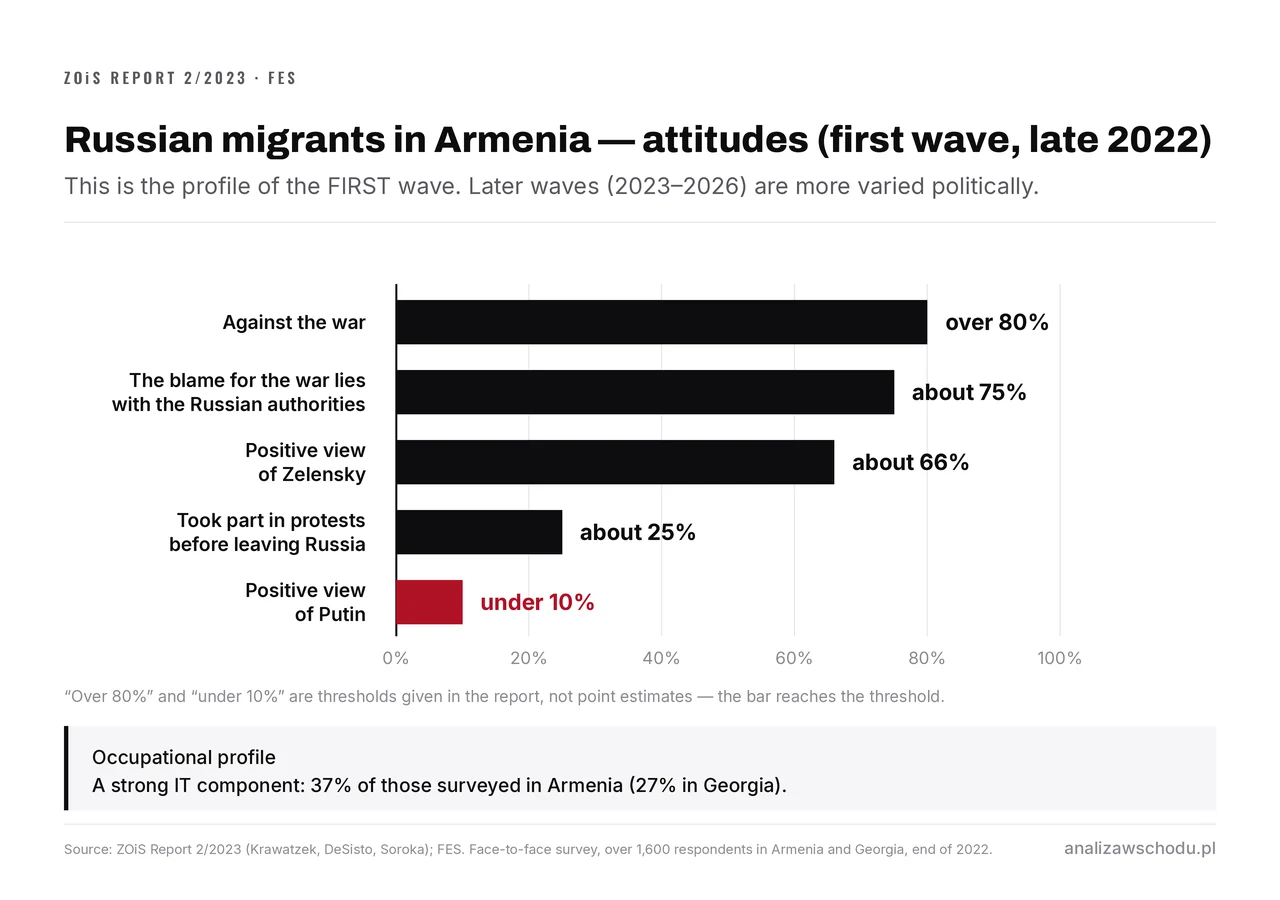
A more recent ZOiS report on the "political diversity of the new migration from Russia" is a reminder in any case that there is no single liberal exodus. Armenia and Georgia did indeed attract a high proportion of young, well-educated migrants from large cities, among them many IT workers, with substantial experience of protest and a clearly anti-war position; in Armenia a majority of respondents think Russians abroad ought to protest against their own government. In Turkey and Kazakhstan the profiles are closer to the Russian "average", with a greater presence of pro-government attitudes, and in Kyrgyzstan a mixture of both trends is visible. From Armenia's perspective this means that the first wave really was distinctly anti-war and liberal, while the later waves are far more varied — and within them one meets a former demonstrator as readily as someone who keeps as far from politics as possible.
That variation also helps to make better sense of the differences between Armenia and Poland. In Poland refugees from Ukraine have no voting rights — like Russian relocants in Armenia — but from the outset they received a broad package of social rights and access to the labour market: a full right to employment, family benefits, healthcare, and the ability to set up firms, which in 2022–2023 produced the registration of some 48,000 sole proprietorships and meant that one in ten new companies in Poland was Ukrainian. In Armenia the legal framework is narrower, and Russian arrivals — even the most politically engaged — are left with more limited access to formal routes of integration, which reduces their influence on institutions to indirect channels: the labour market, the media, NGOs and networks of contacts.
These three waves — flight from war, selective outflow and a late relocation of comfort — together make up what is visible in Yerevan today with the naked eye and what other interlocutors describe too: IT friends moved from Moscow on contracts in Armenia, journalists and activists who treat Yerevan as a safer base, entrepreneurs who opened bars and clubs in 2022 and shut them two years later, service workers who preferred to stay and "just live". The result is that the Russian presence in Armenia is no longer one heroic story about anti-war emigration, but a set of superimposed layers — from the politically overheated to the entirely apolitical — and which of them will matter more to Armenian politics after this election remains open.
Whichever wave someone belongs to — the anti-war one of 2022, the revolving one of 2023 or the "comfort" one of 2026 — the result of Sunday's vote will touch them in the same place: personal safety, and the certainty that Armenia will not sell them back to Moscow.
What the election result means for them
For Russian relocants in Armenia, Sunday's election is not an abstract vote "about geopolitics" but a practical question: will it be safer here than in Russia, Georgia or Turkey, and for how long. The result will not give them a vote, but it may radically change two things that matter to them: the level of risk from Russian state structures, and how Armenia arranges its relations with Moscow on extradition and the presence of Russian services on its territory.
In the background hangs the memory of specific "bad cases". In December 2023 the Russian military police detained the Russian deserter Dmitry Setrakov in Gyumri and took him to Russia with no legal procedure at all — the Armenian Prosecutor General's Office stated that it had received no extradition request, and human rights organisations described the case as an extrajudicial abduction rather than an extradition. A few months earlier the Armenian services had detained, at Moscow's request, a Russian citizen accused of desertion and then — under public pressure — released him from custody, which showed how large the grey zone is between the letter of the agreements and actual practice. In 2025 the media also described the case of the anti-war activist Liliya Manyukhina, convicted in Russia formally of "robbery" (the alleged theft of a pistol while putting up anti-war posters — Memorial regards the sentence as political), who was detained in Armenia on 30 August 2025 on a Russian extradition request and spent many weeks in custody before the case reached the higher courts.
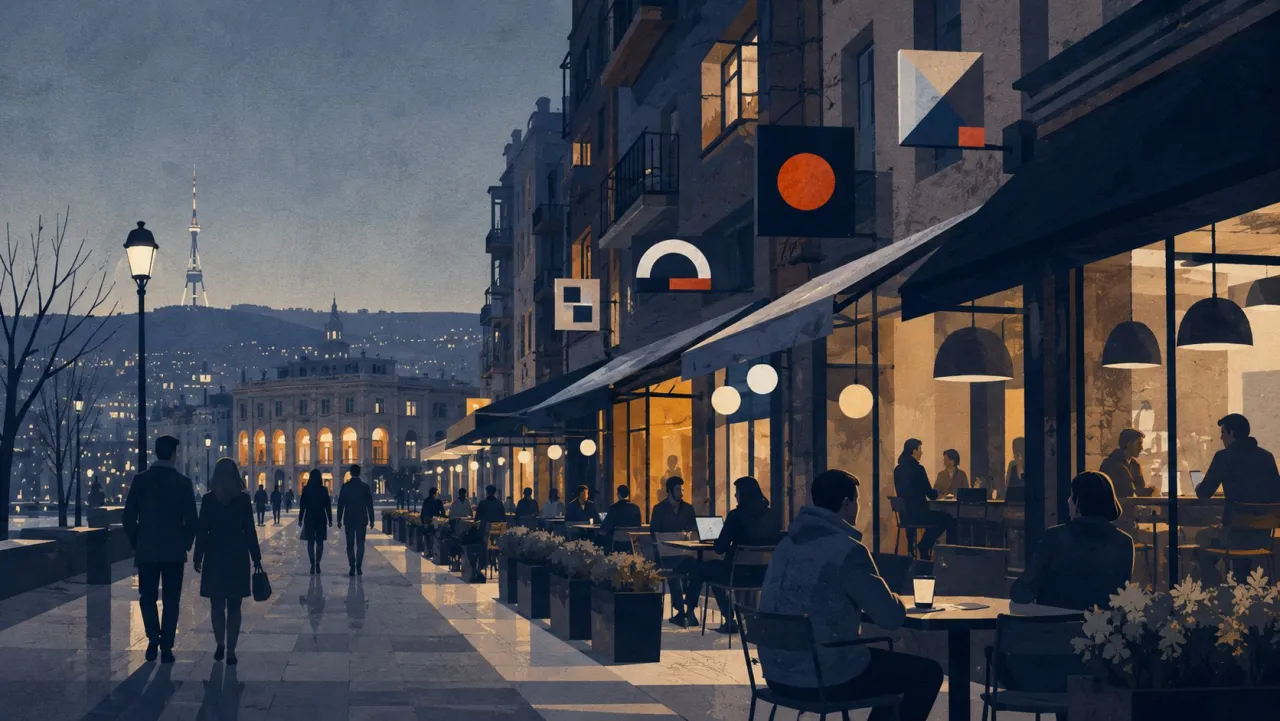
Against that background the decision to remove the FSB from Yerevan airport is symbolic. In 2024 Armenia formally asked Moscow to end the work of Russian border guards at Zvartnots airport; in July 2024 a protocol was signed on the takeover of border control by Armenian services, and the FSB Border Guard ended its service there after 32 years. For many Russian migrants that was a visible signal: at the point of entry to the country there no longer stands a Russian formation that had been accused of abuses, of turning back inconvenient people and of "increasing the sensitivity" of Armenia's border to Moscow's expectations. An ordinary scene — boarding a plane to Yerevan knowing that on the other side the passport will be checked by an Armenian and not by an FSB officer — became for many of them a simple indicator of the direction the host state is taking.
The election result will decide whether that direction is maintained and reinforced, or rather halted. A Breavis poll from May 2026 (5–11 May, 1,551 respondents) gives Pashinyan's party close to 65 per cent of decided voters, with no opposition party above 12 per cent — a continuation of the pro-Western course is the base case today. In that variant one can expect further limits on cooperation with Russia over extradition and less willingness to act on Russian requests for the surrender of activists, deserters or journalists. The speaker of parliament, Alen Simonyan, said outright in 2026 that Yerevan does not plan to hand over Russian citizens at Moscow's demand, which together with the FSB's removal from the airport makes a coherent political line. For relocants, especially those with convictions in Russia or experience of violence from the Russian services, that is a real difference: not between being a "citizen" and a "non-citizen", but between living with a suitcase packed "just in case" and being able to plan a future over several years.
The opposite scenario — a return to "balancing" between Russia and the West — is less likely today, but cannot be ruled out; in it the same group would find itself in a harder position. Moscow is already trying to strengthen the legal instruments that protect its own citizens serving in the Russian army from extradition to third countries, while aggressively pursuing anti-war activists abroad. In such an arrangement every wobble by Yerevan towards "normalising" relations with the Kremlin will be read by them through specific cases — like the deserter from Gyumri, or the Manyukhina case: will Armenia stand on the side of human rights, or on the side of military agreements with Russia.
Who are the ones who stayed
Research by ZOiS and FES shows that Russian migrants in Armenia are overwhelmingly young, urban and well educated, with a strong IT component. At the top sits a layer of programmers, product managers, data and cybersecurity specialists and startup people — often moved to Yerevan on contract by large firms — and below it stretches a layer of service work and small enterprise, visible for instance in the story of one interlocutor: catering, a marketing agency, later a canine training centre.

Research and local analysis suggest that around 30–40 per cent of this new migration in Armenia is directly connected with IT and information services — in Georgia the share is lower — with the rest in services, small trade, freelancing, education, media and NGOs. The Apri Institute estimates that after 2022 most newly arrived Russians in Armenia were IT specialists, and that by the end of 2023 around 60,000 Russians may have remained in the country, mainly in Yerevan. Kursiv and more recent analyses speak of around 50,000 programmers and around 2,000 relocated IT firms, which in the war's first two years increased the number of IT employees in the country by roughly 50 per cent.
At the macro level this group has become one of the main engines of the Armenian economy. The OECD notes that as early as 2022 the ICT sector grew by around 20 per cent and generated about 4.5 per cent of Armenia's GDP, pointing to the relocation of firms and specialists from Russia as the main factor in that jump. Government and industry data from 2024–2025 paint a stronger picture still: according to the Armenian Ministry of Economy and the Statistical Committee, the country's economy grew by 7.2 per cent in 2025, and among the three fastest-growing sectors are construction, financial services and ICT. The high-tech sector has grown more than tenfold in the number of firms and almost threefold in employment over eight years (chart below). Technology and the broader high-tech sector generate around 7 per cent of Armenia's GDP today, and over the past decade have grown at 20–25 per cent a year, with individual years higher still.
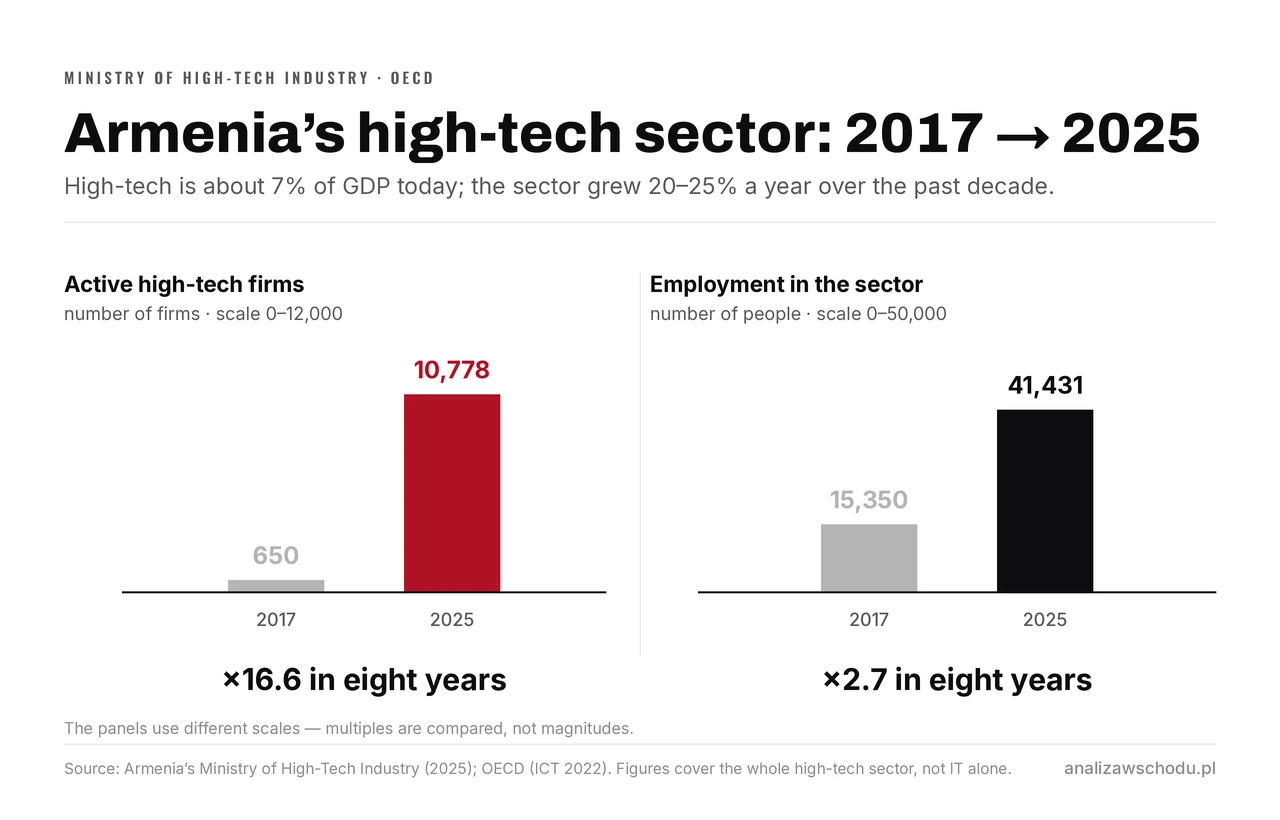
A whole ecosystem of co-working spaces, coding schools and payment services has grown up around the relocated firms — which on one hand provides jobs and on the other creates a new channel of potential economic pressure. Armenia is following a path Cyprus took a decade ago. There the ICT sector grew to 11–16 per cent of gross value added and became one of the main motors of the economy thanks to the relocation of firms from Russia, Ukraine and Belarus. In Armenia technology accounts today for 5–7 per cent of GDP, but is growing at 20–25 per cent a year, largely on the wave of post-war migration from those same countries.
At the individual level this translates into large differences within the group. A programmer on a relocated contract at a big firm often earns several times the Armenian average, pays taxes in the new state, rents a flat in the centre and is a beneficiary of Armenia's course towards integration with the West. A barista, a barman or a dog trainer working in venues opened by relocants, by contrast, depends far more on the condition of the real economy and on customers' moods — their stake in the election is more down-to-earth than geopolitical. The profile of this group is paradoxical: in terms of GDP and the tech sector's statistics, Russian migrants are a new engine of the Armenian economy, yet their internal variety means the same election result is read very differently by people living in one city and often sitting in the same café.
Migration as an instrument of influence — and what Armenia will do about it
Russian migration after 2022 is for Armenia a rescue and a risk at once. On one hand it set off rapid growth in IT, services and part of exports — to the point that technology and the broader high-tech sector account today for an estimated 5–7 per cent of GDP, and the number of firms and employees in the industry has grown several times over in a few years. On the other, a large part of that growth is bound up with Russian economic and social networks: firms that have merely "hooked themselves" onto Armenian law, platforms handling payments and logistics, and thousands of people remaining in the grey zone between emigration and relocation.
From Moscow's perspective such an arrangement is convenient. The Russian authorities can let some of their unruly citizens "leave instead of protesting", offloading the cost of maintaining them onto transit and destination states, while keeping over them the shadow of Russian sentences, wanted notices, extradition requests and economic pressure on the countries hosting their firms and their money. In Armenia this is especially sharp: in 2022–2024 the same channel that carries programmers and taxes can serve to force decisions over deserters, anti-war activists or the regulation of Russian platforms.
Sunday's election in Armenia will largely settle how the state answers that double logic. The pro-Western course favoured in the polls means gradually closing the space in which Russia combines migration, criminal law and economic platforms into a package of pressure: less room for the FSB at the border, a harder line on extradition, more attention to data and digital infrastructure security, and clearer rules of residence and work. The less likely return to "balancing" between Moscow and the West would leave more flexibility for negotiating exceptions and informal arrangements — but it is exactly that flexibility Russia has used to turn migration and business into instruments of influence in Georgia, Kazakhstan and Armenia.
For the relocants themselves the stake is whether they remain above all human capital — programmers, entrepreneurs, service specialists — or become a bargaining chip in Armenia's relations with Russia and the West. For Armenia the stake is the reverse: whether it can use their presence as an argument for becoming independent of Moscow, showing that it can protect those fleeing the Russian state and build their competence into its economy, before Russia inverts that logic and reminds Yerevan that every wave of migration can be not only a gift but a lever.
#KierunekWschodni #Armenia #Migration
First published: X Article (in Polish), 03.06.2026
Cite as: Denis Salnikov, “Armenia: the vote that will change the lives of people with no vote”, Analiza Wschodu, 03.06.2026, https://analizawschodu.pl/en/articles/armenia-without-a-vote.html
Text © Denis Salnikov. Quotation with attribution and a link is welcome. To reprint a full text or reuse a chart, write to ds@analizawschodu.pl
* Graphics marked with an asterisk are mood images and may contain AI-generated elements. Charts, timelines and tables carry no asterisk — their figures come from the sources named beneath them.