Who has the right to say "colonialism"?
· Denis Salnikov
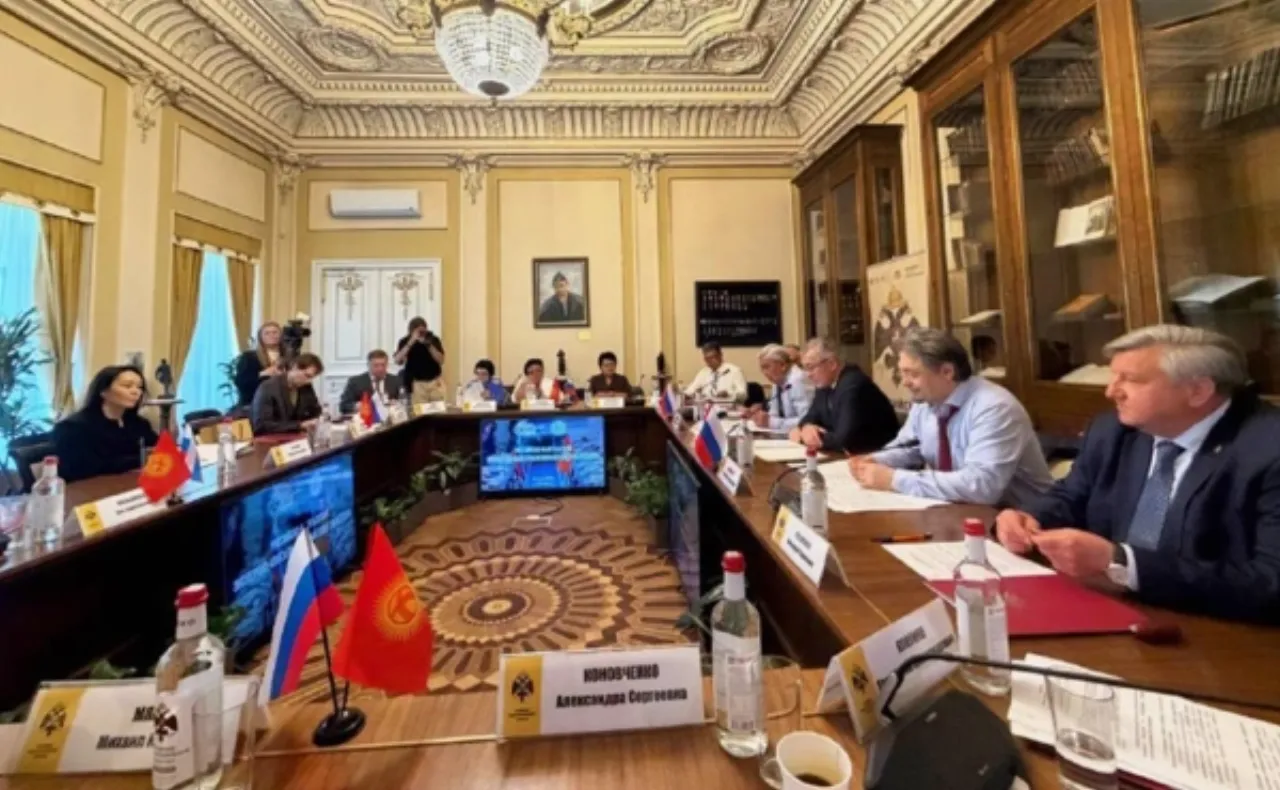
On paper it was a modest academic council attached to the Russian Military Historical Society: experts from Russia and Kyrgyzstan were to agree on joint history textbooks. In practice the meeting ended on a single word — "colonialism" — and a full-scale war over memory.
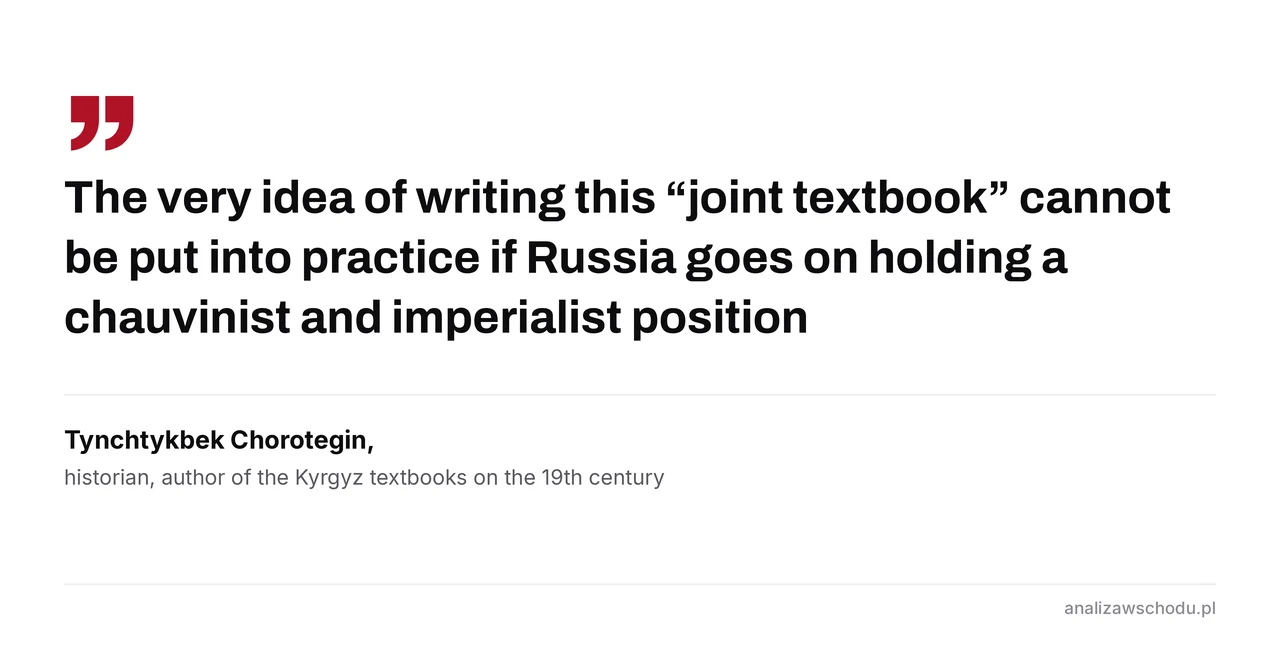
The Russian historians — led by Andrey Bykov, who called the use of the word "colonialism" simply a "fashion" — proposed replacing it in Kyrgyz textbooks with terms such as "administration" or "administrative measures", supposedly more "neutral". The authors from Bishkek refused, and Tynchtykbek Chorotegin later called the very idea of a joint textbook "impossible" and "disgraceful" for as long as Russia holds to its chauvinist frame.
Moscow's response was textbook: Rybar, the Russian military-propaganda Telegram channel, is indignant that an "allied" state enjoying Russian preferences speaks of "colonial oppression", and Kommersant does its homework, arguing that Turkestan was a loss-making province and nothing like British India, so the word "colony" is an overstatement. The Kyrgyz answer that they want to name their own history as they lived it — and that their experience fits the classic definitions of colonialism all too well.
Moscow: "administration" in place of "colonialism"
The course of the Moscow session is by now fairly well documented — from Kommersant's account to the public posts of the Kyrgyz historians themselves. The Russian side started from the premise that the term "colonialism" is "at the least debatable, if not mistaken", and that swapping it for "administration" is enough to be rid of the "negative connotations".
The authors of the Kyrgyz textbooks, among them Chorotegin (nineteenth century) and Marat Imankulov (twentieth and twenty-first), found themselves in the dock — their passages about the "chauvinist and reactionary policy of the colonial authorities" and the "colonising thrust" of the Russian empire were presented by Russian media as an ideological crusade against a "common history". Chorotegin replies directly in his Facebook posts: a joint textbook is impossible as long as Russia insists on an imperial vocabulary and refuses to acknowledge the colonial character of its presence in the region.
What Moscow is forcing here is more than a correction of vocabulary — it demands that Bishkek give up the one category that allows the asymmetry of the relationship with the centre to be described at all.
The semantic trick: "colonisation" ≠ "colonialism"?
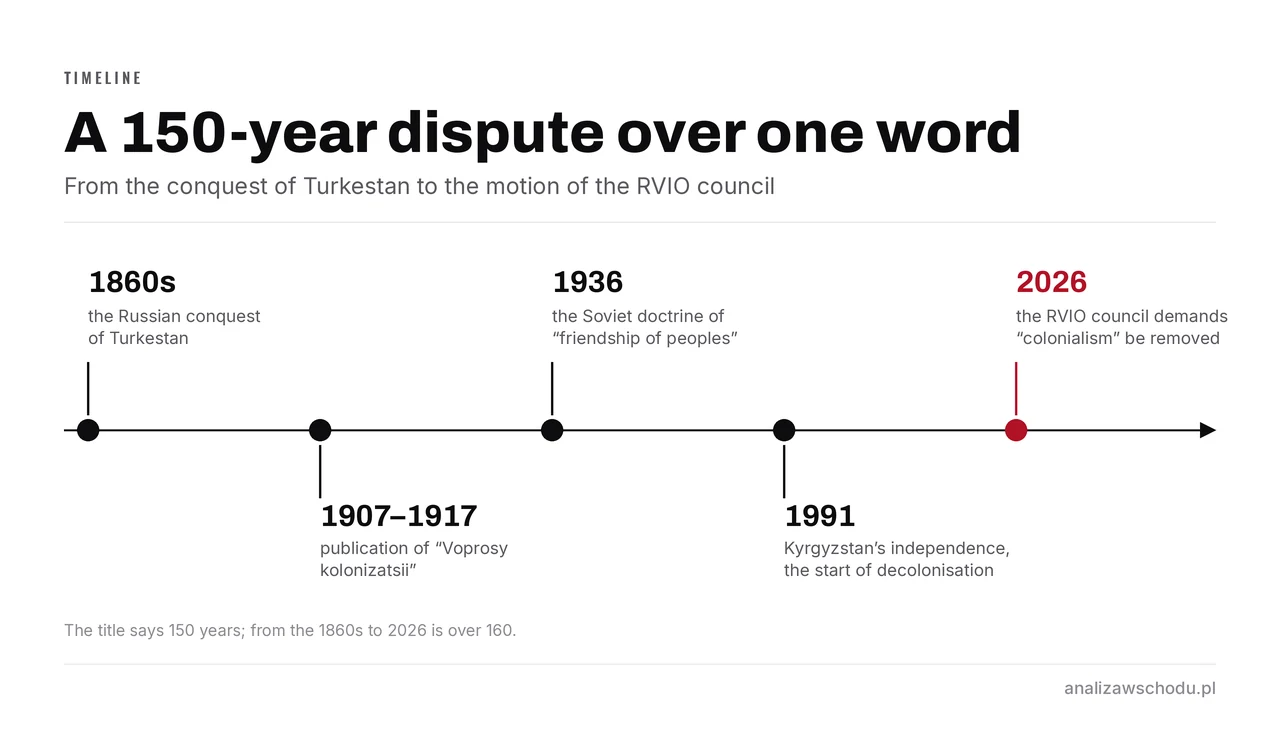
Kommersant performs a semantic manoeuvre at this point. When the Kyrgyz historian Eleri Bitikchi cites the imperial series Voprosy kolonizatsii ("Questions of Colonisation") of 1907–1917 as evidence that Russia itself used the language of colonisation about Turkestan, the author in Moscow accuses him of anachronism. She explains that in the administrative jargon of the day "colonisation" supposedly meant only "resettlement policy, land development and economic growth", and not "colonialism" in the sense of postcolonial studies.
The trouble is that from the perspective of contemporary research on empires, precisely those practices — militarised expansion, settlement, seizure of land, subordination of structures of power to the centre — are the core of a colonial relationship. Russian scholarship on Turkestan calls it a colonial region without hesitation, describes the conquest, the separation of legal systems and the subordination of the economy to the needs of the metropole.
"Anachronism" thus becomes a shield: its job is to protect Russian memory from having the same concepts applied to it that we apply to other empires of the nineteenth and twentieth centuries.
Figures meant to acquit
The second pillar of the Russian argument is the budget. In its "Figures and facts" section Kommersant cites the accounts: in 1867–1881 revenues from Turkestan are said to have come to over 32 million roubles, while expenditure reached almost 100 million — so the region was "deeply loss-making", "subsidised". To which is added a quotation from Karl Nesselrode, the tsar's foreign minister, about "quiet and calm" as Russia's goal rather than "pecuniary advantage".
In the logic of the piece the conclusion is simple: if an empire spends more on a province than it extracts from it, colonial exploitation is hard to speak of. From the perspective of research on empires, though, the central budget is only one layer — it covers neither forced labour, nor asymmetric prices in trade, nor the costs of enforced political loyalty.
What is more, empires invested in their "peripheries" for strategic, military and prestige reasons — building infrastructure and garrisons does not rule out a colonial relationship; often it is exactly what entrenches one. The "loss-making colony" argument therefore says more about the need for moral absolution in Moscow than about the real balance of power.
Is "real colonialism" India?
The clearest passage in Kommersant is the one where the Russian author reaches for the strongest contrast available — British India. The text invokes the work of Dylan Sullivan and Jason Hickel on excess deaths from famine, estimates the fall in India's share of world GDP from around 25 per cent to a few per cent, and quotes Utsa Patnaik on the astronomical value of the resources transferred out.
Against that background Turkestan is meant to look almost like a development aid project: "subsidies", "hospitals", "veterinary services", no mass famines — so where is the colony here? It is the classic move of "we were not as bad as all that": if we did not reach the British level of destruction, the same language may not be used about us.
Russia performs the same rhetorical gesture in Africa today: it sells itself there as an "anti-colonial partner" standing up to the France or Britain of old. The specific instruments differ — in the Central African Republic and Mali they are private and state armed forces, military bases, raw-material concessions and extracted payments. In Central Asia they are academic councils and textbooks. One thing is common: the narrative "we are not like the West", used as a shield against accusations about imperial practices of one's own.
The trouble is that definitions of colonialism do not require every empire to replicate the worst case. It is enough that it meets the key criteria: asymmetric power, subordination of territory, cultural hierarchies, economic integration subordinated to the metropole. That the British were more effective at producing demographic catastrophes does not annul the colonial character of other relationships. It shows, rather, how readily every empire points to somebody "worse" in order to absolve itself.
Kyrgyzstan: decolonisation beginning with the textbooks
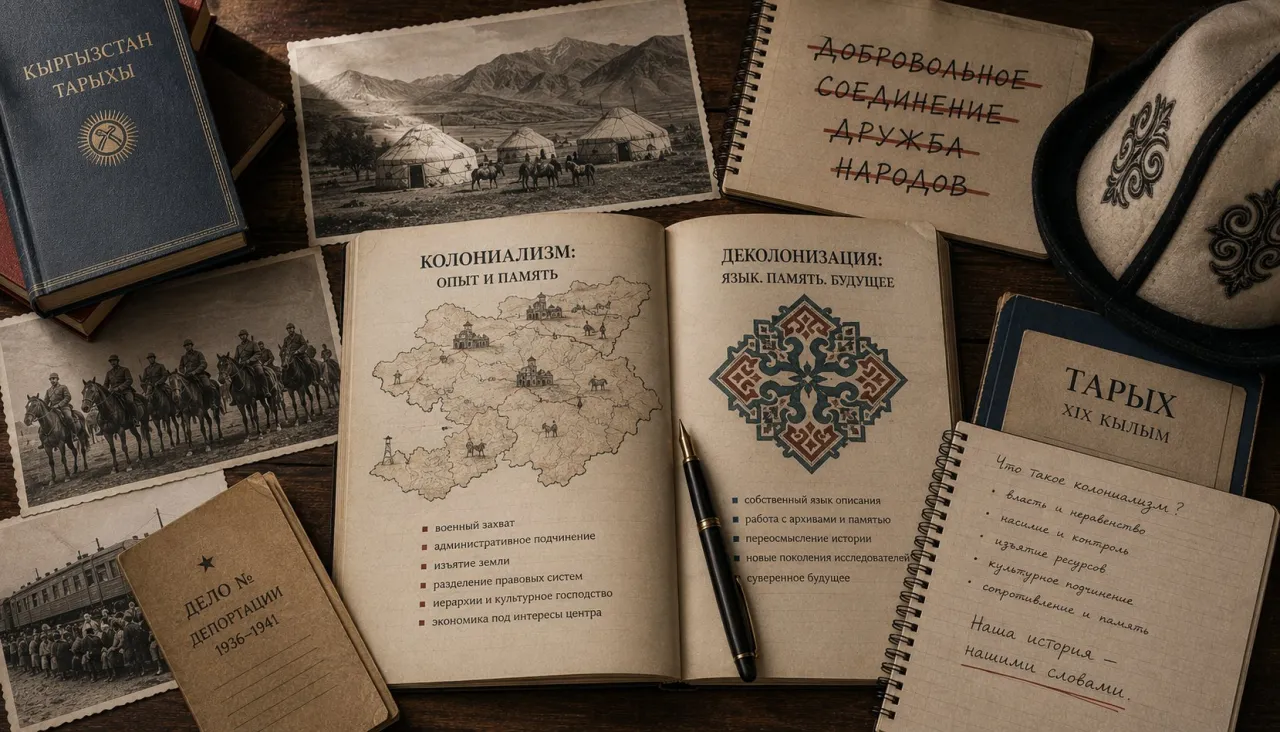
Seen from Bishkek, this discussion did not begin in the Society's meeting room. Since the 1990s Kyrgyz intellectual elites have — with varying intensity — been rewriting their own history, trying to climb out from under the weight of Russian and Soviet narratives about "voluntary unification" and the "friendship of peoples".
Researchers describe the Russian conquest as a military and administrative process that changed the structures of land ownership and subordinated local elites to the centre; and the Soviet period as a mixture of modernisation and violence — from forced sedentarisation to purges among the "best economic and party cadres", designed to separate the people from their own elites.
The category of "colonialism" appears here not as a fashionable calque from Western cultural studies departments, but as a working key that captures the experience of subordination and dependency better than the language of "brotherly assistance". Kyrgyz debates take place not only in expert council chambers but in a broader field of decolonisation covering language, symbols, urban space and the way the past is told — the Esimde project and analysts such as Elmira Nogoibaeva systematise that work from the side of archives and memory.
As early as 2023 Aizirek Almazbekova (Kloop.kg) pointed out in CABAR.Asia that Kyrgyz decolonisation proceeds in the shadow of three concrete blockages: the dominance of Russian media in the local market, economic tethering through hundreds of thousands of labour migrants in Russia, and Bishkek's repeated attempts to copy Russian legislation — from restrictions on the media to the ban on protests near the Russian embassy. That explains why a dispute over one word in a textbook weighs as much as it does: it is one of the few fields on which the Kyrgyz side can still refuse.
Since 2023 the consensus in Kyrgyz academia has visibly tightened. The younger generation of researchers no longer debates whether Sovietisation was a colonial experience — the question is how to compare it with the European colonisation of Africa and Asia. The dispute now being conducted in Moscow is therefore not a discussion between equals, but pressure on a milieu that has already settled the matter internally.
The Centre for Eastern Studies (@OSW_pl) puts it plainly: Russia's aggression against Ukraine and the palpable threat from it — including the Kremlin's questioning of Kazakhstan's borders and the fear of Russian hybrid attacks — have become a catalyst of patriotic attitudes and "intensified the decolonisation discourse under way across Central Asia (least intensively in Turkmenistan)". Binazir Yusupova (Dublin City University) adds the detail that Uzbekistan began de-Sovietisation as early as Karimov's presidency, but that it then served not civic rethinking but the strengthening of the ruler's own power. In Kazakhstan, as Kamila Smagulova (PaperLab) notes, the contemporary decolonisation discourse runs horizontally, in a network of activists, artists and civic movements, without coordination with the state. What we are seeing in Bishkek today is therefore not an isolated escapade by textbook authors, but part of a broader regional attempt to name post-Soviet dependency in a language of one's own.
The state readily takes over some of these threads — the substitution of toponyms, say, or selective criticism of the USSR — but anything that goes beyond the official line tends to be pushed to the margins; the textbooks by Chorotegin and Imankulov are one of the few places where this dispute over language is visible in black and white.
Ukraine: the same dispute over words
Looked at more broadly, the Kyrgyz textbooks belong to the same dispute over vocabulary that Ukraine has been having with Russia for years.
Ukrainian historians increasingly describe both tsarist policy towards the Hetmanate and the lands along the Dnipro and the later practices of the USSR in colonial terms: Russification, subordination of the economy, destruction of elites, famine as an instrument of control. Moscow replies with the same repertoire as in Kyrgyzstan: accusations of "politicisation", "falsifying history", insistence on the narrative of "voluntary unification" and "brotherly unity".
In both cases the stake is whether one may say that Russian rule was a form of colonialism — without the obligatory immediate addition that "it also brought development, schools and the railway".
Poland: occupation or liberation
The Polish case differs in form but not in logic. Warsaw does not use the word "colony" about the partitions or the Polish People's Republic; it speaks rather of "occupation", "domination", "lack of sovereignty". But when Polish institutions of memory stress the double trauma — German and Soviet — Moscow reacts much as it does to Kyrgyz textbooks: charges of "forgery", "Russophobia", "spitting on the liberators".
Disputes over Red Army monuments, over Katyn, over the interpretation of 1944–1945 show the same allergy to a language that denies Moscow a monopoly on defining its own role. Poland and Ukraine speak of occupation, Kyrgyzstan of colonialism — the answer from Moscow is the same: change your vocabulary, or there is no conversation.
Language as the empire’s extension
In the context of my Understanding Russia cycle, this story is about language as an instrument of power. An empire does not end at the moment the troops withdraw; it continues in the categories its former subjects use, and in the pressure the centre exerts on their textbooks, monuments and curricula.
In Kyrgyzstan that takes the form of "joint textbooks" and demands that the word "colonialism" be removed in favour of "administration". In Ukraine — condemnations of decommunisation and de-Russification as "falsifying history", and the justification of the war by appeal to an alleged "historical unity". In Poland — diplomatic rows over whether the Red Army was a liberator or a new occupier.
In parallel Moscow is tightening discipline within its own education system: successive revisions of state history textbooks build in the narrative of the "special operation" against Ukraine and cut out inconvenient threads. There are also attempts to restrict access to Wikipedia for "falsifying tsarist, Soviet and contemporary history", and lists of publications deemed to "undermine the sovereignty of Ukraine" — the same logic that requires the vocabulary in Kyrgyz schools to be corrected.
OSW describes Russia today as neo-imperial and stresses that from being the guarantor of a flawed stability in the post-Soviet order it has become "the principal threat to the stability of the region", Kazakhstan above all; an end to the war against Ukraine on terms favourable to the Kremlin would raise the risk of political and even military pressure on the states of Central Asia. The dispute over a word in a Kyrgyz textbook is therefore not taking place in a vacuum, but in the shadow of a real force that still wants to decide how far its neighbours' sovereignty reaches.
In each of these cases Moscow is fighting to keep the words "colony", "occupation" and "empire" from sticking to its own history — because that would make it harder to justify today's claims to "spheres of influence" and the "near abroad".
Kyrgyzstan as a barometer
This is why a dispute over one word in a Kyrgyz textbook matters to Warsaw and Kyiv — and to this cycle. Russia does not reject every post-imperial vocabulary — it readily uses imperial terminology itself when that serves the centre: from Putin's invocations of tsarist greatness to the concept of the russkiy mir, the "Russian world", as a geopolitical programme. What it consistently rejects is the vocabulary that casts it as a colonial perpetrator — the analogue of the Western empires of the nineteenth and twentieth centuries. If even a small, formally allied state in Central Asia cannot use that category in its school books, it means Russia is systematically blocking every perspective in which it is not its own narrator.
A simple counterfactual is worth running here: had the Kyrgyz intellectual elites accepted the Russian vocabulary of "voluntary unification" after 1991, today's council at the Society would be meeting without a Kyrgyz side — not because anyone had excluded it, but because there would be no authors capable of refusing anything. A dispute is possible only where somebody earlier declined to yield.
Provided Bishkek does not retreat and accept "administration" in place of "colonialism" — which is not a given — this dispute may become a precedent: it will show other capitals that one's own vocabulary can be held even under economic dependency. If in a few years we do see soft, "neutral" language in Kyrgyz textbooks, it will have to be read as a victory not of dialogue but of pressure.
What Poland can do about it
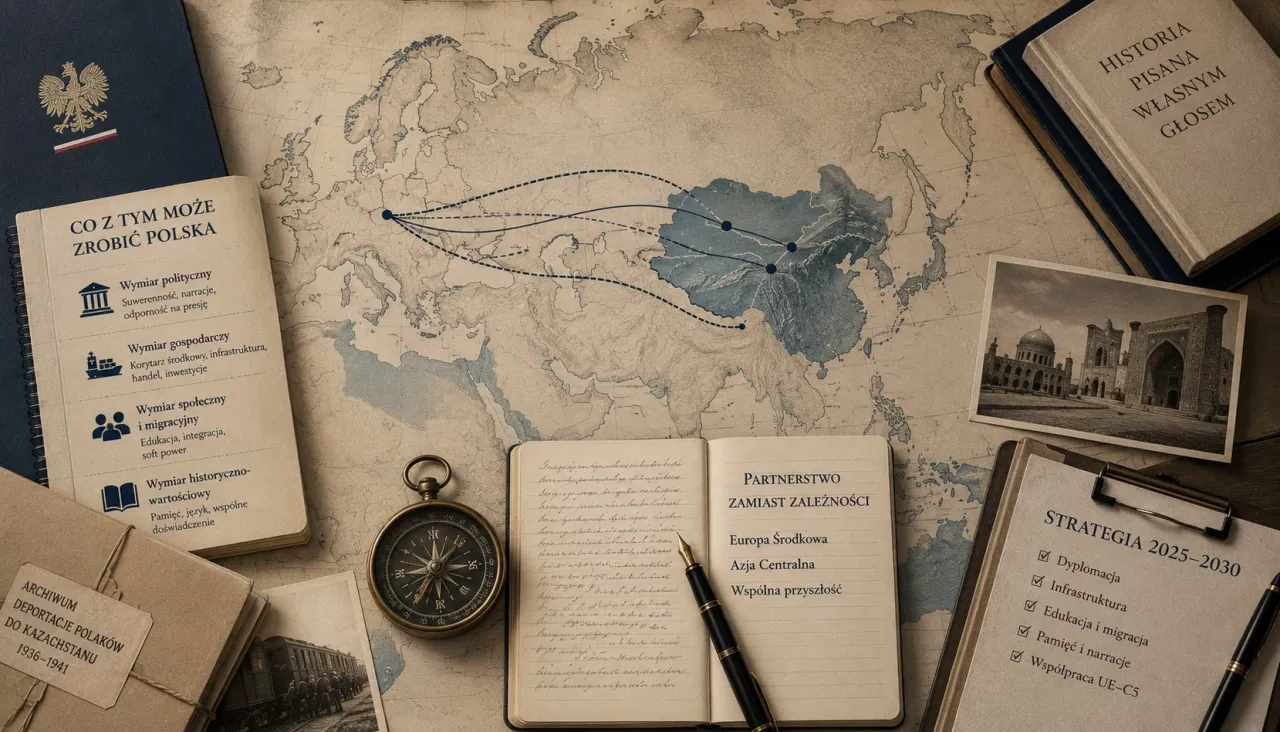
The OSW report describes the present situation as a "particular window of opportunity" for the EU and Poland: Russia's war against Ukraine has weakened Moscow's position in Central Asia, increased Western interest in the region and opened space for strengthening the sovereignty of the states there. The authors do not conceal at the same time that Central Asia will not become a priority direction of Polish foreign policy, and that the natural instruments for Warsaw remain EU mechanisms and cooperation with the United States and Turkey.
In that light the dispute over Kyrgyz textbooks becomes an operational question: does Poland want to be an observer of the regional post-imperial order, or one of its makers.
The political dimension. OSW recommends developing political contacts in the region and supporting these states' resilience against Russian pressure. In the EU–C5 and Global Gateway formats it is worth adding to the list of priorities not only connectivity and raw materials but also the language of sovereignty and these states' right to historical narratives of their own. This is an area in which the Polish milieux that work with post-Soviet memory — the College of Eastern Europe, the Centre for East European Studies (@SEW_UW), the KARTA Centre — have real experience and networks of contacts in the region. In support, the Institute of National Remembrance (@ipngovpl) holds a concrete archival resource on Polish deportations to Kazakhstan, which can serve as a bilateral point of entry.
The economic dimension. The development of the Trans-Caspian International Transport Route — more broadly the "Middle Corridor" — is a shared interest of the EU and the states of the region, because it reduces dependence on routes through Russia. For Poland, in the context of the Three Seas Initiative and Ukraine's role, this means a chance to position itself as the natural terminal node of that corridor. The more firmly Central Asian routes can be plugged into the region's infrastructure, the less space there is for Russian threats against Bishkek and Warsaw alike. This is a field of work both for the Ministry of Foreign Affairs (@MSZ_RP) and the infrastructure ministries, and for @PISM_Poland, which has been describing the region's growing weight in the global economy for years, and for the agencies that support Polish firms expanding towards Central Asia (@PAIH_pl).
The social and migration dimension. Poland is today one of the main destinations for migration from Central Asia: in 2025 more than 8,500 students from the region's states were studying at Polish universities, and in October 2025 the registers showed around 24,000 citizens of those countries living in Poland. OSW suggests treating that presence not only as a labour-market resource but as an instrument of soft power — an investment in the region's future elites.
I saw this mechanism in Russia at close range. I was living in Krasnodar then and travelled regularly to Moscow. Between 2004 and 2016 the presence of labour migrants from Central Asia in Russian cities grew exponentially — they received more than half of all work permits — and nationalist pressure around them grew with it. Russian media systematically amplified every crime involving a migrant, although the statistics showed migrants accounted for a single-digit share of all crime; the SOVA Center documented hundreds of hate-motivated attacks in the Moscow region alone. The attack on Crocus City Hall in March 2024 — carried out by citizens of Tajikistan — became the catalyst of an institutional backlash: in the week after the attack the number of court cases against migrants rose by 70 per cent, and in the summer of 2024 the law was amended to allow deportations without a court ruling. What Poland is now receiving as a migration destination is in part a redirection away from Russia, which is ceasing to be an attractive market for people who until recently would have gone to Moscow.
The 2025–2030 migration strategy should not repeat the Russian model of "cheap, interchangeable labour": it needs real integration pathways, protection against a segmented labour market that locks migrants into the lowest tiers, and a deliberate policy towards diasporas — treated as a network of contacts with the region rather than as a public-order problem.
The stake is larger than integration: the same field is today an instrument of hybrid warfare. In Russia the state and the security services have repeatedly played on anti-immigrant feeling — tolerating or instigating violence, then using it to strengthen the apparatus of repression. A similar repertoire is visible in Russian and Belarusian operations against the EU's borders and in attempts to stoke conflicts around refugees from Ukraine. If Poland treats migrants from Central Asia purely as easily replaceable labour, a few incidents will be enough to build a destabilising campaign around them.
The historical and value dimension has a long genealogy in Polish debate. Between the wars the Promethean movement tried to build a network of contacts with the elites of the nations enslaved by the USSR — from Georgians, Azerbaijanis and Ukrainians to representatives of the peoples of Asia. Poland today is not the Second Republic and does not have its freedom of action, but the lesson stands: policy towards an empire and its peripheries is not only borders and armies, but also work with memory, language and political elites on both sides. OSW, the College of Eastern Europe, the Centre for East European Studies at Warsaw University and the KARTA Centre can here — each from its own position — help create a space in which the Polish experience (the partitions, the Polish People's Republic, decommunisation) meets the Kyrgyz or Kazakh one without paternalism, but also without false symmetry.
If that move succeeds, Poland will stop being merely a consumer of decolonial rhetoric about Russia and will become one of the actors helping to shape the language of post-imperial Europe — one in which Kyrgyzstan, Kazakhstan or Uzbekistan are no longer just a "raw-material hinterland", but partners telling in their own voice what Russian colonialism was and what they would like to put in its place.
A memory that cannot name a relationship for what it was stops being memory — it becomes an operating manual for somebody else's empire.
First published: X Article (in Polish), 28.05.2026
Cite as: Denis Salnikov, “Who has the right to say "colonialism"?”, Analiza Wschodu, 28.05.2026, https://analizawschodu.pl/en/articles/right-to-say-colonialism.html
Text © Denis Salnikov. Quotation with attribution and a link is welcome. To reprint a full text or reuse a chart, write to ds@analizawschodu.pl
* Graphics marked with an asterisk are mood images and may contain AI-generated elements. Charts, timelines and tables carry no asterisk — their figures come from the sources named beneath them.